
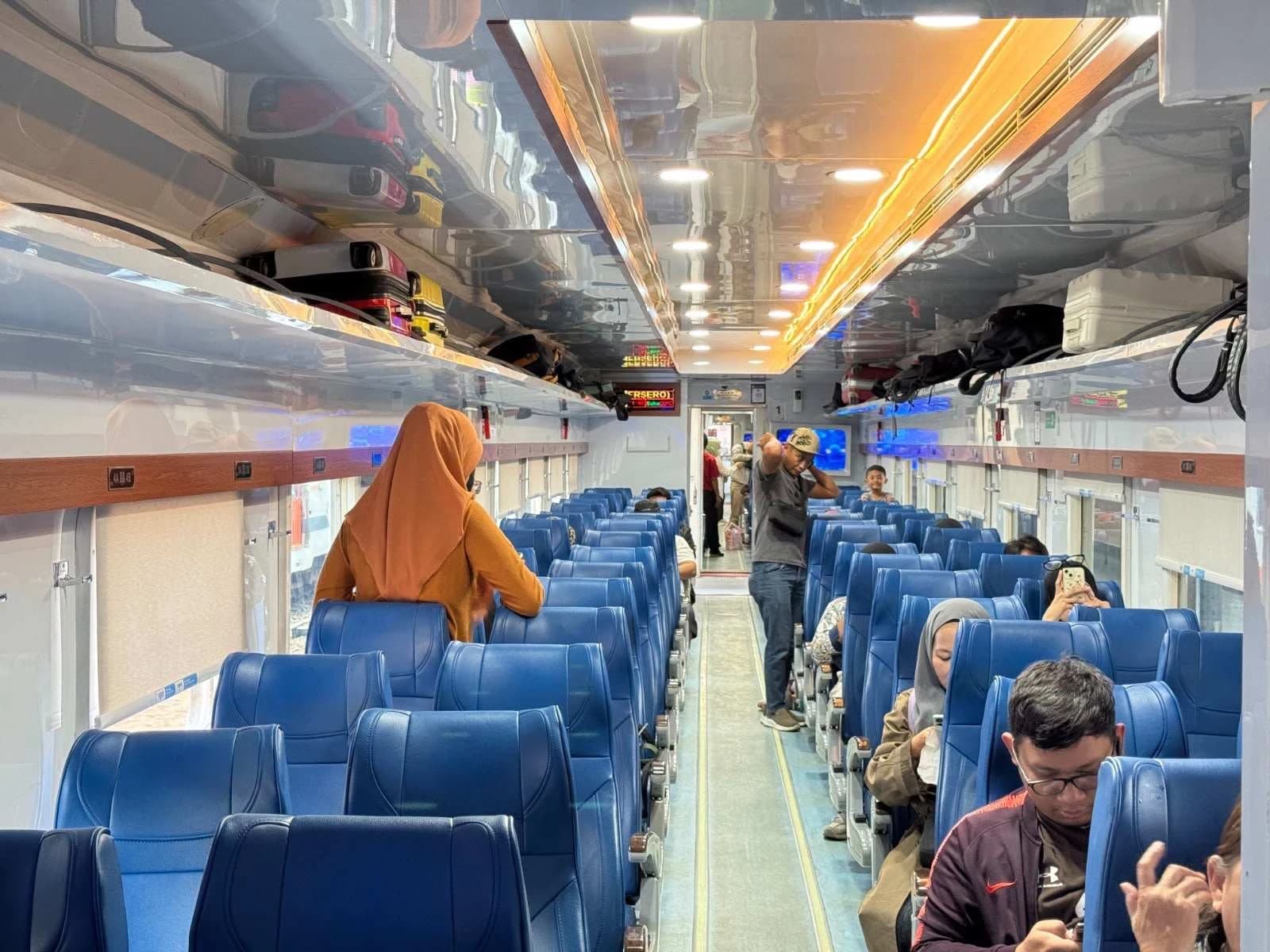
Trains 187 and 193 Lead at the Top, Joglosemarkerto Dominates Commercial Trains in Semester I 2026
The Joglosemarkerto train service was recorded as one of the public’s favorite services during Semester I 2026. Overall, all Joglosemarkerto trips served 730,575 customers, an increase of 10.29 percent compared to Semester I 2025 with 662,409 customers.
Two Joglosemarkerto services also ranked at the top among commercial trains with the highest number of customers. Train 187 Joglosemarkerto ranked first by serving 268,545 customers, followed by Train 193 Joglosemarkerto with 253,411 customers during January–June 2026.
Vice President Corporate Communication of KAI, Anne Purba, explained that the high interest in Joglosemarkerto is related to its distinctive travel pattern. This service connects various cities in Central Java and the Special Region of Yogyakarta through a circular route. Joglosemarkerto meets diverse intercity travel needs, ranging from customers who work, pursue education, run businesses, visit family, access healthcare services, to those enjoying tourism destinations.
Train 187 Joglosemarkerto serves the route Solo Balapan–Semarang Tawang–Tegal–Purwokerto–Solo Balapan–Semarang Tawang. Meanwhile, Train 193 serves the route Solo Balapan–Purwokerto–Tegal–Semarang Tawang–Solo Balapan.
This travel pattern links Solo and Yogyakarta—strong in education, culture, and tourism activities; Purwokerto as a center of community activities in Banyumas and surrounding areas; Tegal and Pekalongan with their trade and industrial activities; as well as Semarang as a hub of government, industry, construction, trade, and services in Central Java.
The Joglosemarkerto travel pattern allows a single seat to be used interchangeably by multiple customers within one trip. After a passenger reaches their destination city, the same seat can be booked again by another passenger for the next segment. This pattern is reflected in the occupancy rate of Train 187 at 255 percent and Train 193 at 241 percent during Semester I 2026. Occupancy above 100 percent illustrates seat turnover across multiple travel segments, not the number of passengers onboard at the same time.
For example, a seat used by a passenger traveling from Solo to Semarang can later be used by another passenger for the Semarang–Pekalongan or Semarang–Tegal segment. With this pattern, available capacity can serve more intercity travel demand. Anne stated that Joglosemarkerto customers come from many cities with different destinations, and the high seat turnover indicates that this service is relevant for short-, medium-, and long-distance travel.
Data from the Central Statistics Agency (BPS) provides an overview of regional activities along the Joglosemarkerto route. BPS of Central Java Province recorded that Central Java’s economy in Q1 2026 grew by 5.89 percent compared to the same period the previous year. The accommodation and food service sector recorded the highest growth at 14.14 percent. This data was released on May 5, 2026.
During the same period, the economy of the Special Region of Yogyakarta grew by 5.84 percent. The accommodation and food service sector also recorded the highest increase at 11.59 percent. This BPS DIY data was released on May 5, 2026 for the Q1 2026 period.
On the northern corridor, BPS of Semarang City recorded that the city’s economy throughout 2025 grew by 6.49 percent. Gross Regional Domestic Product at current prices reached Rp288.05 trillion, with manufacturing, construction, and trade as the main contributors. This data was released on April 22, 2026.
Pekalongan City also has an economic structure closely tied to trade and industry. Based on BPS Pekalongan City publication released on December 29, 2025, wholesale and retail trade as well as motor vehicle repair contributed 20.76 percent to the city’s GRDP in 2024. Manufacturing contributed 19.86 percent, while construction accounted for 15.84 percent.
On the southern side, BPS Banyumas Regency recorded that domestic tourist trips to Banyumas during January–February 2026 reached 1,134,470 trips. The data, released on April 1, 2026, provides context on the scale of travel activity to Purwokerto and surrounding areas.
Meanwhile, the economy of Surakarta City in 2025 grew by 5.63 percent. The information and communication sector recorded the highest increase at 11.29 percent. This data was released by BPS Surakarta City on March 4, 2026.
According to Anne, the diversity of economic characteristics along the route makes Joglosemarkerto suitable for many purposes. Passenger journeys are linked to activities in markets and trade centers, industrial zones, campuses, hospitals, offices, hotels, culinary centers, and tourist destinations. When various activity centers can be reached within a single travel pattern, people have more options to plan trips according to their needs.
The high volume of Joglosemarkerto aligns with the increasing use of commercial long-distance trains. During Semester I 2026, KAI’s commercial long-distance train services served 19,230,100 customers, an increase of 8.8 percent compared to Semester I 2025 with 17,670,625 customers.
The following are the top 10 commercial trains with the highest number of customers in Semester I 2026:
1. Train 187 Joglosemarkerto (Solo Balapan–Semarang Tawang–Tegal–Purwokerto–Solo Balapan–Semarang Tawang): 268,545 customers
2. Train 193 Joglosemarkerto (Solo Balapan–Purwokerto–Tegal–Semarang Tawang–Solo Balapan): 253,411 customers
3. Train 251 Jayakarta (Surabaya Gubeng–Pasarsenen): 192,030 customers
4. Train 252 Jayakarta (Pasarsenen–Surabaya Gubeng): 187,941 customers
5. Train 254 Kertajaya (Pasarsenen–Surabaya Pasarturi): 179,756 customers
6. Train 253 Kertajaya (Surabaya Pasarturi–Pasarsenen): 177,718 customers
7. Train 248 Logawa (Purwokerto–Surabaya Gubeng–Ketapang): 173,288 customers
8. Train 264 Ambarawa Ekspres (Semarang Poncol–Surabaya Pasarturi): 169,592 customers
9. Train 153 Ranggajati (Jember–Surabaya Gubeng–Cirebon): 166,446 customers
10. Train 154 Ranggajati (Cirebon–Surabaya Gubeng–Jember): 165,862 customers
The strong number of Joglosemarkerto passengers shows that intercity travel demand is also formed among regional cities with complementary functions. Educational cities, trade centers, industrial zones, government hubs, and tourism areas can be connected within a single travel network without all flows having to rely on Jakarta or Surabaya.
Anne concluded by stating that Joglosemarkerto illustrates how services that accurately understand intercity connections can create a strong travel market. Passenger boarding and alighting patterns at each segment become important information in determining capacity, schedules, and stop options that better match the needs of each region.