
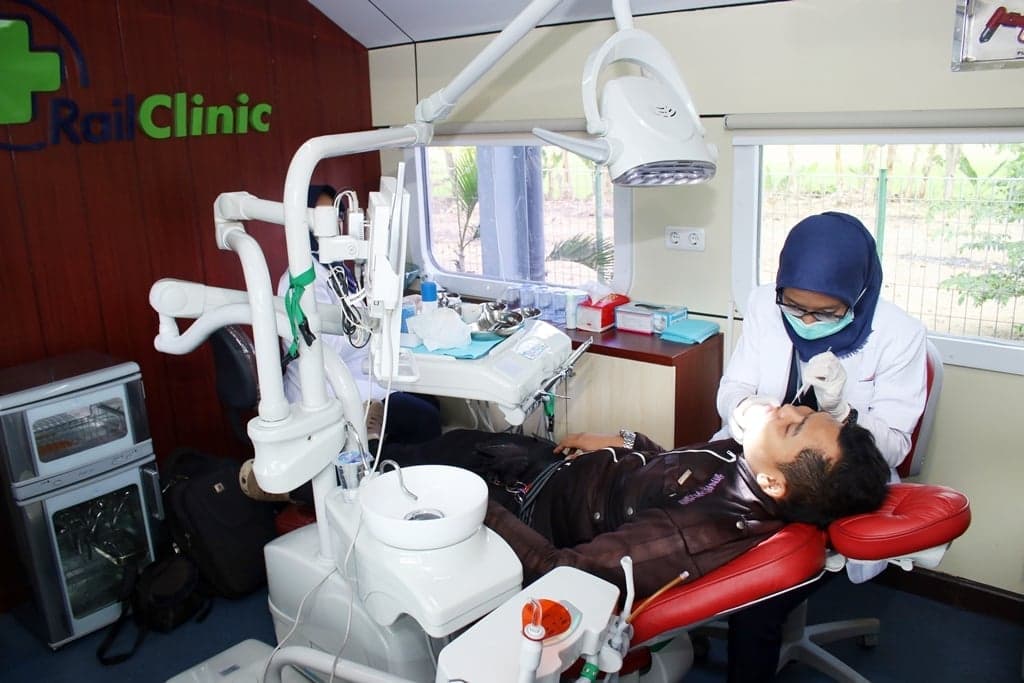
Rail Clinic Returns, Thousands of People Receive Free Health Services
After being suspended due to the Covid-19 pandemic, KAI has once again presented the Rail Clinic program aimed at providing health and social services to the community. This program is not merely an initiative, but also part of the company’s social commitment and environmental responsibility toward society. One of the distinguishing features of this program is the use of railway tracks as a means of delivering health and social services.
Interestingly, the facilities owned by Rail Clinic are quite complete and advanced as they utilize the latest generation, namely the fourth generation. In one train set, there is a medical service carriage as well as a library carriage known as the Rail Library. The Rail Library is equipped with library facilities containing various books, magazines, videos, and e-books, thereby providing education to the attending community.
Various free health services are provided for those in need. These services include general check-ups, dental examinations, antenatal care, eye examinations, laboratory tests, and pharmacy services. In addition, the program also includes health education and KAI education through the Rail Library. The main target of this program is communities living along railway lines.
Joni Martinus, Vice President of Public Relations KAI, explained that in addition to health services, the Rail Clinic program also includes a number of other social activities that provide benefits to the community.
“Some of these include providing glasses to elementary school students, distributing basic necessities to the community during certain events, as well as supporting government programs in stunting prevention. All of these activities are carried out with the aim of providing benefits to communities in areas that are often difficult to access by conventional health facilities,” said Joni.
The selection of Rail Clinic locations is based on areas that are difficult to access by motor vehicles. Thus, Rail Clinic can reach remote areas that often struggle to access healthcare services.
In Rail Clinic operations, around 16 personnel from various fields are involved, consisting of one train driver, one assistant driver, two railway technicians, one conductor, two general doctors, one obstetrician, one midwife, two pharmacists, one eye examiner, two laboratory officers, and two registration officers. They work in synergy between railway operational staff and medical personnel to provide quality healthcare services to the community.
In 2023, Rail Clinic social services were conducted 13 times in various KAI operational areas.
“The total number of Rail Clinic visits reached 5,079 people, consisting of 3,674 patients receiving medical services, 702 participants in health education, and 703 participants in Rail Library education,” Joni revealed.
The Rail Clinic program also involves collaboration with various parties, including the Health Office, the Indonesian Navy, KAI healthcare providers, universities, and state-owned enterprises (BUMN). This collaboration strengthens the implementation of the social service program and expands its impact on communities in need.
“For people who wish to take advantage of this program, they can directly come to the station hosting the Rail Clinic social service activity to receive free medical examinations and medications,” Joni explained.
The Rail Clinic is not only a form of KAI’s social commitment to the community, but also a means of providing better access to healthcare for people living in remote areas.
“This program will continue to run and provide benefits to the community, with the hope that it can further expand and reach more regions in the future. All of this is clear evidence that KAI is committed to supporting the welfare of the Indonesian people,” Joni concluded.