
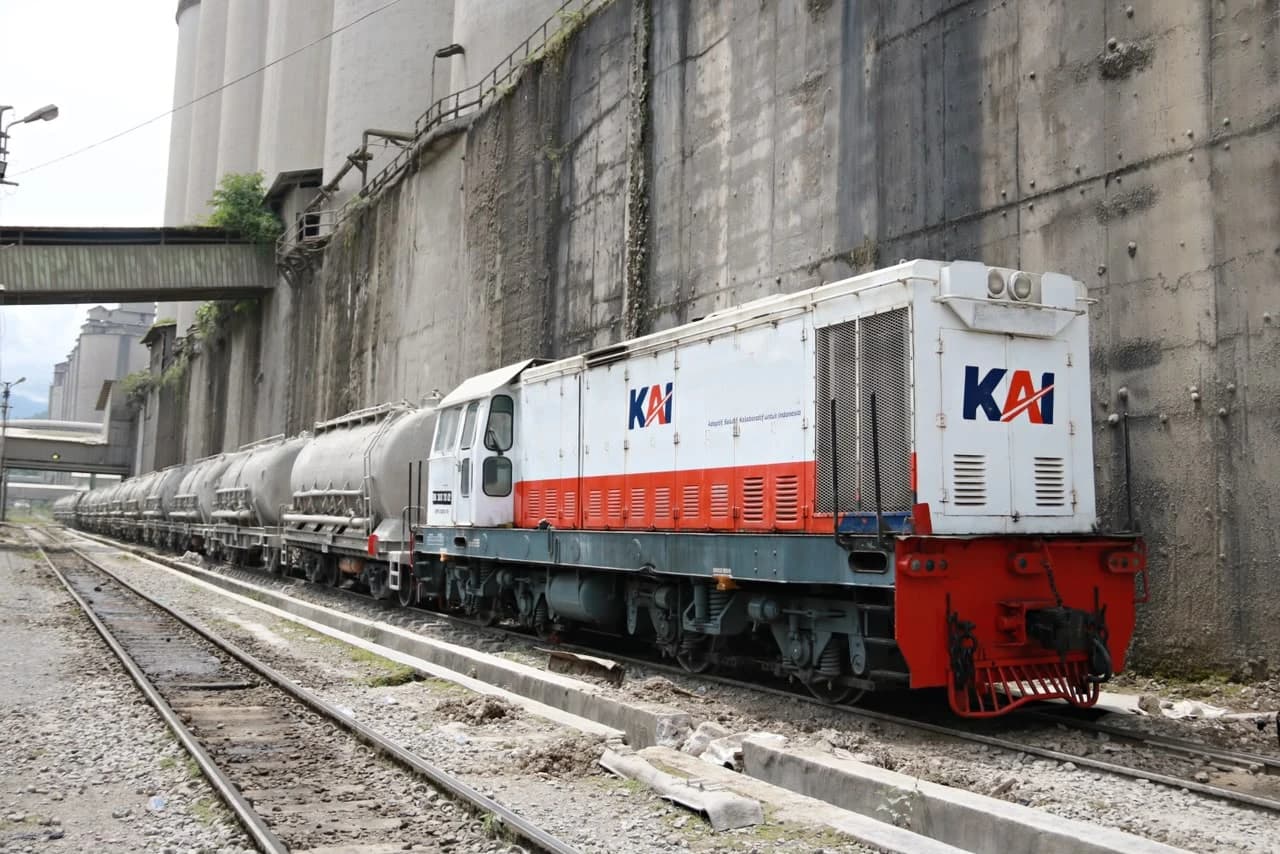
Cement Distribution Runs Smoothly, KAI Transports 1.36 Million Tons Through July 2026
Rail-based transportation continues to play an important role in keeping Indonesia’s industrial supply chains moving. From January through July 2026, PT Kereta Api Indonesia (Persero) transported 1,357,524 tons of cement and clinker.
The volume accounted for approximately 19.4 percent of KAI’s total non-coal freight, which reached 6,987,150 tons during the same period. The cement and clinker freight service also generated Rp82.51 billion in revenue.
Cement and clinker are essential commodities for construction, infrastructure development, industrial areas, and various economic activities. With large carrying capacity and scheduled operations, rail transportation helps ensure a smooth flow of materials from production areas to processing facilities and distribution points.
One of the companies utilizing KAI’s rail freight services is PT Semen Baturaja. Through July 2026, KAI transported 153,734 tons of freight for the company.
Semen Baturaja’s main plant is located in Baturaja, Ogan Komering Ulu Regency, South Sumatra. As part of its distribution process, clinker from Baturaja is transported by rail to the company’s Cement Mill in Palembang, while bulk cement is also distributed using specialized capsule railcars.
Rail transportation has become an important part of Semen Baturaja’s distribution network, connecting Baturaja with several destinations across South Sumatra and Lampung. With the support of the railway network, large volumes of materials can be transported in a more structured and integrated way.
In West Sumatra, KAI also supports the supply chain of PT Semen Padang. From January through July 2026, clinker transportation for Semen Padang reached 200,950 tons.
The service operates along the Indarung–Bukit Putus route, which connects with distribution activities around Teluk Bayur Port. The route provides an important link between the Indarung industrial area and the port, supporting the distribution of Semen Padang products to domestic markets as well as export networks.
Using rail to transport large volumes of commodities brings broader benefits to the logistics system. High-capacity train sets can move substantial amounts of material in a single trip, helping reduce the need for heavy trucks on public roads while keeping goods moving smoothly from production areas to distribution points.
On the Indarung route, for example, rail freight provides a direct connection between the production area and distribution facilities linked to the port. This connectivity makes material movement more efficient while strengthening the industrial supply chain.
KAI also continues to explore opportunities to integrate industrial areas, railway networks, distribution centers, and ports as part of its logistics business development. As of July 31, 2026, KAI’s total non-coal freight reached 6.99 million tons, equivalent to 102.3 percent of its cumulative target of 6.83 million tons.
The achievement highlights growing demand from industries for reliable rail-based logistics capable of handling large volumes consistently. With high capacity, scheduled services, and strong connectivity between regions, rail transportation is becoming an increasingly relevant part of a more efficient logistics system.
Moving forward, KAI will continue strengthening collaboration with industrial partners by increasing freight capacity, developing loading and unloading facilities, and optimizing connectivity between production areas, distribution centers, and ports. These efforts are expected to keep supply chains moving smoothly, optimize the use of road infrastructure, and support the competitiveness of Indonesian products.