
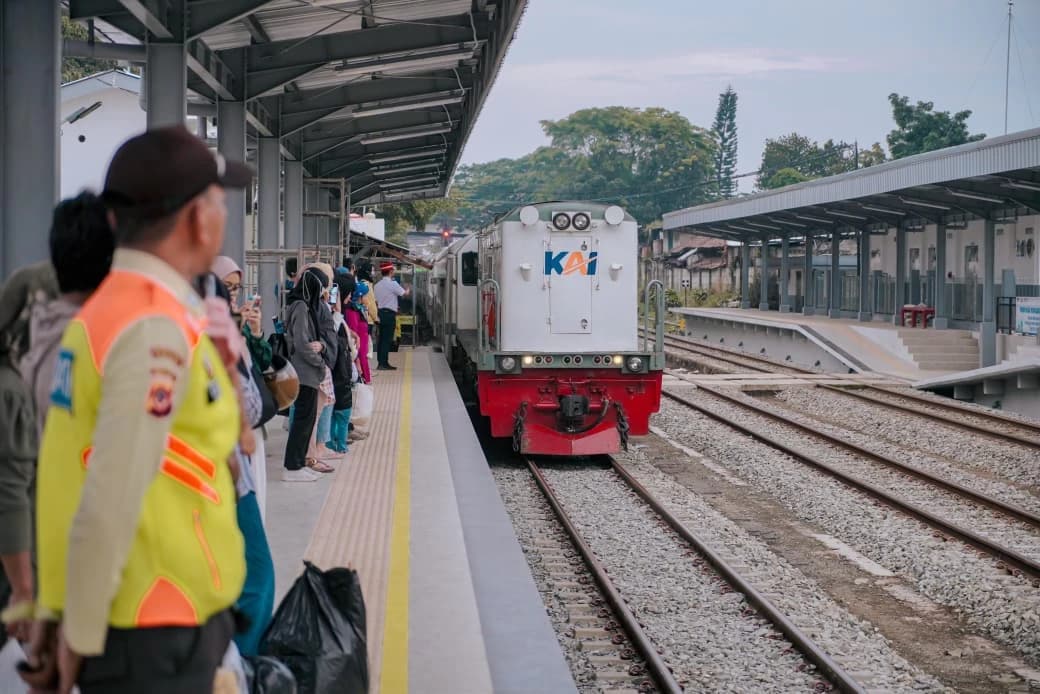
More People Take the Train, Bandung Raya Local Train Passengers Reach 11.87 Million
Mobility in Bandung Raya continues to increase, and rail transportation has become one of the main options supporting this movement. From January to July 2026, local train services in the area served 11,872,273 passengers.
The figure grew 8.55 percent compared with the same period in 2025. Looking further back, the growth reached 38.13 percent compared with January–July 2023, which recorded 8,595,185 passengers.
The increase shows that the need for mass transportation in Bandung Raya is becoming increasingly established. Trains are not only being used as an alternative means of travel, but have become part of the mobility patterns of the community that take place consistently.
The annual trend reinforces this picture. The number of Bandung Raya local train passengers increased from 14.72 million in 2023 to 16.16 million in 2024, then reached 18.73 million in 2025. Over two years, passenger volume increased by approximately 27.22 percent.
Travel activity has also remained relatively stable throughout 2026. From January to July, monthly passenger numbers ranged from 1.45 million to 1.84 million. March was one of the periods with the highest number, at around 1.84 million passengers, while July still recorded approximately 1.77 million passengers.
The consistent growth has made transportation capacity the next focus. Capacity improvements are not only related to the number of train journeys, but also track readiness, signaling systems, station facilities, passenger access, fleets, and the potential use of technologies such as electrification.
Each development option needs to be adjusted to the conditions of the railway corridor. The number of users, travel patterns, travel frequency, energy availability, infrastructure conditions, investment needs, and benefits for the public are factors that need to be considered before an infrastructure project is implemented.
The condition of Bandung Raya also provides a broader picture of the relationship between regional growth and transportation needs. As economic activity and mobility increase, public transportation capacity needs to develop in a measured manner so it can keep up with community needs.
A similar approach is needed in developing railway networks outside Java. The Government is encouraging railway development in Sumatra, Kalimantan, and Sulawesi to strengthen connectivity, support logistics, and expand transportation access between regions.
Mobility data shows this potential. From January to June 2026, the number of railway passengers outside Java, covering Sumatra and Sulawesi, reached 3.99 million people, up 9.22 percent compared with the same period a year earlier. Sea and air transportation in several cities also recorded passenger growth during the same period.
However, high mobility does not automatically mean that railway networks should be built in every region. Each area has different geographical characteristics, activity centers, passenger and freight potential, and investment needs. Therefore, potential and feasibility studies remain the basis before development priorities are determined.
The same approach is also being applied in exploring railway development in Papua. In April 2026, the Papua Provincial Government and KAI prepared an initial survey to examine potential routes and field conditions. Technical studies are an important stage in ensuring that the infrastructure developed truly matches regional needs.
The growth in Bandung Raya passengers ultimately provides an example of how travel data can be used to understand transportation needs. When demand continues to grow and is supported by sound studies, capacity improvements can be prepared gradually so public transportation can keep pace with the development of communities and regions.