
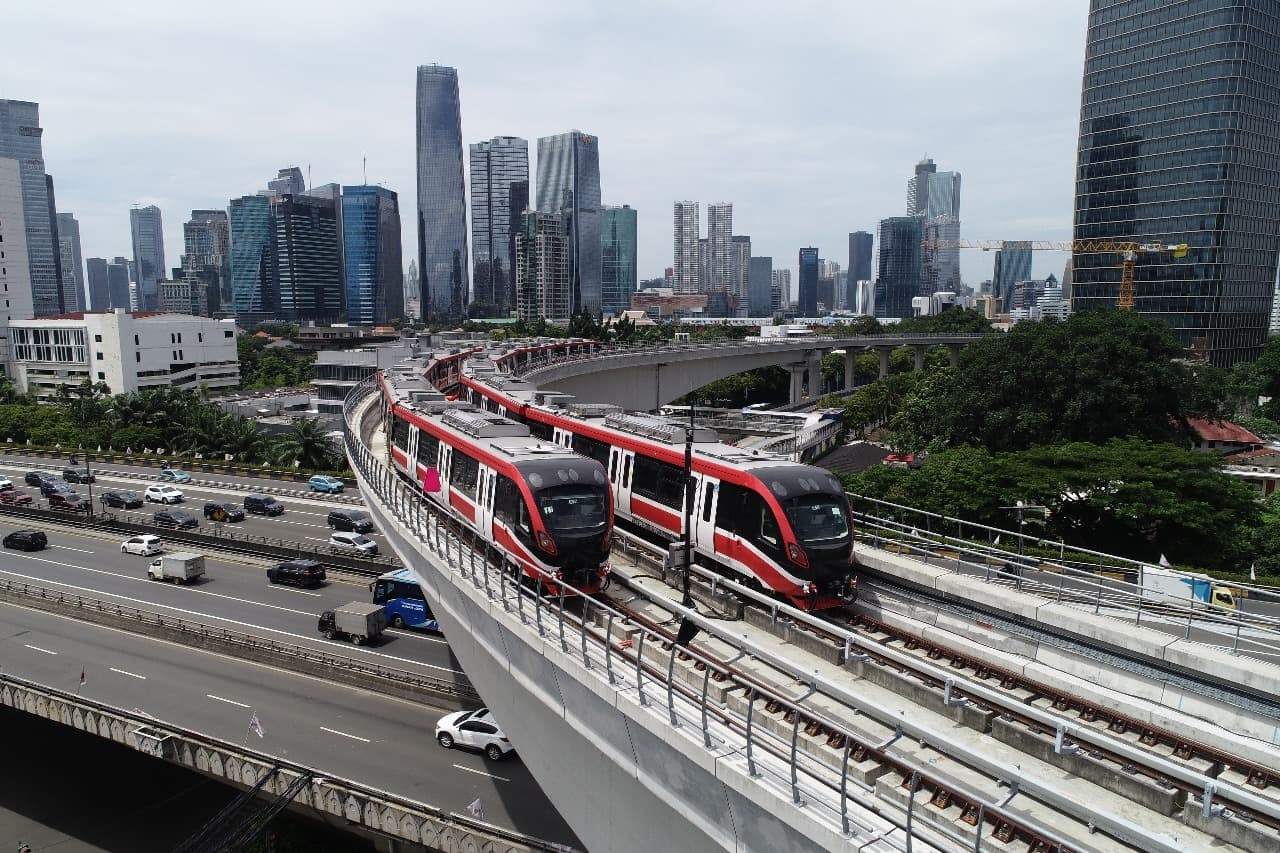
Now in Operation, Jabodebek LRT Offers a New Solution to Traffic Congestion in Jakarta
Major cities in Indonesia, especially Jakarta, are often faced with traffic congestion and air pollution. As the population and the number of vehicles continue to grow, transportation has become one of the biggest challenges for both the government and the public. To address these issues, the Jabodebek LRT (Light Rail Transit) has been introduced as a solution expected to help reduce congestion and air pollution in Jakarta and its surrounding areas.
The Jabodebek LRT is one of Indonesia's National Strategic Projects (PSN), aimed at improving transportation services to support development across the Jabodebek region (Jakarta, Bogor, Depok, Tangerang, and Bekasi). Developed as an efficient and environmentally friendly mass transportation alternative, the Jabodebek LRT is expected to reduce public dependence on private vehicles while easing traffic congestion.

The Jabodebek LRT was inaugurated by President Joko Widodo and officially began operations on 28 August 2023, with operating hours from 05:00 WIB to 23:30 WIB. A total of 434 daily trips are scheduled to serve passengers. The system operates with 31 trainsets, consisting of 27 trainsets for daily operations and 4 reserve trainsets. Each Jabodebek LRT trainset consists of six cars with a maximum capacity of 1,308 passengers.
There are two service lines:
- Cibubur Line: Dukuh Atas Station – Cawang – Harjamukti Station (round trip)
- Bekasi Line: Dukuh Atas Station – Cawang – Halim – Jati Mulya Station (round trip)
The Jabodebek LRT features 18 stations connecting Jakarta, Bogor, Depok, and Bekasi. These stations include Dukuh Atas, Setiabudi, Rasuna Said, Kuningan, Pancoran, Cikoko, Ciliwung, Cawang, TMII, Kampung Rambutan, Ciracas, Harjamukti, Halim, Jatibening Baru, Cikunir I, Cikunir II, Bekasi Barat, and Jati Mulya.
Strategically located across residential areas and business districts, these stations are designed to make travel to and from Jakarta and surrounding regions more convenient. They are also integrated with various public transportation services, including the Commuter Line, MRT Jakarta, TransJakarta, Mikrotrans, Jakarta–Bandung High-Speed Railway, Trans Patriot, public minibuses (angkot), and other public transportation services. This integration enables passengers to transfer easily between transportation modes.
Jabodebek LRT stations are divided into two types: Interchange Stations, represented by Cawang Station, and Typical Stations, which include the remaining 17 stations. The main differences between these station types are the number of tracks, station size, and additional facilities available.
The Interchange Station consists of three levels:
- First floor: Boarding and commercial area
- Second floor: Platform area
- Third floor: Commercial area
Typical Stations consist of two levels:
- First floor: Boarding area
- Second floor: Platform area
Cawang Station serves as the network's Interchange Station, allowing passengers to transfer between routes. For example, passengers traveling from Harjamukti Station to Jati Mulya Station can transfer trains at Cawang Station, and vice versa.
To improve passenger comfort, Jabodebek LRT stations are equipped with various accessibility facilities, including escalators, stairs, and elevators. Additional amenities include restrooms, nursing rooms, prayer rooms, health service rooms, Passenger Information Display Systems (PIDS), public announcement systems, and CCTV.
The Government of Indonesia and KAI are also committed to making Jabodebek LRT stations accessible for passengers with disabilities by providing accessible gates, dedicated accessible restrooms, and tactile paving. These facilities are expected to make travel easier and more convenient for passengers with disabilities.
To ensure excellent station services, KAI has deployed dedicated personnel, including station supervisors, ticketing officers, customer service staff, cleaning personnel, healthcare staff, and security officers.
As part of Indonesia's 78th Independence Day celebration, the Jabodebek LRT introduced a 78% promotional discount, offering a flat fare of Rp5,000 across all routes until the end of September 2023. Following this promotion, the Ministry of Transportation prepared a promotional fare scheme with a maximum fare of Rp20,000 for the longest journey and lower fares for shorter trips through the end of February 2024.
Jabodebek LRT fares are regulated under Indonesian Minister of Transportation Decree No. KM 67 of 2023, with a base fare of Rp5,000 for the first kilometer and an additional Rp700 per kilometer thereafter.
The launch of the Jabodebek LRT is expected to provide an effective solution for reducing traffic congestion and air pollution in Jakarta and surrounding areas. By offering efficient, reliable, and comfortable public transportation, the Jabodebek LRT encourages people to shift from private vehicles to mass transit. This achievement reflects the collaboration between the Government of Indonesia, KAI, and other stakeholders in creating a transportation system that supports better mobility for the public.