
Mak Itam Tourist Train Returns to Operation in Sawahlunto
The Mak Itam Tourist Train in Sawahlunto has resumed operations after being out of service since 2014. The reactivation was made possible through collaboration among several Indonesian State-Owned Enterprises (SOEs), namely KAI, Bio Farma, Pupuk Indonesia, and Semen Indonesia Group (SIG). In addition, InJourney served as the Chair of the SOE Project Management Office for West Sumatra Tourism.

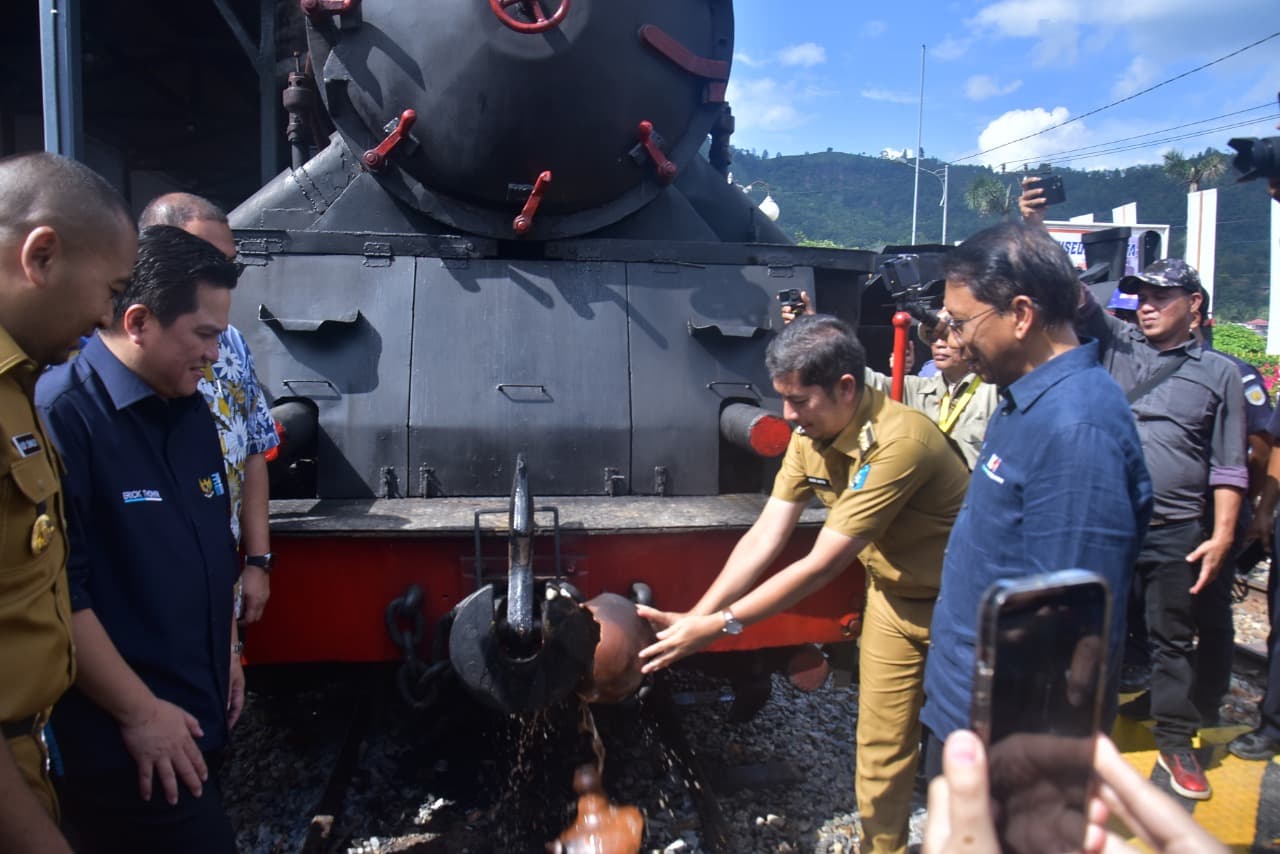
Traditional Pot-Breaking Ceremony During the Reopening of the Mak Itam Tourist Train on the Sawahlunto–Muaro Kalaban Railway Line, West Sumatra
The official reopening of the Mak Itam Tourist Train on the Sawahlunto–Muaro Kalaban railway line in West Sumatra was inaugurated by the Minister of State-Owned Enterprises, Erick Thohir, alongside West Sumatra Vice Governor Audy Joinaldy, Sawahlunto Mayor Deri Asta, Member of Commission VI of the House of Representatives Andre Rosiade, Deputy for Human Resources and Information Technology at the Ministry of SOEs Teddy Barat, and other stakeholders at Sawahlunto Pupuk Indonesia Station on Tuesday (20/12).
The reopening of the tourist train aims to boost tourism in West Sumatra, particularly in the Sawahlunto area. Visitors can now enjoy rail tourism within the Ombilin Coal Mining Heritage of Sawahlunto, a UNESCO World Heritage Site.
The project was realized with support from Pupuk Indonesia, Bio Farma, and SIG. Through their collaboration with KAI, the three SOEs obtained naming rights for stations and the tourist train in the area. As a result, Sawahlunto Station has been officially renamed Sawahlunto Bio Farma Station, Muaro Kalaban Station has become Muaro Kalaban Pupuk Indonesia Station, and the tourist train is officially named Mak Itam SIG Tourist Train.
To reactivate the 4-kilometer Sawahlunto–Muaro Kalaban railway line, KAI carried out extensive rehabilitation works, including track improvements, repairs to two bridges, tunnel restoration, signaling upgrades, station building renovations, and depot improvements. In addition to infrastructure rehabilitation, KAI also restored the historic E1060 steam locomotive, better known as Mak Itam, which previously operated on this line transporting coal.
Throughout the restoration process, KAI overcame several challenges, including limited availability of repair materials and sections of the railway that had been used by local residents for daily activities. Restoring the 57-year-old Mak Itam steam locomotive also presented significant technical challenges. KAI brought in a specialized Steam Locomotive Restoration Team from the Ambarawa Railway Museum to repair the historic locomotive. Through effective coordination and communication, KAI completed the restoration ahead of its original January 2023 target.
Minister of State-Owned Enterprises Erick Thohir stated that the reopening of the Mak Itam Tourist Train would not have been possible without sincere collaboration among all stakeholders. He emphasized that collaboration and mutual cooperation are core values that form the foundation of Indonesia.
"State-owned enterprises account for 92% of the People's Business Credit (KUR). If we develop tourism, empower MSMEs, and strengthen financing, it will create a sustainable ecosystem. This cannot be achieved alone, which is why the role of local governments is essential in ensuring long-term sustainability. One example is the railway infrastructure we are inaugurating today from Sawahlunto to Muaro Kalaban, which we plan to extend to Silungkang," said Erick.
KAI President Director Didiek Hartantyo expressed his appreciation to Minister Erick Thohir, the central government, the West Sumatra Provincial Government, the Sawahlunto local government, participating SOEs, and the people of Sawahlunto and surrounding areas. Thanks to this strong collaboration, the long-standing hope of Sawahlunto residents to once again enjoy train services has become a reality.
"The operation of the Mak Itam Tourist Train and the Sawahlunto–Muaro Kalaban railway line represents a concrete contribution from state-owned enterprises to support economic recovery in West Sumatra through tourism development by optimizing SOE assets in the region as catalysts for local economic activity, in line with the Ministry of SOEs' vision," said Didiek.
Bio Farma President Director Honesti Basyir also welcomed the reopening of the railway line as tangible proof of SOEs' commitment to serving the community.
"We are delighted that the Sawahlunto–Muaro Kalaban railway line is active once again. We hope communities along this corridor can truly experience the presence of state-owned enterprises, particularly the four SOEs collaborating on this project. We also hope this initiative will help strengthen the local economy, especially while recovery from the pandemic continues," said Honesti.
PT Pupuk Indonesia (Persero) Director of Human Resources, Governance, and Risk Management, Tina T. Kemala Intan, stated that Pupuk Indonesia fully supports the reopening of the Sawahlunto–Muaro Kalaban railway line.
"Besides supporting local tourism and the regional economy, West Sumatra is one of Pupuk Indonesia's operational areas and an important agricultural center on Sumatra Island," she said.
"For that reason, the station at Muaro Kalaban has officially been renamed Muaro Kalaban Pupuk Indonesia Station," Tina added.
She further emphasized that, as a state-owned enterprise, Pupuk Indonesia should provide added value to society rather than solely pursuing profits. She hopes that reactivating the legendary Mak Itam train will once again benefit local communities.
SIG President Director Donny Arsal said the company is proud to participate in revitalizing the Sawahlunto–Muaro Kalaban railway line as part of efforts to preserve West Sumatra's railway heritage while supporting tourism development within the UNESCO World Heritage Site of the Ombilin Coal Mining Heritage of Sawahlunto.
"The revitalization of the Sawahlunto–Muaro Kalaban line is expected to maximize West Sumatra's tourism potential, positively impact local incomes, and accelerate economic recovery in the post-pandemic period," Donny said.
As the holding company for Indonesia's tourism SOEs, InJourney is committed to continuously developing tourism destinations across Indonesia, particularly Sawahlunto, a UNESCO World Heritage city with exceptional tourism potential beyond its mining history.
InJourney President Director Dony Oskaria explained that, as project leader, the company will introduce several initiatives to support tourism in Sawahlunto, including expanding accommodation facilities, creating bundled travel packages, and developing collaborative programs involving local MSMEs.
"This presents an excellent opportunity to establish Sawahlunto as one of Indonesia's premier heritage tourism destinations, in line with the city's Smart City development program," he added.
The reopening of the Sawahlunto–Muaro Kalaban railway line is the result of a cooperation agreement signed by four SOEs—KAI, Pupuk Indonesia, Bio Farma, and SIG—in Jakarta on June 23, 2022. Prior to the inauguration, the railway infrastructure and rolling stock rehabilitation officially commenced with a kick-off ceremony at Sawahlunto Station on July 1, 2022.
The Sawahlunto–Muaro Kalaban railway line was originally constructed by Sumatra Staats Spoorwegen (SSS) and began operations in 1894. It was primarily built to transport coal from the Ombilin mines in Sawahlunto. However, as coal production declined in the late 2000s, railway operations on the line eventually ceased.
The route was briefly used by the Mak Itam Tourist Train in 2009 before operations stopped completely in 2014. The Mak Itam locomotive was subsequently displayed at the Sawahlunto Railway Museum. Mak Itam is a German-built E1060 rack steam locomotive manufactured in 1965.
The Mak Itam SIG Tourist Train will now operate regularly, allowing residents and visitors to West Sumatra—particularly those traveling to Sawahlunto—to experience this historic railway attraction. KAI and all participating stakeholders will continue coordinating to ensure excellent service on the Sawahlunto–Muaro Kalaban railway line.
The event also included the signing of a Memorandum of Understanding between KAI and the Agam Regency Government concerning future cooperation in managing KAI assets located within Agam Regency.