
Developing Manggarai Central Station to Improve Services in the Jabodetabek Agglomeration
Manggarai Station is projected to become a new epicenter for public movement in the Jabodetabek agglomeration area. This is being realized through the development of Manggarai Station into the first and largest central station in Indonesia.

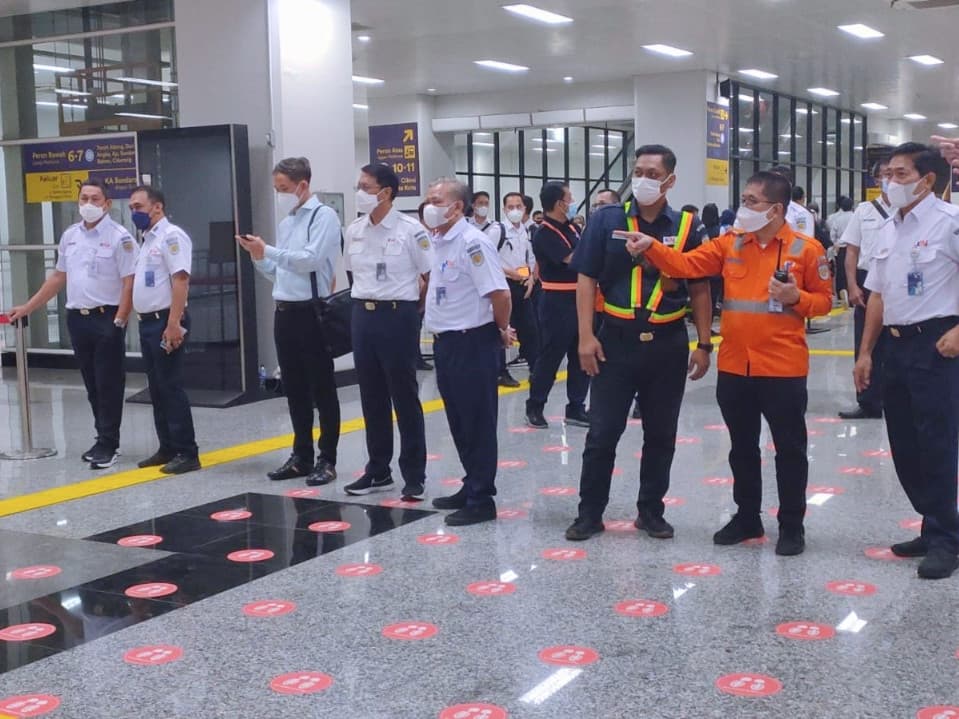
KAI President Director Didiek Hartantyo conducts an inspection at Manggarai Station during the implementation of SO5 at Manggarai Station, Monday (30/5)
Furthermore, during a presentation to the media and railfan communities, the Director General of Railways Zulfikri explained that there is an urgent need that must be addressed immediately by the DJKA through the development of Manggarai Station. It was mentioned that the condition of Manggarai Station prior to development was relatively limited for serving train journeys and managing the significant surge in passenger numbers each year.
“With only 8 tracks for the Commuter Line and 2 tracks for intercity trains, Manggarai Station had to shoulder a burden of 726 train trips every day with a total of 1.2 million passengers, causing bottlenecks and train queues to enter Manggarai Station," Zulfikri explained.
Zulfikri is optimistic that through the construction of Manggarai Station, problems in commuter train services within the Jabodetabek agglomeration area can be gradually resolved. This is because Manggarai Station will eventually feature 18 active tracks to serve the Commuter Line, Long-Distance Trains, and Airport Trains. The station will also be equipped with a spacious concourse area to support passenger mobility. Nevertheless, Zulfikri acknowledges that discomfort will arise while the construction process is underway.
Moreover, several stages still need to be carried out to complete Manggarai Station. Following Switch Over (SO) 5, there is still SO6 scheduled for October 2023, up until SO8 which will be executed in July 2025.
“Therefore, we hope everyone can understand the ongoing construction and remain patient with the current conditions to welcome a grander and more comfortable Manggarai Station," Zulfikri emphasized.
To support the operations of Manggarai Station, DJKA will synergize with the Local Government and related stakeholders regarding environmental arrangements around the station. Intermodal integration will also be a primary focus of Manggarai Station's development to facilitate public mobility while increasing the ridership crossing through this station, in accordance with what Zulfikri conveyed.
"We continue to coordinate with the DKI Jakarta Provincial Government regarding access and spatial planning around Manggarai Station to maximize the station's function as a Transit-Oriented Development (TOD) area on this 2.4-hectare land," Zulfikri added.
This is also supported by the President Director of PT Kereta Api Indonesia (Persero), Didiek Hartantyo, who added that his team is ready to back DJKA's efforts in developing Manggarai Station.
"We will strive to optimize the infrastructure, including the platforms at Manggarai Station, to support train operations so that construction can proceed smoothly," Didiek stated.
Regarding the addition of CCTV cameras proposed by the community, he mentioned that his party already utilizes cameras with face recognition technology to reduce crime rates and sexual harassment at stations and on trains. In addition, KAI Group is ready to support this by adding feeder trains for the Commuter Line along with increasing and expanding carrying capacity to reduce passenger crowding at Manggarai Station, while ensuring that KAI Group has the rolling stock and human resources ready to support the expansion plan.
"We will also maximize the operations of Matraman Station, which has been completed by our colleagues at DJKA, as an alternative for passengers besides Manggarai Station and Jatinegara Station," Didiek concluded.