
KAI Collaborates with Basarnas to Support Jabodebek LRT Operations
As an effort to support the operation of the Jabodebek LRT, PT Kereta Api Indonesia (Persero) will partner with the National Search and Rescue Agency (Basarnas). The cooperation between the two entities was marked by the signing of a Memorandum of Understanding (MoU) regarding the Implementation of Search and Rescue.

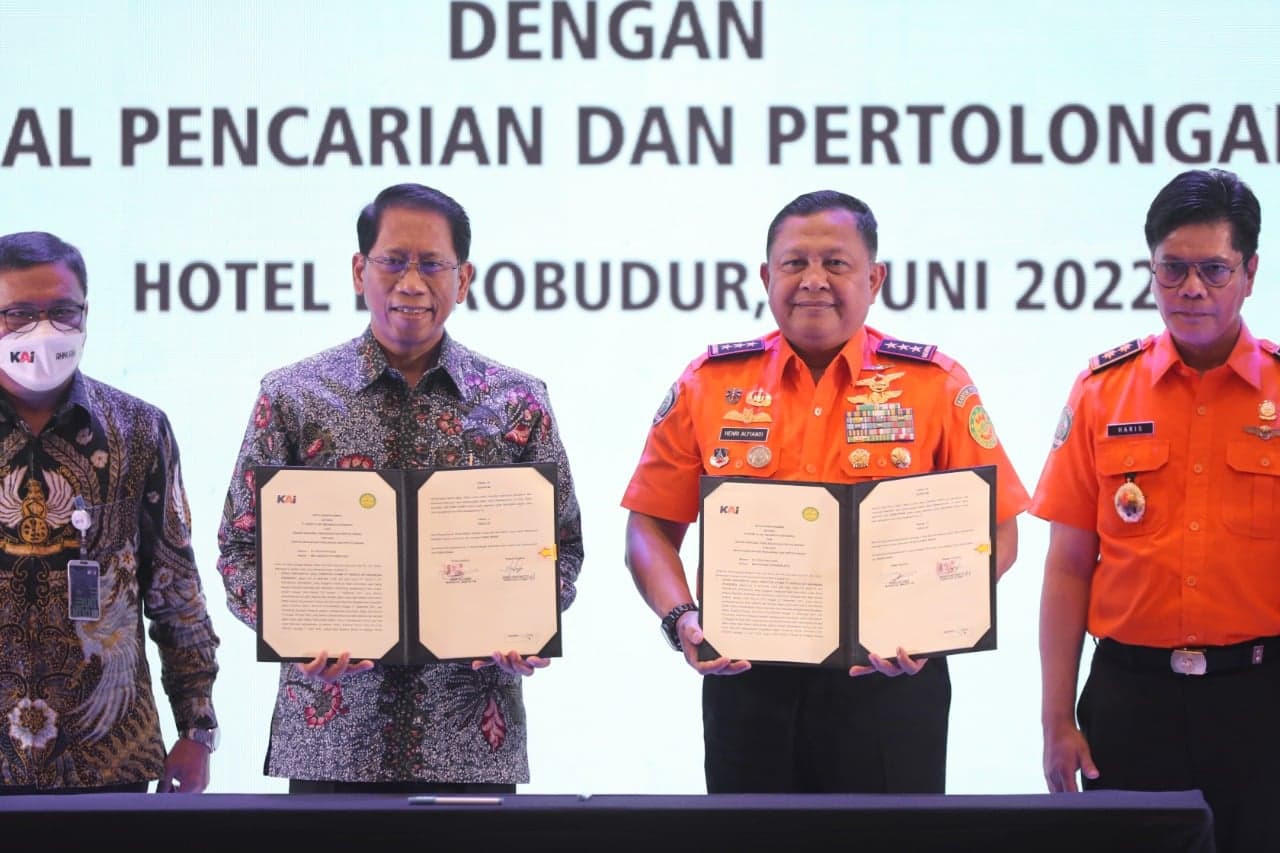
KAI President Director Didiek Hartantyo (left) and Head of the National Search and Rescue Agency (Basarnas) Henri Alfiandi (right) display the signed MoU concerning the Implementation of Search and Rescue at the Borobudur Hotel, Jakarta, Wednesday (8/6).
The signing of this MoU aims to improve coordination, cooperation, alignment, and mutual support for each party's tasks, functions, and authorities in handling emergency situations.
The MoU was signed by KAI President Director Didiek Hartantyo and Head of Basarnas Air Marshal Henri Alfiandi at the Borobudur Hotel, Jakarta, Wednesday (8/6).
The scope of this MoU includes cooperation in data and information sharing, handling emergency conditions and accident management in railway operations through search and rescue activities, search and rescue exercises, resource utilization, and human resource capacity building.
KAI and Basarnas are committed to supporting and ensuring the success of the Jabodebek LRT operational mandate in terms of anticipating and managing emergency events during the operation of the Jabodebek LRT.
KAI President Director Didiek Hartantyo stated that ahead of the Jabodebek LRT operations, which will hold a soft launching on August 17, 2022, one of the highly critical aspects is safety. Therefore, KAI took the initiative to approach Basarnas to jointly build operational readiness for the Jabodebek LRT to ensure its safety is maintained. This step is also a form of KAI's commitment to building a proactive safety culture.
“This cooperation with Basarnas is not only a preventive measure, but also for situations where contingency action is required. The Jabodebek LRT is operated entirely above ground, elevated, meaning we must maintain its level of safety more stringently compared to regular trains,” Didiek said.
Currently, the progress of the Jabodebek LRT has reached 82.7%. In the future, the Jabodebek LRT will be operated automatically using the GoA 3 system, which is why KAI continues to carry out safety efforts such as a series of testings, verification checks, and routine maintenance by competent personnel supervised by experts in their fields.
“We highly hope this safety culture can continue to be built, both within KAI and its subsidiaries, and together we convey that KAI is ready to continuously adapt to safeguard the safety of sustainable railway transportation,” Didiek said.
Head of Basarnas Air Marshal Henri Alfiandi stated in his speech that the first viable access to reach a location in the event of an emergency would certainly be by air, which can be achieved using helicopters. With the addition of a helicopter fleet, Basarnas will be better prepared to provide SAR services if an emergency occurs on the Jabodebek LRT train line.