
KAI Simplifies Jabodebek LRT Payment System
PT Kereta Api Indonesia (Persero) will implement a cashless payment system for the Jabodebek LRT to support the National Non-Cash Movement.
To ride the Jabodebek LRT, customers can use Transport Electronic Money Cards, Banking Electronic Money Cards, and various types of Digital Wallets.

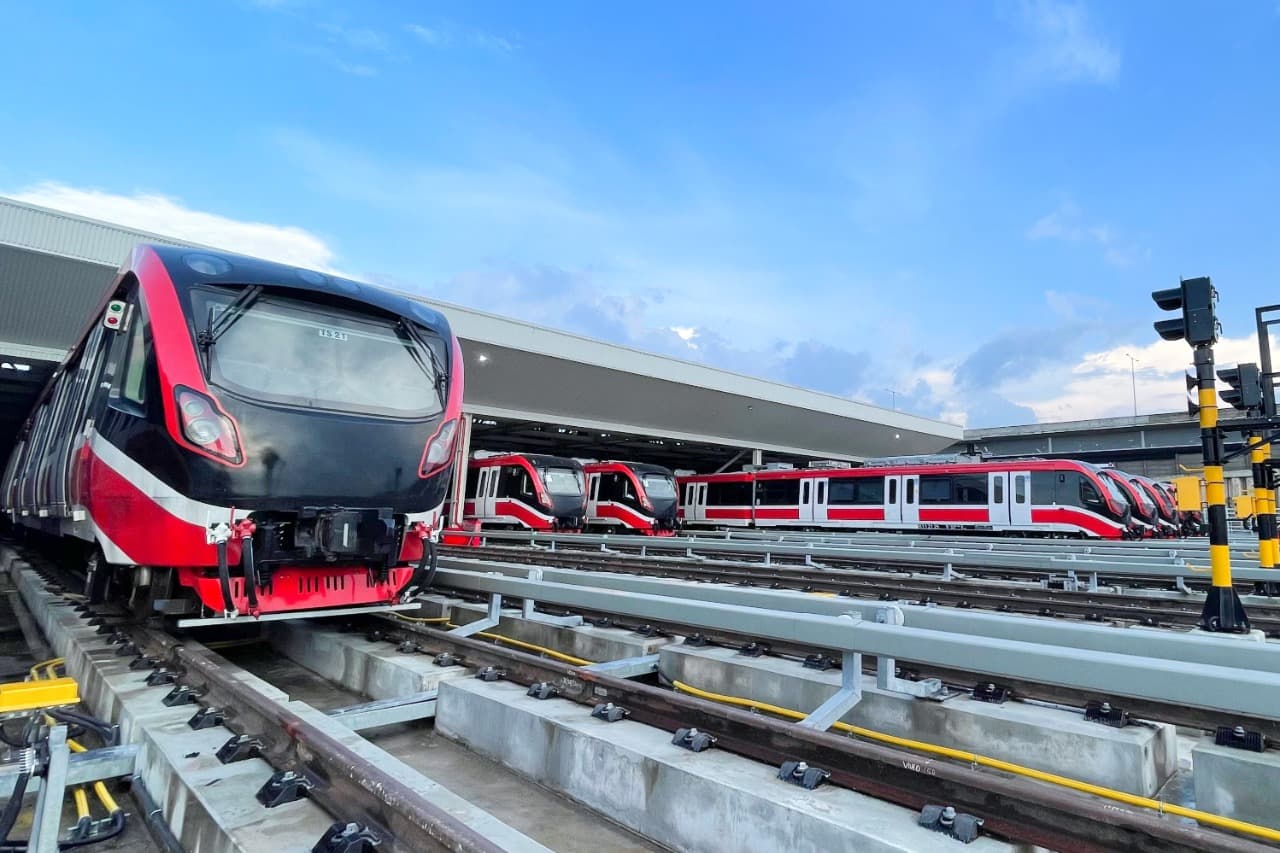
Several Jabodebek LRT trainsets parked at the Jabodebek LRT Depot
KAI VP Public Relations Joni Martinus stated that KAI will conduct a comprehensive ticketing system integration where all existing transport electronic money cards, banking electronic money cards, and digital wallets can be used to ride the Jabodebek LRT.
Currently, the Transport Electronic Money Card to be implemented is the Multi Trip Card (KMT) owned by KAI Commuter. The KMT can be used to ride rail transit across various KAI Group services, such as the Jabodebek Commuter Line (KRL), Yogyakarta-Solo KRL, and Soekarno-Hatta Airport Train. Since late 2021, KMT has also been viable for riding other public transportation modes, namely the Jakarta MRT, Jakarta LRT, and Transjakarta Buses.
If customers use an electronic money card, the Jabodebek LRT payment workflow requires them to first Tap In at the departure station to validate the card and check the balance, which records travel data (time, gate ID, station ID). Upon arriving at the destination station, customers Tap Out, and their electronic money card balance is automatically deducted.
Meanwhile, if customers pay using a digital wallet, they Tap In to validate the payment QR code, check the balance, deduct the balance for the maximum fare, and record travel data (time, gate ID, station ID). Upon arriving at the destination station, customers Tap Out to scan the QR code, and the balance will be refunded if there is a fare difference.
"The advantages of using electronic money or digital wallets as a payment instrument are that they are more practical, secure, and multi-functional. Consequently, Jabodebek LRT customers will have many options to make ticket payments," Joni said.
The Jabodebek LRT will operate across 18 stations, namely Dukuh Atas, Setiabudi, Rasuna Said, Kuningan, Pancoran, Cikoko, Ciliwung, Cawang, TMII, Kampung Rambutan, Ciracas, Harjamukti, Halim, Jatibening Baru, Cikunir I, Cikunir II, Bekasi Barat, and Jatimulya stations.
For Tapping services on the Jabodebek LRT, KAI has installed 14 Turnstile-type gates and 2 Wide-type gates for passengers with disabilities at each station. Specifically at Halim Station, KAI utilizes Flap-type gates to accommodate customers transferring to or from flights.
As for refilling electronic money card balances, KAI has installed 2 Ticket Vending Machine units at every station. KAI also provides 2 Point of Sales units to be operated by counter staff for electronic money card sales.
The Jabodebek LRT Ticketing System service utilizes an Automatic Fare Collection (AFC) ticketing system. The AFC ticketing system is an automated ticketing system computed based on an integrated group of sensor components. Through this AFC system, all ticketing services can be accommodated, including sales, handling problematic tickets, cancellations, penalties, and route additions.
“We adapt services on the Jabodebek LRT to the advancement of the era where digitalization is an absolute necessity. It is expected that customers will gain transactional convenience as well as a pleasant public transportation experience,” Joni concluded.
Up until May 2022, the progress of the Jabodebek LRT reached 82.34 percent. The Jabodebek LRT is targeted to hold a soft launching on August 17, 2022, and subsequently commence commercial operations shortly after.