
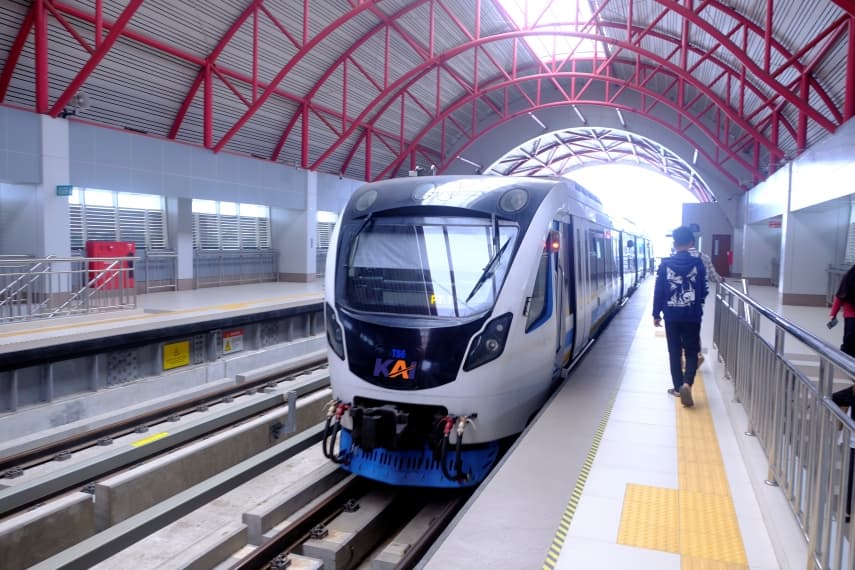
KAI Implements Cashless Payments at Ampera LRT Station
Effective 1 December 2021, passengers boarding the Light Rail Transit (LRT) from Ampera LRT Station are required to make cashless payments as part of the National Cashless Movement initiated by the Government in Palembang.
This initiative is the result of a collaboration between KAI Regional Division III Palembang, the South Sumatra Light Rail Transit Management Agency (BPKARSS), and Bank Indonesia. Through this collaboration, Ampera LRT Station has been designated as the pilot project for the National Cashless Movement. Instead of cash payments, passengers are encouraged to use Electronic Money Cards (Kartu Uang Elektronik/KUE) or the LinkAja digital wallet.
In addition to making transactions more convenient, the cashless payment system also helps make travel more efficient and time-saving. The implementation of this program also supports the optimization of health protocol measures at Ampera LRT Station.
PT KAI Regional Division III Palembang Public Relations Manager Aida Suryanti explained that passengers who wish to purchase an Electronic Money Card (KUE) can obtain one from participating banks. PT KAI Regional Division III has partnered with five banks for this program: BNI, Mandiri, BCA, BRI, and Bank Sumsel Babel.
Electronic Money Cards (KUE) can also be purchased and activated at all LRT stations. Passengers use the card when tapping in at Ampera LRT Station.
Passengers who begin their journey from stations other than Ampera LRT Station and exit at Ampera LRT Station can still tap out using a manual (QR) ticket. The remaining 12 LRT stations have not yet implemented the cashless payment program.
Regarding the implementation of the program, Aida Suryanti said that continuous evaluations will be carried out to encourage LRT users to gradually adapt to the new habit of using cashless payments. At present, only around 5 percent of passengers use the cashless payment system.
"Through the implementation of the cashless payment program at Ampera LRT Station, we hope to gradually encourage the public to shift toward non-cash transactions," Aida concluded. (Public Relations KAI)