
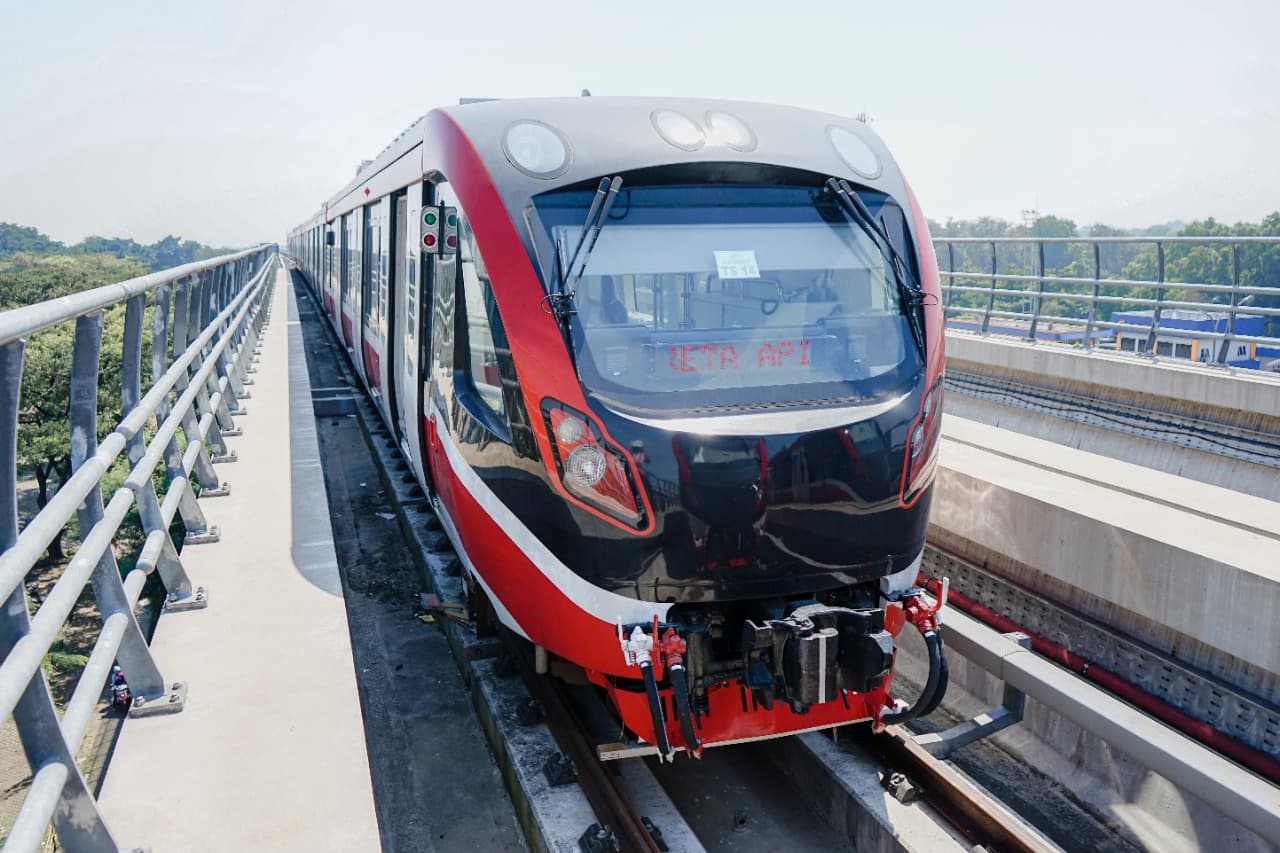
Reaching More Communities Through 18 LRT Jabodebek Stations
LRT Jabodebek is targeted to begin operations in mid-2022 to serve the transportation needs of people in the capital city and its surrounding areas.
Currently, KAI, together with related stakeholders, is preparing all aspects required for the operation of the LRT system, including rolling stock, infrastructure, passenger service facilities, and the necessary operational permits.
“As one of the National Strategic Projects, the presence of LRT Jabodebek is highly anticipated to support safe, comfortable, and congestion-free public transportation,” said KAI Vice President Public Relations, Joni Martinus.
Joni explained that based on Presidential Regulation No. 49 of 2017, KAI has been assigned to develop and operate the facilities and infrastructure of LRT Jabodebek. These responsibilities include the procurement of rolling stock, operation and maintenance of both rolling stock and infrastructure, commercial management of the facilities and infrastructure including infrastructure financing, as well as the implementation of the Automatic Fare Collection (AFC) system.
A total of 18 LRT Jabodebek stations will serve passengers, namely Dukuh Atas, Setiabudi, Rasuna Said, Kuningan, Pancoran, Cikoko, Ciliwung, Cawang, TMII, Kampung Rambutan, Ciracas, Harjamukti, Halim, Jatibening Baru, Cikunir I, Cikunir II, Bekasi Barat, and Jatimulya.
The LRT Jabodebek stations are strategically located in residential areas as well as business districts. This is intended to make it easier for commuters traveling to and from the capital city and other surrounding areas.
The LRT stations consist of two types: the Interchange Station, represented by Cawang Station, and the Typical Station, which applies to the remaining 17 stations. The difference between these station types lies in the number of tracks, station size, and additional facilities. The Interchange Station has three levels, with the first floor serving as the boarding and commercial area, the second floor as the platform area, and the third floor as an additional commercial area. Meanwhile, the Typical Station has two levels, with the first floor functioning as the boarding area and the second floor as the platform area.
“Cawang Station is designed as an Interchange Station because it serves as a transfer station. Passengers traveling from Harjamukti Station to Jatimulya Station can transfer trains at Cawang Station, and vice versa,” said Joni.
To enhance passenger comfort, LRT Jabodebek stations will be equipped with facilities including escalators, stairs, elevators, toilets, nursing rooms, prayer rooms, health rooms, Passenger Information Display Systems (PIDS), passenger announcement systems, and CCTV.
The Government and KAI are also committed to making LRT Jabodebek stations accessible for passengers with disabilities by providing elevators, accessible gates, accessible toilets, and tactile paving. These facilities are expected to make travel easier for passengers with disabilities.
To optimize station services, KAI has prepared personnel who will be available to assist passengers. These include Station Supervisors, ticketing staff, passenger service officers, cleaning service personnel, health officers, and security officers.
In terms of accessibility, LRT Jabodebek stations offer the advantage of integration with various public transportation modes. For example, Dukuh Atas Station is located close to Sudirman Commuter Line Station, Dukuh Atas BNI MRT Station, BNI City Airport Rail Station, Transjakarta bus stops, and various other public transportation services. Halim Station will also be integrated with the Jakarta–Bandung High-Speed Railway Station and is located near Halim Perdanakusuma International Airport.
“The LRT Jabodebek stations are located close to other public transportation hubs, making it easier for passengers to continue their journeys using connecting public transportation,” said Joni.
To provide greater convenience, passengers will be able to use existing Transportation Electronic Money Cards (KUE), such as KMT, other electronic money cards, or digital wallets (e-wallets) to access LRT Jabodebek services.
As the operational launch approaches, the LRT Jabodebek project has shown significant progress. As of September, the infrastructure development had reached 94.36%, consisting of 98.98% completion for Service Line I (Cawang–Harjamukti), 90.7% for Service Line II (Cawang–Dukuh Atas), and 91.8% for Service Line III (Cawang–Jatimulya). Meanwhile, station access development had reached 42.71%, depot construction 51.39%, rolling stock procurement 64.70%, and system integration 35.49%.
To ensure the project is completed on schedule, KAI has proposed receiving IDR 2.7 trillion in State Capital Injection (PMN) for 2021. The funding is planned to cover the project's cost overrun resulting from delays in project completion.
“KAI appreciates the support of all stakeholders in the development of the LRT Jabodebek project. We continue to coordinate with all related parties to ensure that LRT Jabodebek begins operations as scheduled in mid-2022. We hope LRT Jabodebek will become the preferred mode of transportation for people traveling to and from the capital city,” Joni concluded. (Public Relations KAI)

LRT Jabodabek