
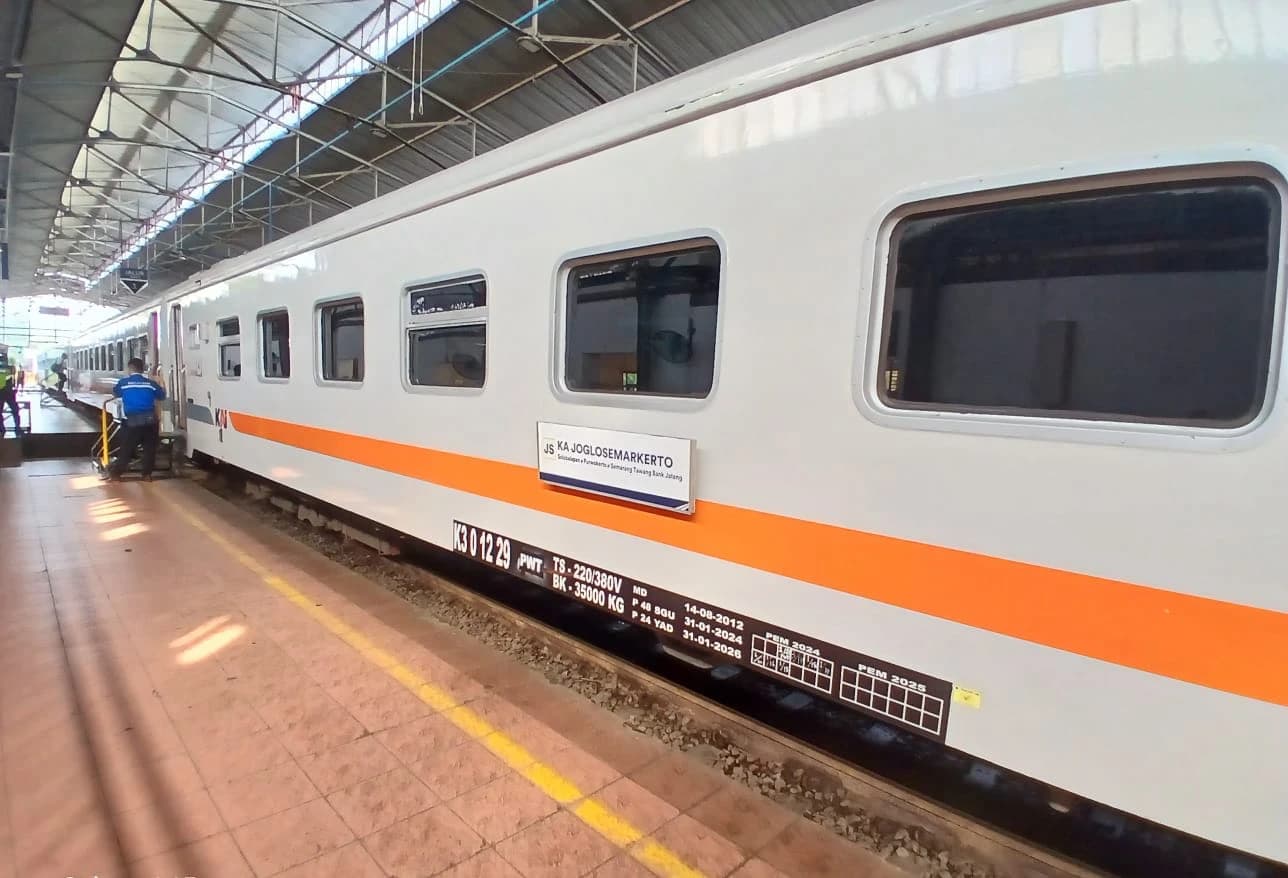
Joglosemarkerto Records 256% Occupancy as Intercity Rail Travel Continues to Grow
Intercity rail travel continues to reflect the diverse mobility needs of the public. Whether commuting for work, visiting family, or taking a weekend getaway, passengers can travel between multiple cities on a single train service, with seats becoming available for new passengers at different stations along the route.
PT Kereta Api Indonesia (Persero) recorded occupancy rates above 100% on several commercial long-distance train services from January to September 2026. According to KAI data, KA Joglosemarkerto recorded the highest occupancy rate at 256% during the first nine months of the year.
Occupancy rates above 100% are possible because the same seat can be used by different passengers on separate segments of a train’s journey. As a result, one seat can serve multiple passengers over the course of the train’s full route.
The following are the ten commercial long-distance train services with the highest occupancy rates from January to September 2026, based on KAI data:
1. KA 187 Joglosemarkerto, operating on the Solo Balapan–Semarang Tawang–Tegal–Purwokerto–Solo Balapan–Semarang Tawang route: 256%.
2. KA 193 Joglosemarkerto, operating on the Solo Balapan–Purwokerto–Tegal–Semarang Tawang–Solo Balapan route: 242%.
3. KA 70 Malabar, operating on the Bandung–Malang route: 178%.
4. KA 145 Blambangan Ekspres, operating on the Ketapang–Surabaya Pasarturi–Semarang Tawang–Pasarsenen route: 174%.
5. KA 153 Ranggajati, operating on the Jember–Surabaya Gubeng–Cirebon route: 173%.
6. KA 157 Wijayakusuma, operating on the Ketapang–Surabaya Gubeng–Cilacap route: 173%.
7. KA 146 Blambangan Ekspres, operating on the Pasarsenen–Semarang Tawang–Surabaya Pasarturi–Ketapang route: 170%.
8. KA 158 Wijayakusuma, operating on the Cilacap–Surabaya Gubeng–Ketapang route: 168%.
9. KA 248 Logawa, operating on the Purwokerto–Surabaya Gubeng–Ketapang route: 167%.
10. KA 91 Jayabaya, operating on the Malang–Surabaya Pasarturi–Pasarsenen route: 167%.
KAI Vice President of Corporate Communication Anne Purba explained that the figures reflect the variety of intercity travel needs. Some passengers travel long distances, while others use the service for shorter segments. Once a passenger gets off at their destination, the same seat can be occupied by another passenger continuing their journey.
KA Joglosemarkerto is one example of a service connecting cities across Central Java and the Special Region of Yogyakarta. Solo, Semarang, Yogyakarta, Purwokerto, and Tegal are among the cities along its route, supporting travel for work, education, family visits, culinary experiences, and tourism. From January to September 2026, the service carried more than 1.10 million passengers.
Similar intercity travel patterns can be seen on KA Malabar, Blambangan Ekspres, Ranggajati, Wijayakusuma, Logawa, and Jayabaya. Their extensive routes and multiple destinations give passengers more options for both long-distance journeys and shorter trips between cities.
Anne clarified that occupancy rates above 100% do not mean that the number of passengers inside a train simultaneously exceeds its seating capacity. Instead, the figures represent cumulative seat utilization throughout the journey, as seats can be used again after previous passengers get off at their destination stations.
According to Anne, these occupancy figures also reflect the many reasons people travel, including work, education, family visits, and tourism. Through its train services connecting cities across Indonesia, KAI continues to provide passengers with more options for reaching their destinations and carrying out their daily activities.