
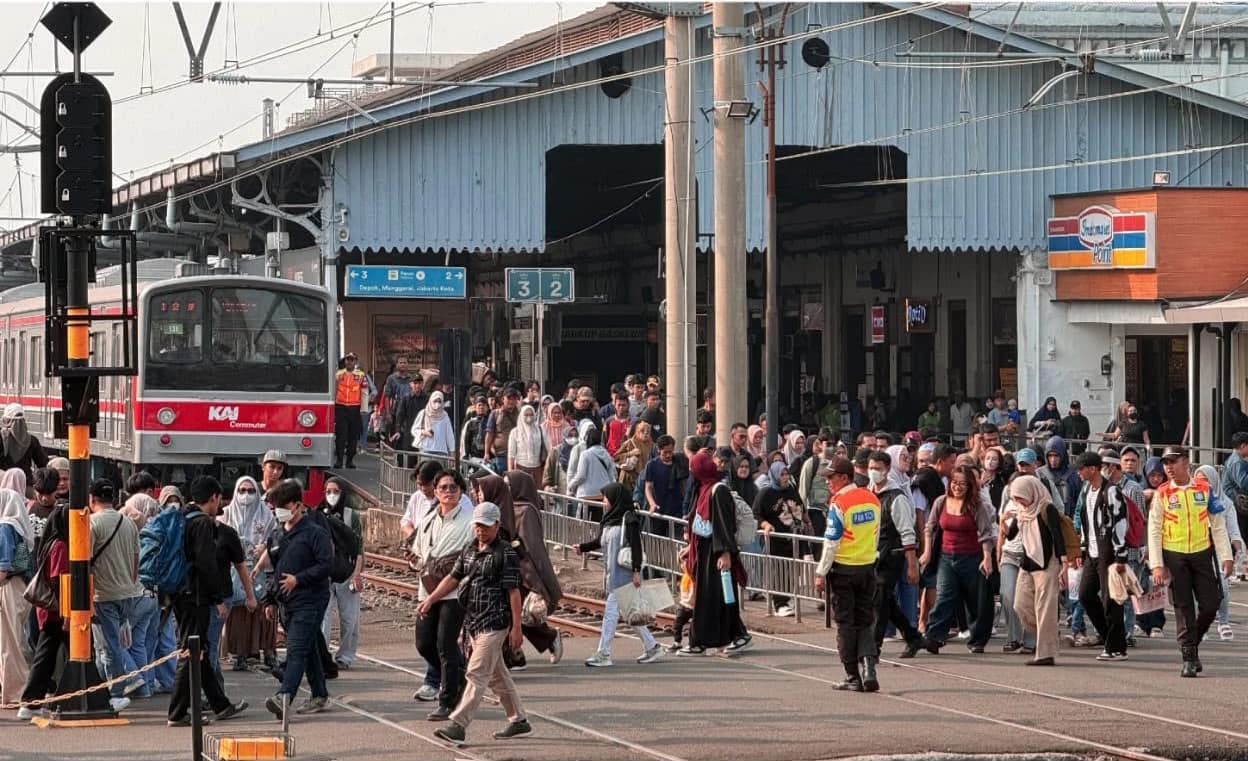
From Bogor to Padang, KAI Station Activity Grows by Up to 108.61%
Rail travel continues to gain momentum across various regions of Indonesia. From January to September 2026, several stations in Java and Sumatra recorded significant increases in passenger activity, with growth reaching more than double the level of the same period last year. The gains span diverse areas, from metropolitan satellite cities to regional activity centers.
Bogor Paledang Station recorded the highest growth among the stations highlighted, with total passenger boardings and alightings rising from 395,471 in 2025 to 825,011 in 2026, an increase of 108.61%.
Purwakarta Station followed, with activity increasing from 201,953 to 321,384, up 59.14%. In West Sumatra, Air Tawar Station recorded 330,554 passenger activities, a 27.66% increase from 258,929.
Growth was also recorded at Purwosari Station in Solo, which handled 494,319 activities, up 22.17%. Karawang Station recorded 306,533 activities, an increase of 21.98% from the same period last year.
KAI Vice President of Corporate Communication Anne Purba explained that the growth was spread across areas with different characteristics. These included metropolitan satellite cities, regional activity centers, education hubs, industrial cities, and destinations for everyday travel. The trend reflects the increasingly diverse mobility needs served by rail.
Other stations also recorded notable increases. Semarang Tawang handled 3,329,748 passenger activities, up 16.68%. Cilacap Station grew by 17.51% to 358,605 activities, while Baturaja Station in South Sumatra recorded a 16.57% increase to 293,252.
In Sumatra, Tanjungkarang Station recorded 562,993 activities, up 13.99%. Kertapati Station handled 862,450 activities, an increase of 13.78%, while Padang Station reached 921,282 activities, up 13.74%.
Growth was also evident at stations with higher overall activity volumes. Purwokerto Station recorded 2,770,189 activities, up 12.41%, while Surabaya Pasarturi Station reached 2,789,112, an increase of 12.32%.
Anne explained that station activity is calculated by adding the number of passengers boarding and alighting. The figures therefore reflect how intensively a station is used as a starting point or destination, rather than the number of unique passengers.
The differences between stations illustrate distinct travel patterns. Purwokerto and Surabaya Pasarturi recorded high activity volumes, while Bogor Paledang and Purwakarta showed faster growth. These figures help KAI understand how travel needs are evolving across regions.
The trend coincides with strong domestic mobility nationwide. Statistics Indonesia (BPS) recorded 104.30 million domestic tourist trips in August 2026, an increase of 11.47% compared with August 2025. Although domestic tourist trips and station passenger activity are different indicators, both provide insight into movement between regions.
For KAI, rising station activity helps inform evaluations of passenger services, station space capacity, travel patterns, train schedules, and access to and from stations. Each region has different needs, whether related to tourism, education, industry, government centers, or everyday economic activity.
Anne emphasized that station-level data is essential to understanding these developments. As activity increases, more journeys are being connected through the railway network. KAI will continue using travel data to align its services with the needs and characteristics of each region.