
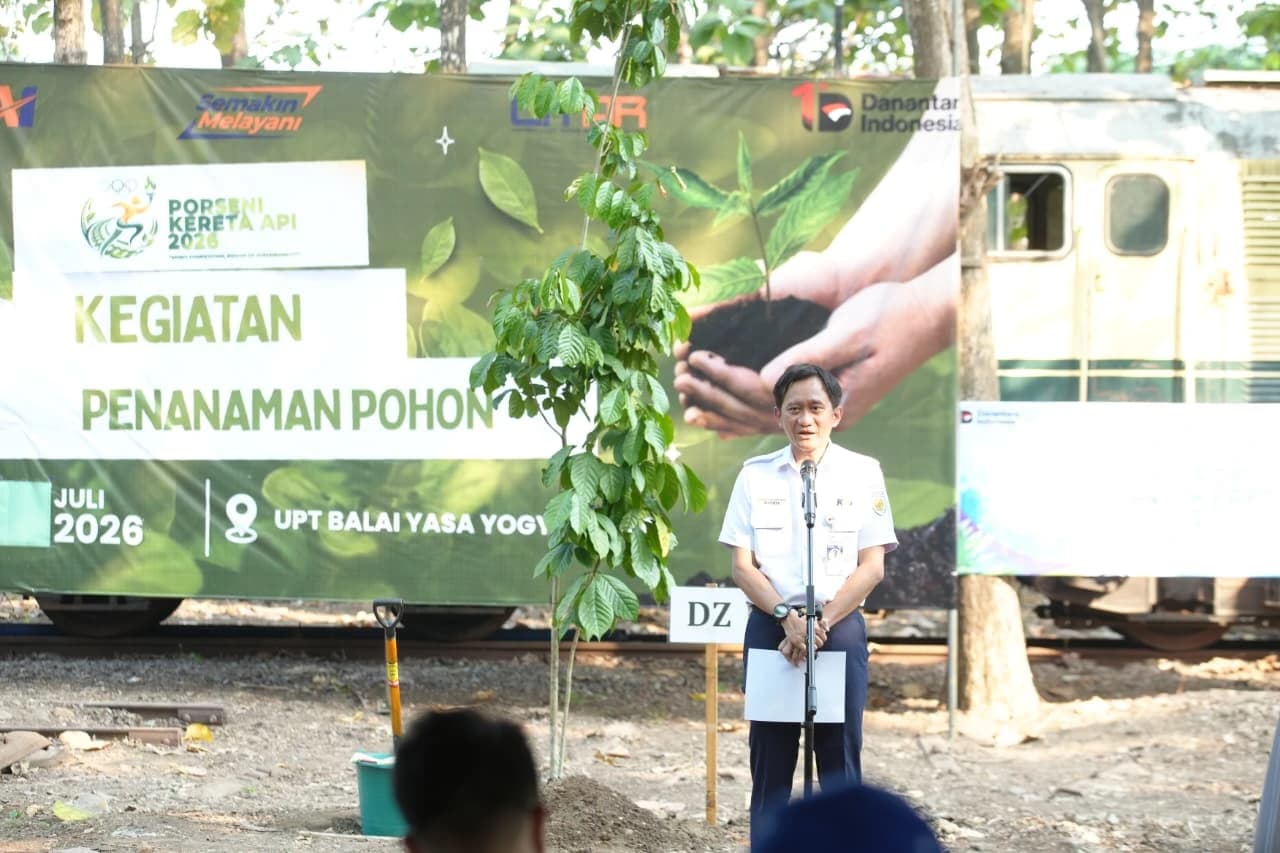
During Porsenika 2026, KAI Plants 25 Trees, Total Reaches 99,785 Trees Since 2022
A total of 25 productive trees were planted at Balai Yasa Yogyakarta on Monday (July 13). This activity, part of the 2026 Railway Sports and Arts Week (Porsenika), reflects the implementation of sustainability principles within the KAI Group.
The trees planted have an average height of 2.5 to 3 meters, consisting of 10 mango trees, 2 mundu trees, 5 duku trees, 5 jackfruit trees, and 3 velvet apple trees. The planting locations and spacing were arranged to ensure optimal growth and provide environmental benefits for the Balai Yasa Yogyakarta area.
President Director of KAI, Bobby Rasyidin, explained that tree planting reflects the company’s transformation direction, emphasizing a balance between profit, people, and planet. According to him, business performance must go hand in hand with improving human welfare and environmental preservation, and this principle is part of how KAI conducts its business sustainably.
Throughout 2026, KAI has planted 4,540 trees. Cumulatively, from 2022 to July 13, 2026, the total number of trees planted has reached 99,785. This includes 64,157 trees in 2022, 17,123 trees in 2023, 6,716 trees in 2024, 7,249 trees in 2025, and 4,540 trees throughout 2026. Planting has been carried out across various KAI operational areas, taking into account tree suitability and local environmental conditions.
The symbolic planting at Balai Yasa Yogyakarta was carried out by Heads of Regional Operations, Heads of Regional Divisions, the Head of LRT Jabodebek Division, representatives from PT Kereta Cepat Indonesia China, representatives of subsidiary groups, and heads of contingents participating in Porsenika 2026.
Balai Yasa Yogyakarta, located in the Pengok area, is one of KAI’s major locomotive heavy maintenance centers. This facility performs maintenance, repairs, and reliability improvements to ensure rolling stock remains ready to support safe and smooth train operations.
Bobby added that the involvement of unit leaders and Porsenika participants shows that environmental awareness must be built through collective participation across the entire KAI Group. Tree planting as part of Porsenika combines the spirit of healthy competition with environmental care, and the involvement of leaders and contingents is expected to strengthen good practices that can be applied in their respective workplaces.
Porseni Kereta Api 2026 involved 1,632 participants from 17 KAI Group contingents. The event serves as a platform to strengthen health, sportsmanship, creativity, and collaboration among employees.
Sustainability principles were also applied throughout the event. Employees collected unused R6 white uniforms to be processed into new products with added value. Participants were also encouraged to use reusable tumblers and eating utensils to help reduce single-use waste.
According to Bobby, the activities at Balai Yasa Yogyakarta complement various environmental programs that KAI has implemented in its operations and customer services.
In terms of energy, KAI has operated 113 solar power units across 92 locations. The total installed capacity reaches 4,430.65 kilowatt peak, with the potential to reduce more than 5,000 tons of carbon dioxide emissions annually.
Since July 1, 2026, KAI has also begun implementing B50 biodiesel as part of the government mandate. B50 is a blend of 50 percent plant-based biodiesel and 50 percent diesel, aimed at increasing the use of domestic energy and reducing dependence on fossil fuels. Its implementation considers rolling stock readiness, fuel quality, safety, and operational reliability. Bobby stated that both solar energy utilization and B50 implementation are part of KAI’s energy transition, carried out in a measured manner while maintaining safety, equipment readiness, and service reliability as top priorities.
Paper usage reduction has also been achieved through service digitalization. Throughout Semester I 2026, the Face Recognition Boarding Gate was used by 5,555,034 Long-Distance Train customers, reducing the need for approximately 13,888 rolls of boarding pass paper with estimated savings of Rp203.80 million. Based on internal simulations, this paper reduction is equivalent to raw materials from approximately 75 trees. Digitalization provides convenience for customers while helping reduce resource consumption in service processes.
KAI has also provided 124 free drinking water facilities across 58 stations. These facilities support the use of tumblers and refillable drinking water, helping reduce single-use plastic bottle consumption during travel.
The processing of used uniforms into new products is also part of circular economy implementation. Materials that are no longer in use are reprocessed to create value and reduce textile waste.
Bobby concluded that KAI’s sustainability programs cover energy management, paper usage, water, and waste. Their implementation is directed toward supporting operational reliability, service quality, cost control, and long-term benefits for society and the environment.