
KAI Prepares Four Growth Engines, Aiming to Transform Railways Toward 2045
The future of Indonesia’s railway industry will not only be determined by the number of train services or the number of customers using rail transportation. Asset management, technology utilization, capability development, and the creation of new business sources are becoming part of the strategy to build long-term growth toward Indonesia Emas 2045.
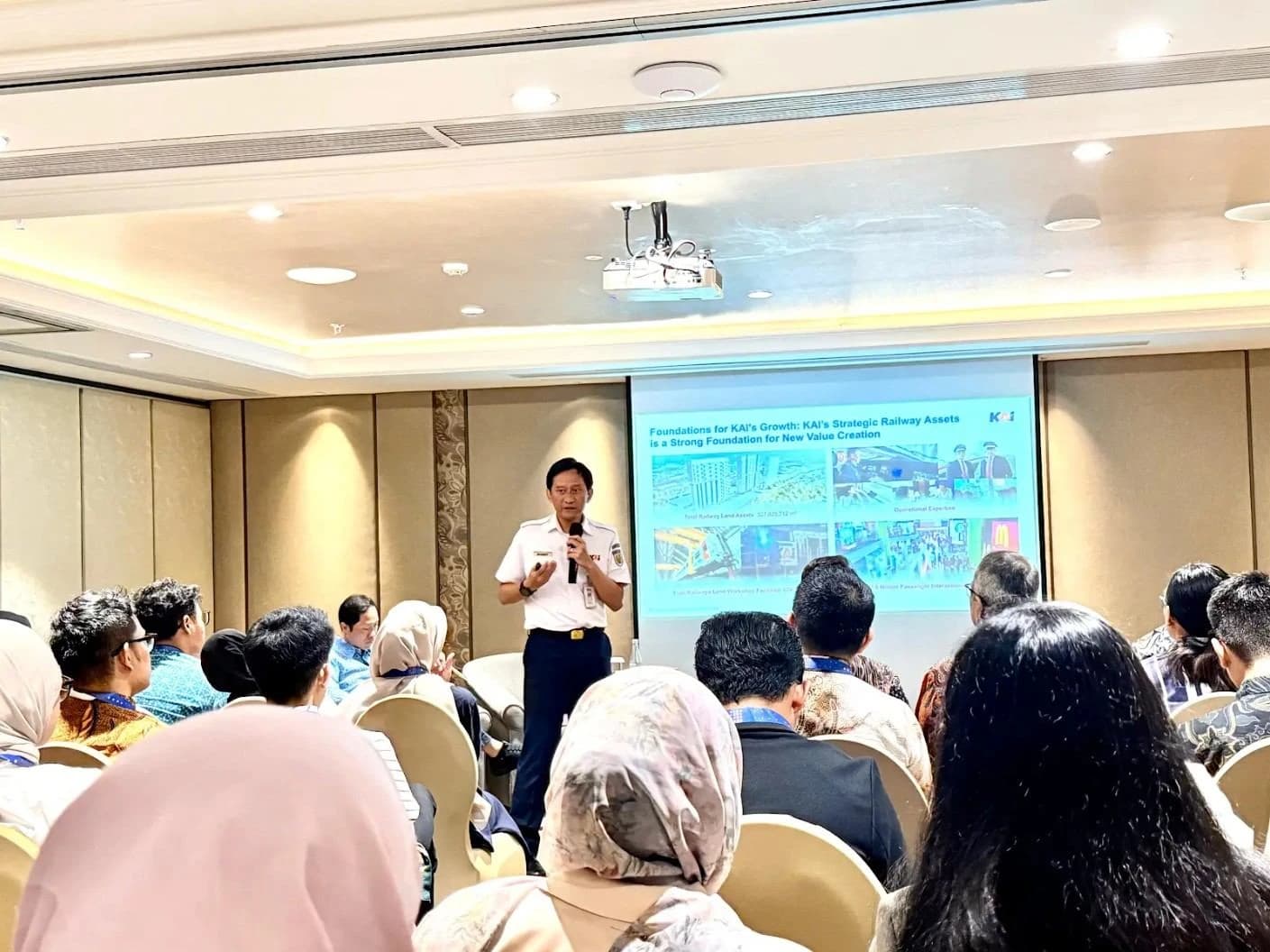
This direction of transformation was among the topics discussed at the SBM ITB Industrial Summit 2026, held at Hotel AYANA Midplaza Jakarta on Wednesday (19/8/2026). The forum, organized through a collaboration between the School of Business and Management Institut Teknologi Bandung (SBM ITB) and Adam Smith Business School, University of Glasgow, brought together industry leaders, regulators, investors, and academics to discuss industrial transformation and Indonesia’s economic competitiveness.
At the forum, President Director of PT Kereta Api Indonesia (Persero), or KAI, Bobby Rasyidin, presented the company’s transformation direction through a presentation titled Growth Beyond the Limits: Transforming Railways for Indonesia’s Economic Future. The transformation is aimed at expanding the company’s sources of value while strengthening the contribution of the railway sector to the national economy.
KAI Group recorded a total of 503.5 million customers throughout 2025, an increase of 8.52 percent compared to 464 million customers in 2024. In its daily operations, KAI also records around 2.8 million customer interactions every day, reflecting the scale of its services and its potential for further development.
So far, around 94 percent of KAI’s revenue still comes from its transportation business, while non-farebox business contributes approximately 6 percent. This condition opens opportunities to develop new sources of growth through four growth engines: operational assets, tangible assets, capability-based assets, and technology assets.
This potential is supported by approximately 327.8 million square meters of railway land assets and a large customer base. Development opportunities include the optimization of areas and properties, Transit-Oriented Development (TOD), digital services, MRO, manufacturing, and the development of expertise in the railway sector.
The utilization of artificial intelligence, or AI, and digital technology is also part of the transformation direction to improve operational productivity and optimize the capacity of the existing network. This approach is expected to ensure that the company’s growth does not rely solely on increasing the number of train services, but also on its ability to create new value from its existing assets and capabilities.
The transformation is also aimed at strengthening the role of railways in improving the efficiency of Indonesia’s transportation and national logistics sectors. More efficient mobility for people and goods is expected to have a greater impact on industrial competitiveness and the Indonesian economy.
In the roadmap toward 2045, KAI Group’s customer volume is targeted to reach approximately 1.4 billion customers per year. Meanwhile, the contribution of non-farebox businesses is also targeted to increase to around 20 to 25 percent, in line with the expansion of new growth sources being developed.
Collaboration with the government, academics, industry players, and the public will also become an important part of this transformation journey. By strengthening productivity, optimizing assets, expanding business sources, and accelerating the use of technology, KAI is aiming to become a world-class railway operator by 2045 while further increasing the contribution of railways to Indonesia’s connectivity and competitiveness.