
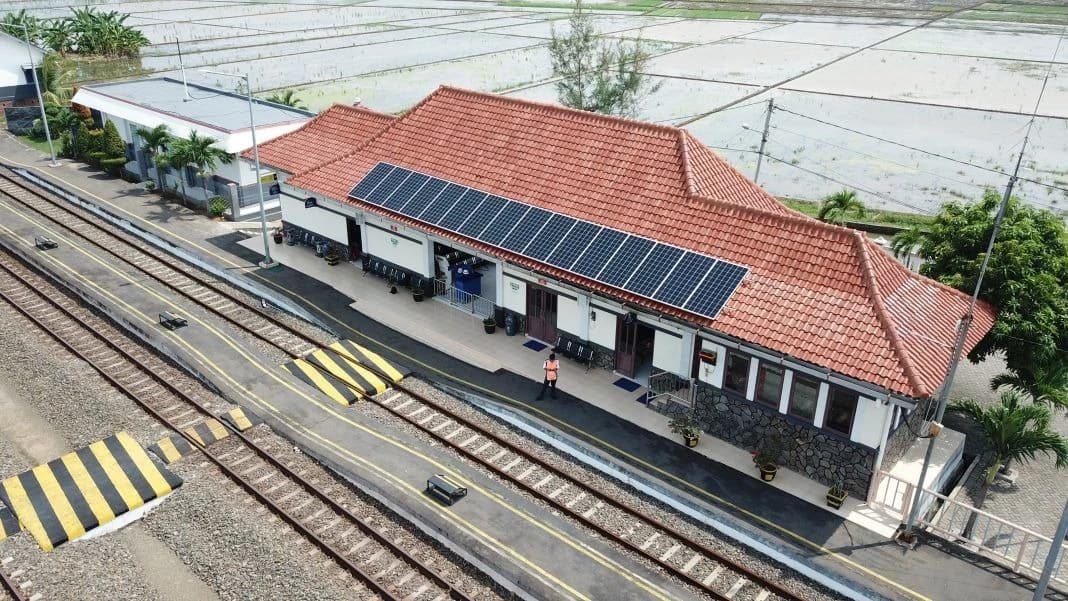
KAI Expands Solar Energy Use, 113 Solar Power Units Now Operating Across 92 Locations
Solar energy is playing a growing role in supporting railway operations. PT Kereta Api Indonesia (Persero), or KAI, now operates 113 solar power units across 92 railway asset locations, with a total installed capacity of 4,430.65 kWp, or around 4.43 MWp.
At this capacity, KAI’s solar power installations have the potential to generate approximately 5.8 million to 6.6 million kWh of electricity per year, based on estimated solar power production in Indonesia. The use of solar energy supports electricity needs across various operational facilities while contributing to more efficient energy management across KAI’s railway ecosystem.
Vice President of Corporate Communication KAI Anne Purba explained that solar power utilization is part of the company’s efforts to adopt energy technology in support of rail-based transportation operations. Reliable railway infrastructure, she noted, also depends on how efficiently energy needs across the company’s assets are managed.
KAI has been developing its solar power capacity in stages since 2022. Installed capacity initially reached 206 kWp, increasing to 1,314.30 kWp in 2023 and 1,914.20 kWp in 2024. In 2025, KAI added 996.15 kWp, while another 500 kWp of additional capacity is being prepared for 2026.
The solar power installations are spread across various types of railway assets. Of the 92 locations, 62 are stations with a combined capacity of 1,759.90 kWp, while 10 Balai Yasa facilities have a combined capacity of 1,786.50 kWp. Solar power is also utilized at offices, Griya Karya facilities, depots, record centers, and other supporting facilities.
With transportation requiring substantial and continuous energy, energy management has become an important part of maintaining operational effectiveness and optimizing railway assets. KAI uses solar power to support electricity needs at customer service areas, operational buildings, rolling stock maintenance facilities, and other supporting infrastructure.
The use of solar power is also reflected in KAI’s energy performance in its 2025 Sustainability Report. Electricity generated from solar panels is included as one of the company’s energy management indicators, alongside the expansion of solar power installations across more than 90 operational assets with a total capacity of around 4.4 MWp.
Beyond supporting electricity needs, solar power development forms part of KAI’s efforts to improve energy efficiency and reduce the environmental impact of its operations. The use of renewable energy also supports the development of lower-carbon transportation.
Going forward, KAI will continue to explore opportunities for innovation in energy and asset management, including the use of technology to support transportation that is increasingly efficient, reliable, and sustainable.