
KAI Cuts Energy Consumption by 15.39%, Energy Efficiency per Customer Improves by 22%
A stronger commitment to sustainable and efficient transportation continues to drive PT Kereta Api Indonesia (Persero). Throughout 2025, the company successfully reduced its total energy consumption by 15.39% compared with the previous year, while continuing to serve more than 503 million passengers and transport 69.57 million tons of freight across Indonesia.
According to the KAI Sustainability Report 2025, the company's total energy consumption declined from 11,945,467 gigajoules (GJ) in 2024 to 10,107,302 GJ in 2025. This represents an energy saving of 1,838,165 GJ, demonstrating that expanding transportation services can go hand in hand with greater energy efficiency.
Vice President of Corporate Communication KAI Anne Purba explained that gigajoules are used as a common unit to measure all forms of energy consumed by the company. KAI utilizes various energy sources, including electricity from the national grid, solar power, gasoline, diesel, and biodiesel, each of which is originally measured in different units.
To enable comprehensive calculation and year-on-year comparison, all energy sources are converted into gigajoules based on the Global Reporting Initiative (GRI) sustainability reporting standards.
A simple analogy is converting kilograms, quintals, and tons into one unit before adding them together. Since electricity and fuel are measured differently, they are first converted into gigajoules. This allows KAI to accurately calculate total energy consumption and monitor efficiency improvements from year to year.
Under this methodology, one liter of gasoline equals 0.0342 GJ, one liter of diesel or biodiesel equals 0.0379 GJ, while one kilowatt-hour of electricity equals 0.0036 GJ. Fuel conversion follows Indonesia's national greenhouse gas inventory guidelines, while electricity conversion refers to national power sector standards and international energy references.
The company's improved energy management is also reflected in its operational efficiency. Average energy consumption per passenger decreased from 0.0263 GJ in 2024 to 0.0205 GJ in 2025, making passenger services 22.05% more energy efficient than the previous year.
This does not mean that each passenger directly consumes 0.0205 GJ of energy. The figure is obtained by dividing KAI's total annual energy consumption by the total number of passengers served. The lower the figure, the more efficiently energy is used to deliver transportation services.
Freight operations also recorded significant improvements, with energy intensity declining from 0.1726 GJ to 0.1453 GJ per ton of freight, representing a 15.82% improvement.
Meanwhile, energy intensity relative to revenue improved by 14.57%, decreasing from 0.3308 GJ per billion rupiah to 0.2826 GJ.
These achievements demonstrate that KAI not only reduced its overall energy consumption but also improved the efficiency of delivering passenger services, freight transportation, and overall business operations.
During the first half of 2026, KAI Group continued to expand its services by serving 258,993,359 customers, up 7.55% compared with the same period last year, while transporting approximately 32.50 million tons of freight.
Expanding our transportation capacity must be accompanied by disciplined energy management. Our priority is to ensure that growing passenger numbers and freight volumes are supported by increasingly efficient energy use without compromising safety or operational reliability.
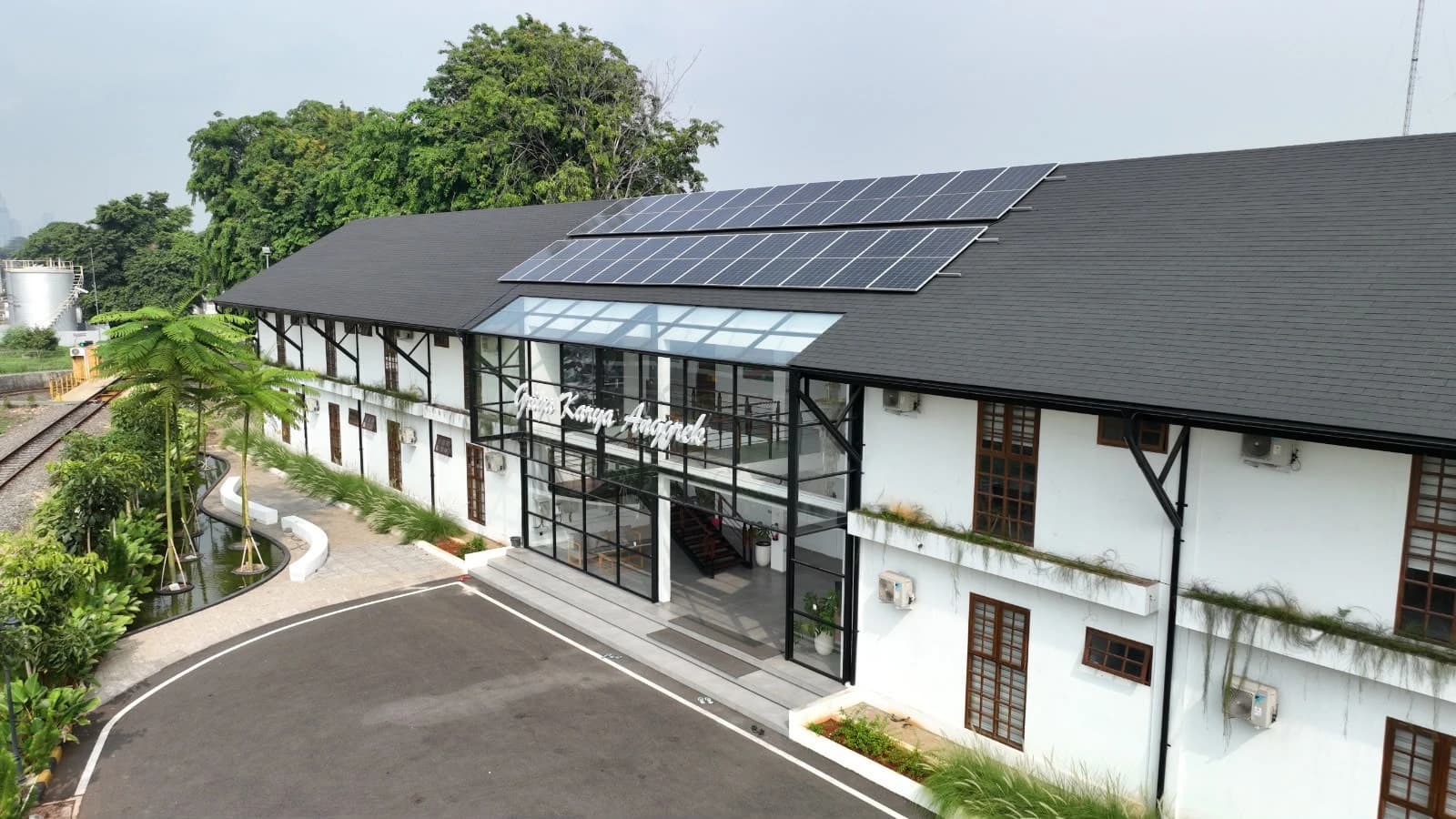
The company's energy transition is further supported by renewable energy initiatives. KAI currently operates 113 solar power systems across 92 locations, including 62 stations, 10 maintenance workshops, 10 offices, six operational facilities, three depots, and one record center.
With a total installed capacity of 4,430.65 kilowatt-peak (4.43 MWp), these solar installations have the potential to reduce more than 5,000 tons of carbon dioxide emissions annually.
Electricity generated by the solar panels is used to support lighting, customer service areas, office operations, electronic equipment, and other operational facilities, helping reduce dependence on conventional electricity supplies.
Since 1 July 2026, KAI has also been conducting a three-month operational trial of B50 biodiesel, a fuel blend consisting of 50% plant-based biodiesel and 50% diesel.
The trial evaluates engine performance, fuel consumption, filtration systems, maintenance requirements, and rolling stock reliability under various operating conditions.
B50 contains a higher proportion of biodiesel than the previously used B40 blend. Therefore, its implementation requires comprehensive technical evaluation to ensure compliance with safety standards, fleet readiness, and operational reliability.
KAI's commitment to resource efficiency also extends to rail-based freight transportation. According to the KAI Sustainability Report 2025, a single freight train can carry approximately 3,050 tons of cargo, equivalent to the load of around 144 trailer trucks.
This significantly improves fuel efficiency, reduces road congestion, and helps minimize road damage caused by heavy vehicles.
For industrial customers, rail freight offers large carrying capacity, reliable schedules, and greater energy efficiency for medium- and long-distance transportation. Expanding rail-based logistics will help strengthen a more efficient national logistics system.
Digital transformation also contributes to resource efficiency. During the first half of 2026, 5,555,034 long-distance train passengers used Face Recognition Boarding Gate technology.
The initiative is estimated to have reduced the use of approximately 13,888 rolls of boarding pass paper, generating cost savings of around Rp203.80 million. Based on internal simulations, the paper savings are equivalent to preserving the raw material of approximately 75 trees.
KAI has also installed 124 free drinking water stations across 58 railway stations in 70 customer service areas, encouraging passengers to refill reusable bottles and reduce single-use plastic waste during their journeys.
Energy efficiency is part of our broader commitment to responsible resource management. KAI manages fuel, electricity, paper, water, and other operational resources in a measurable and accountable manner to maintain reliable services while gradually reducing environmental impacts.