
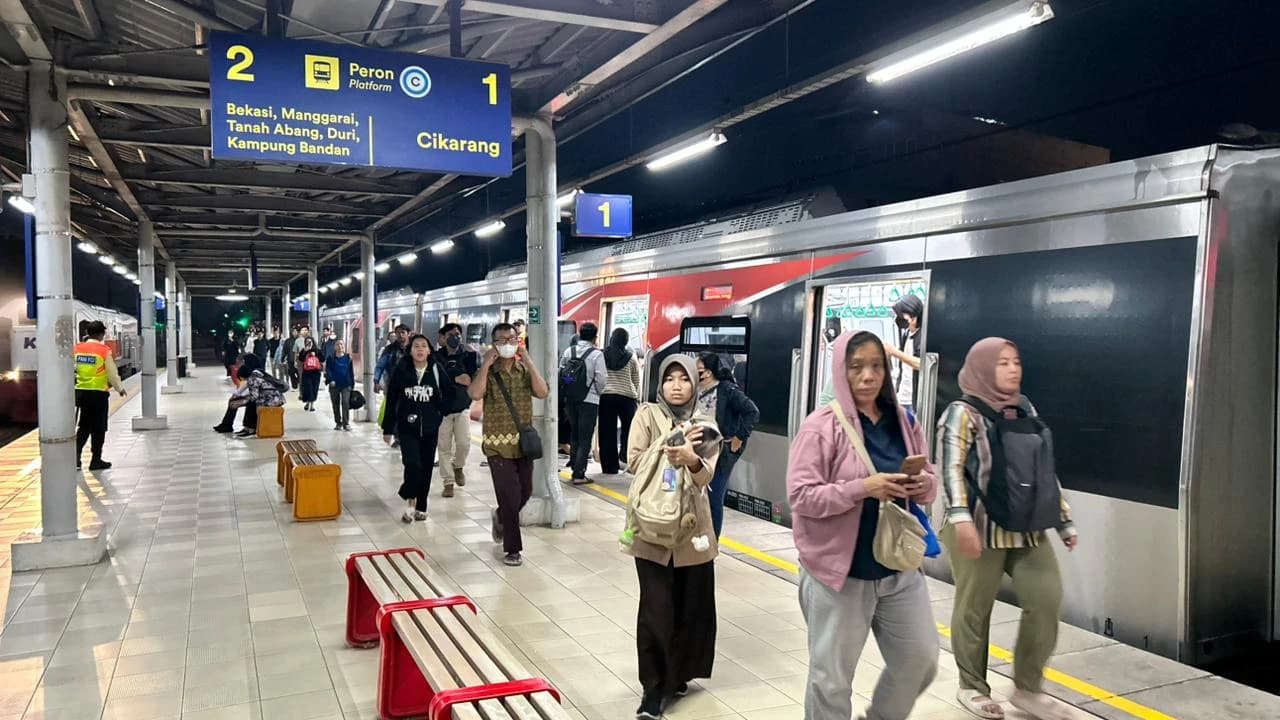
210 Million Customers Ride Commuter Line as Jabodetabek Moves Toward Low-Carbon Mobility
The use of the Jabodetabek Commuter Line continues to grow as demand for daily mobility increases across the metropolitan area. From January to July 2026, the service recorded 210,468,029 customers, or around 210.47 million customers. This figure was 6.39 percent higher than the same period in 2025, when the service recorded 197,833,176 customers.
The growth has remained consistent over the past four years. From January to July 2023, the Jabodetabek Commuter Line served 161,004,449 customers. The number then increased to 186,056,667 customers during the same period in 2024, reached 197,833,176 customers in 2025, and rose again to 210,468,029 customers in 2026.
Compared with January–July 2023, the number of customers this year increased by 49,463,580, or 30.72 percent. This growth shows the increasingly important role of mass transportation in supporting the economic and social activities of people across the Jabodetabek metropolitan area.
The high number of Commuter Line customers also reflects its role in helping people carry out their daily activities more efficiently. The service connects residential areas with various activity centers, including workplaces, schools, shopping areas, healthcare facilities, and public services.
A single train can carry many customers on one trip. This makes rail-based transportation more efficient in the use of urban space, energy, and infrastructure compared with individual trips using private vehicles.
The Commuter Line's connectivity also provides more reliable travel for workers and students while expanding access to economic opportunities. People living in surrounding areas can remain connected to activity centers in Jakarta and its surrounding areas. This connectivity helps maintain smooth daily activities while reducing traffic pressure on roads.
The benefits of using the Commuter Line can also be seen from an environmental perspective. Based on an illustration in KAI's 2025 Sustainability Report, a 30-kilometer trip from Bekasi to Jakarta by train produces around 2.4 kilograms of CO2 emissions per day. Meanwhile, a private car trip over the same distance produces around 12 kilograms of CO2 per day.
The difference reaches 9.6 kilograms of CO2. This means that, in the illustration, using the train can reduce the daily carbon footprint by around 80 percent compared with using a private car.
The same report states that passenger trains produce around 41 grams of CO2 per customer per kilometer, while private vehicles produce around 192 grams of CO2 per customer per kilometer. This difference highlights the potential of rail-based transportation to reduce emissions from the transportation sector and support the development of low-carbon urban areas.
When used by millions of people every day, mass transportation can create a wider environmental impact by reducing travel emissions, improving energy efficiency, and easing the pressure of vehicles on roads.
To meet growing mobility needs, KAI continues to strengthen the capacity and quality of the Jabodetabek Commuter Line service. These efforts include improving the reliability of rolling stock, upgrading station facilities, adjusting train services based on customer needs, strengthening electrical and signaling systems, and integrating the service with other public transportation modes.
In 2026, the Jabodetabek Commuter Line network serves 85 stations, up from 71 stations in 2015. The expansion of the network improves access from surrounding areas to major activity centers while supporting the growth of residential areas and new economic centers.
The growth in mobility can also be seen on the Cikarang Commuter Line, which serves Bekasi and the eastern part of Jabodetabek. Customer volume on this route increased from 55.66 million trips in 2022 to 84.53 million trips in 2025. Over three years, the number of trips increased by around 28.87 million, or 51.86 percent.
In 2025, the Cikarang Commuter Line accounted for 24.53 percent of the total Jabodetabek commuter rail customer volume. This made it the second-largest route by customer volume after the Bogor Commuter Line. The growth reflects the strong demand for travel from Bekasi, Cikarang, and the eastern part of Jabodetabek to various activity centers in Jakarta.
The increase in mobility further highlights the need to expand capacity on the eastern route. This includes improving the reliability of rolling stock, electrical and signaling systems, station facilities, peak-hour service management, and infrastructure development to support the separation of Commuter Line services from other train services.
The increase in customer numbers provides a basis for KAI to gradually expand capacity while continuing to prioritize safety, reliability, punctuality, comfort, and crowd management. Strengthening the Jabodetabek Commuter Line is expected to provide broader benefits for public productivity, urban efficiency, and environmental quality.
The development of mass transportation is also part of efforts to support low-carbon development and contribute to Indonesia's target of achieving Net Zero Emissions by 2060.