
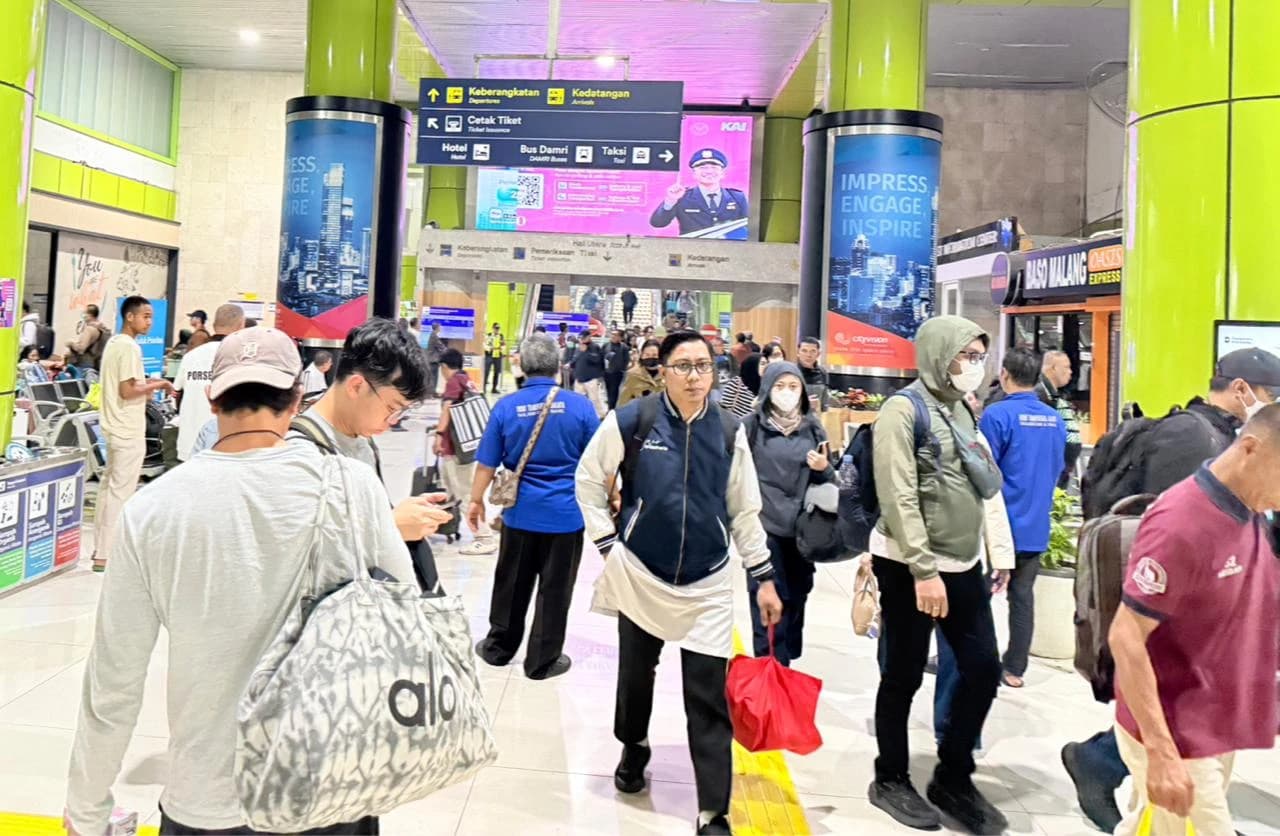
KAI Group Serves 351.6 Million Customers Through August 2026, Up 7.09 Percent
PT Kereta Api Indonesia (Persero) together with KAI Group served 351,602,397 customers throughout January–August 2026, an increase of 7.09% compared to the same period in 2025, which recorded 328,311,868 customers. The growth occurred across various service segments, ranging from tourist trains, LRT, intercity and local journeys, commuter services, airport trains, to high-speed trains.
Vice President Corporate Communication KAI Anne Purba said that this development demonstrates the increasingly diverse needs of the public served through the KAI Group ecosystem.
“A total of 351.6 million customers have used KAI Group services during the first eight months of 2026. Growth occurred across various travel characteristics, ranging from daily mobility in urban areas, intercity travel, access to airports, to tourism journeys. We continue to strengthen connectivity between services so that the benefits of rail-based transportation can reach more people,” said Anne.
The highest growth was recorded by services managed by KAI Wisata, with 216,980 customers, an increase of 49.09% compared to 145,537 customers in January–August 2025. This performance demonstrates the growing utilization of railways as part of luxury travel and people's travel experiences.
The next growth came from LRT Jabodebek. Throughout January–August 2026, this service recorded 21,809,797 customers, an increase of 19.05% compared to 18,320,640 customers in the same period of the previous year. LRT Jabodebek supports people's mobility between Jakarta and surrounding areas through the Cibubur Line and Bekasi Line, while also connecting with the Commuter Line network, MRT Jakarta, TransJakarta, the Whoosh high-speed train, and other connecting modes of transportation.
In South Sulawesi, the Makassar–Parepare Train recorded growth of 13.13%, from 204,856 customers in January–August 2025 to 231,764 customers in January–August 2026. This development demonstrates that the need for railway services continues to grow in Sulawesi while expanding access to public transportation for people in the areas served.
For Long-Distance and Local Train services managed by KAI, the number of customers reached 40,379,062, an increase of 8.69% compared to 37,152,345 customers in the same period of the previous year. The network serves intercity and local journeys connecting various economic, educational, governmental, tourism, and residential centers.
The largest contributor to KAI Group's customer volume continues to come from KAI Commuter, with 277,272,682 customers, an increase of 6.32% compared to 260,797,109 customers in January–August 2025. Commuter services support the daily mobility of people in Jabodetabek as well as several service areas in Java.
Furthermore, Whoosh served 4,078,168 customers, an increase of 0.68% compared to 4,050,791 customers in the same period of the previous year. The high-speed train service strengthens Jakarta–Bandung connectivity and connects with several connecting services, including LRT Jabodebek at Halim and Feeder Trains to central Bandung.
Meanwhile, KAI Bandara served 4,647,947 customers, an increase of 0.19% compared to 4,639,062 customers in January–August 2025. The presence of airport trains expands public access options to airports while connecting them with urban and intercity transportation networks.
In South Sumatra, LRT Sumsel served 2,965,997 customers throughout January–August 2026. The service connects Sultan Mahmud Badaruddin II Airport Station to DJKA Station in the Jakabaring area, passing through central Palembang and several community activity centers.
Anne explained that the scale of KAI Group enables the public to use several types of railway services within a single journey. On Java Island, the Long-Distance and Local Train network is connected to KAI Commuter, LRT Jabodebek, KAI Bandara, Whoosh, and various urban transportation services at integrated stations.
This connectivity can be seen, among others, in the Halim area, where LRT Jabodebek connects with Whoosh, in the Dukuh Atas area, which brings together the Commuter Line, LRT Jabodebek, MRT Jakarta, KAI Bandara, and TransJakarta; as well as Greater Bandung through the connection between Whoosh, Feeder Trains, and other railway networks.
In Sumatra, railway services are also an important part of people's mobility. The intercity and local passenger train network serves various areas in Sumatra, while LRT Sumsel strengthens urban transportation in Palembang and access to Sultan Mahmud Badaruddin II Airport. This connectivity provides people with mass transportation-based travel options while supporting regional economic and tourism activities.
“Each service has complementary functions. Intercity trains connect regions, commuter and LRT services serve urban mobility, airport trains connect journeys with air transportation, while Whoosh strengthens travel between metropolitan areas. This integration is what we continue to develop so that people's mobility becomes more efficient and convenient,” said Anne.
In line with passenger mobility, KAI also supports the national logistics chain. Throughout January–August 2026, KAI transported 36,854,758 tons of coal and 8,051,205 tons of non-coal freight, including containers, cement, fuel, pulp, plantation products, and retail goods. Rail-based freight services support the distribution of commodities from production centers to industrial areas and distribution points.
“KAI Group will continue to improve the safety, reliability, capacity, and integration of its services. Customer growth is an encouragement for us to ensure that the railway network provides increasingly greater benefits for public mobility and the national economy,” concluded Anne.