
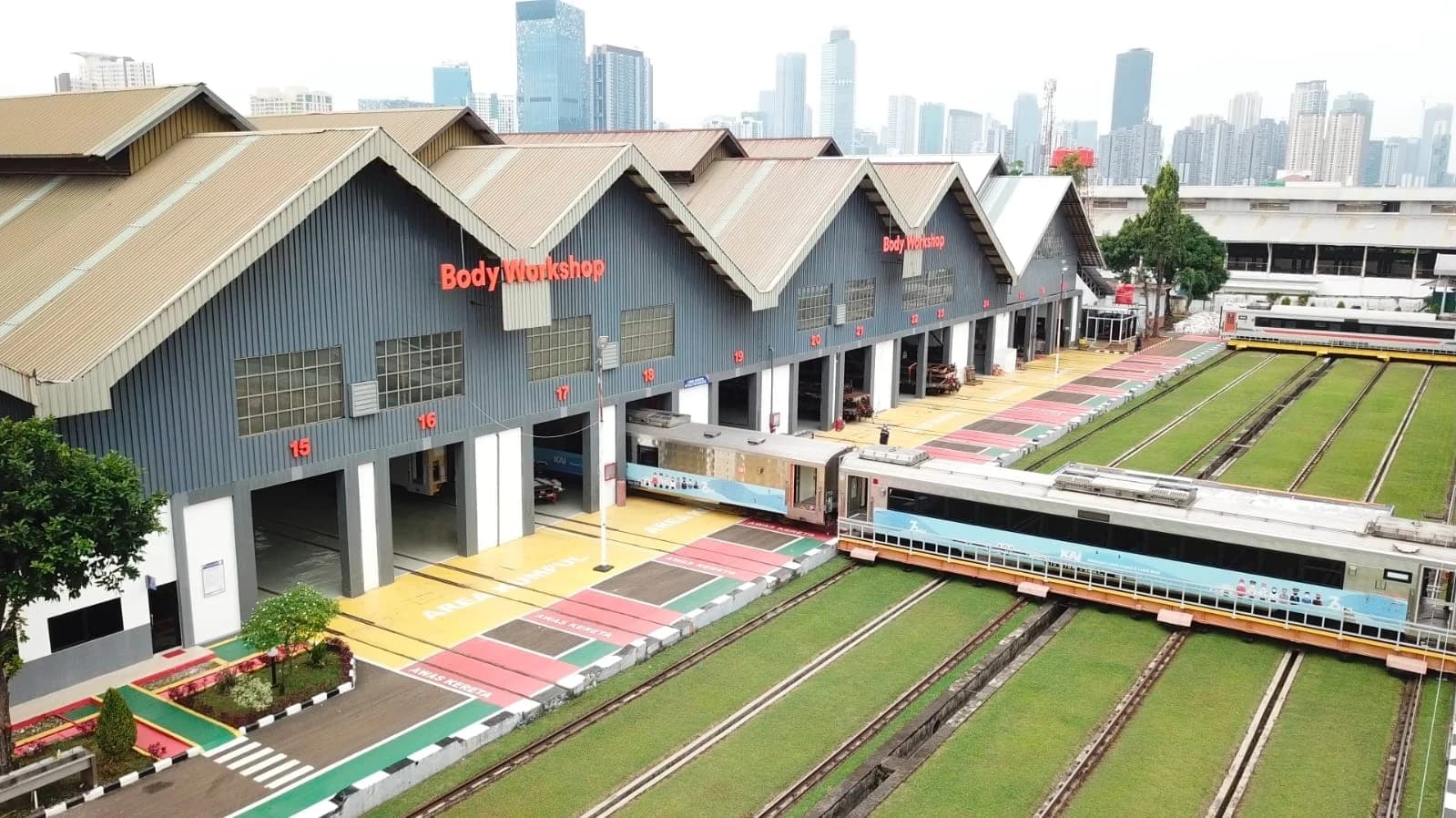
Balai Yasa Manggarai Completes Maintenance of 246 Train Cars in Semester I 2026, Here’s What Happens Behind It
Throughout Semester I 2026, UPT Balai Yasa Manggarai completed biennial and quadrennial periodic maintenance or P24/P48 on 246 train cars. This realization reached 102% of the program target of 242 train cars.
Vice President Corporate Communication of KAI, Anne Purba, explained that behind every train ready to serve customers, there is a long inspection process carried out by technicians with high precision. Every component is inspected, measured, maintained, repaired, and tested before the rolling stock is declared ready to return to service. Customers may only see a train when it is already at the platform and ready for departure, whereas at Balai Yasa Manggarai, the process of preparing the train begins from initial inspection, component dismantling, maintenance of the car body and bogie, testing of braking and electrical systems, to final inspection.
Balai Yasa Manggarai has a long history in Indonesian railways. This workshop complex began construction in 1915 and started operations in 1920 under the name Hoofd-Werkplaats Manggarai. In its early years, the workshop handled the manufacturing of spare parts as well as inspection and repair of locomotives, passenger cars, and freight wagons. Today, Balai Yasa Manggarai focuses on the maintenance and development of passenger cars, dining cars, and power generator cars or gensets.
Balai yasa has a different function from depots. Daily inspections and short-term periodic maintenance are carried out at depots, while balai yasa handles long-term periodic maintenance, repairs requiring special facilities, rehabilitation, and rolling stock modification.
In biennial or quadrennial maintenance, train cars undergo comprehensive inspections based on two-year and four-year cycles. The car body and bogie are separated so that technicians can inspect the structure, wheelsets, braking systems, suspension, electrical systems, doors, interior, and supporting travel facilities in greater depth. Anne explained that periodic maintenance functions to keep rolling stock conditions in accordance with technical standards. Components that still meet requirements are maintained and tested, while components that have reached their usage limits are repaired or replaced. After all work is completed, the train passes quality inspection before returning to operation.
In addition to train maintenance, Balai Yasa Manggarai completed maintenance in the medium overhaul and general overhaul categories or MO/GO on 26 gensets out of a program of 29 units, equivalent to 89.6%. Gensets in power generator cars function to supply electricity for air conditioning, lighting, and various service facilities during the journey. Completion of the remaining program will continue in Semester II 2026 by adjusting to the arrival of rolling stock scheduled for maintenance.
Balai Yasa Manggarai also handled 302 repair works on train cars and gensets during Semester I 2026. This number is equivalent to 127% of the achievement in the same period last year or grew by around 27%. As many as 67% of repair works were related to wheel reprofiling and replacement. Wheel reprofiling is carried out to restore the wheel surface profile according to standard measurements. In operations, continuous contact between wheels and rails can change the wheel profile. Through precise measurement and reprofiling, the wheel shape is restored according to standards so that wheel-rail interaction remains stable and supports travel comfort.
The performance of Balai Yasa Manggarai is also reflected in the completion of modifications of six Kereta Ekonomi Kerakyatan or 100% of the Semester I 2026 program. Five cars were completed to support the 2026 Eid Transportation period, while one additional car was completed in May 2026. Kereta Ekonomi Kerakyatan is the result of improving the quality of economy-class cars with more comfortable interior arrangements and seating. This train has 93 seats with a 3–2 configuration, with seats that can be adjusted to face the direction of travel. Its presence expands options for comfortable yet affordable services for the public.
In the same period, Balai Yasa Manggarai completed the installation of 650 kVA gensets on four power generator cars to support the 2026 Eid Transportation. The 500 kVA genset adjustment program has also reached 90%, while the modernization process of 30 executive-class cars continues in stages.
In terms of governance, the absorption of the Balai Yasa Manggarai work budget reached 86.6%. Three out of four 2026 investment programs are in progress with overall progress of 35.2%. These programs are aimed at increasing facility capacity, maintenance quality, and internal capability in developing rolling stock.
The historical legacy of Balai Yasa Manggarai is also preserved through the existence of a water tower that once supported the workshop’s operational needs. The Balai Yasa Manggarai Water Tower has been designated as a cultural heritage building through the Decree of the Governor of DKI Jakarta Number 403 of 2025. This designation shows that the area holds value in the journey of technology and the railway industry in Indonesia.
Anne stated that Balai Yasa Manggarai brings together more than a century of experience with continuously developing technical competence. KAI will continue to enhance facilities, the capabilities of maintenance personnel, the application of technology, and quality control so that every rolling stock returning to serve customers is in reliable, safe, and comfortable condition.