
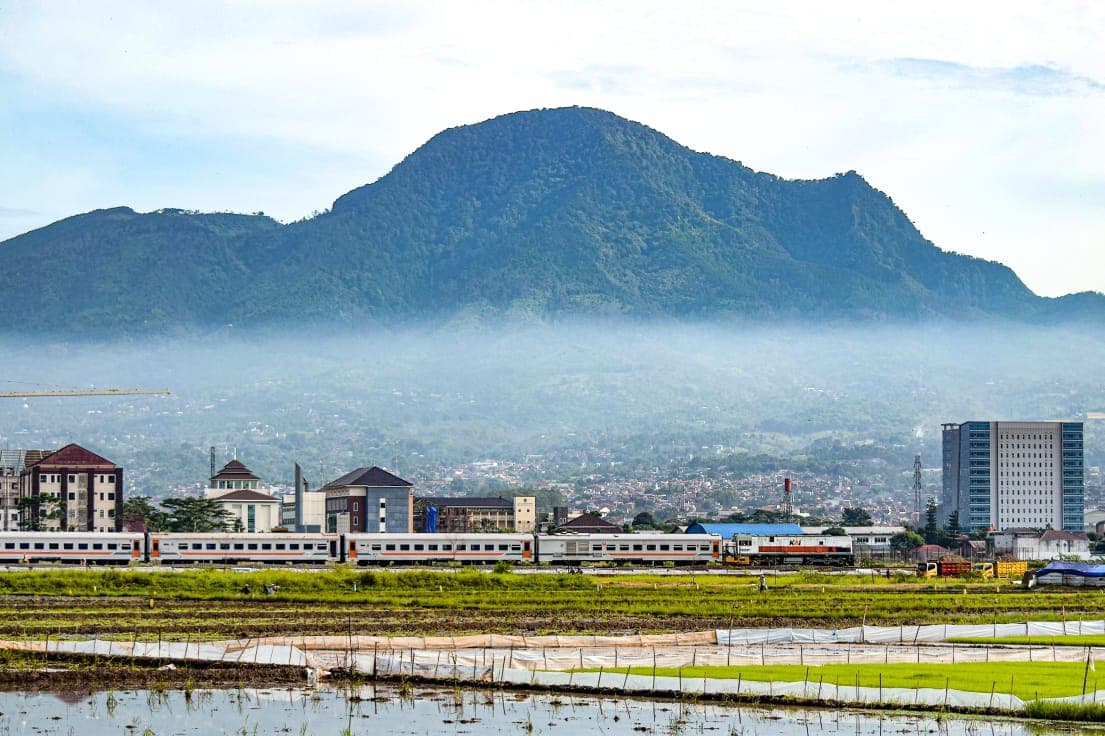
Reduce Pollution, Let’s Take the Train!
In recent times, air pollution issues have emerged in the Greater Jakarta (Jabodetabek) area. The high level of air pollution in the region has become increasingly concerning, drawing attention from many parties, especially environmental observers. Air pollution is one of the environmental issues closely linked to transportation. Many people are becoming more aware of climate change, leading to greater awareness of vehicle emissions, as exhaust gases from vehicles significantly contribute to air pollution.

Using mass transportation for daily mobility is one of the recommended solutions to reduce air pollution. Trains are one of the answers. Besides offering comfort and travel efficiency, trains are also considered a more environmentally friendly mode of transport compared to other motor vehicles.
Compared to other modes, rail transport provides significant sustainability benefits. One of them is carbon emission reduction. Trains use electricity or diesel more efficiently, producing lower greenhouse gas emissions compared to other vehicles. This helps reduce the negative impact on climate change and the environment.
Train efficiency can be seen from its large passenger capacity. For example, a long-distance train consisting of 8 to 14 cars can carry up to 1,120 passengers in one trip. Compared to private cars with a capacity of 7 people or motorcycles with 2 people, a single train trip can replace 160 cars or 560 motorcycles.
“This reduces the need for fossil fuels and helps preserve energy resources,” said Vice President of Public Relations KAI, Joni Martinus.
Based on research conducted by the UK Department for Business, Energy & Industrial Strategy through Our World in Data, CO2 equivalent emissions per passenger-kilometer for trains are 41 grams, motorcycles 103 grams, and cars 192 grams. Thus, when a train carries 1,120 passengers, total CO2 emissions are only 45,920 grams per km. This figure is far lower than motorcycles at 115,360 grams and cars at 215,040 grams for the same distance.
This data shows that trains have a smaller carbon footprint compared to motorcycles and cars. By choosing train travel, we can help reduce greenhouse gas emissions and contribute to environmental protection.
KAI also operates more environmentally friendly electric-based train services, such as Jabodetabek KRL, Yogyakarta–Solo KRL, Soekarno-Hatta Airport Rail Link, and South Sumatra LRT. For commuter travel, one KRL trainset consists of 8 to 12 cars with a maximum capacity of up to 3,000 passengers. This means a single KRL train can replace 428 private cars and 1,500 motorcycles.
“In the future, KAI will also introduce electric-powered trains for the Jabodebek LRT and the Jakarta–Bandung High-Speed Train,” added Joni.
To accommodate public demand for mass transportation and reduce emissions, KAI also increased train services following the implementation of Gapeka (Train Travel Chart) 2023 starting June 1, 2023. Passenger train trips increased by 48 services, from 605 to 653 trains. Meanwhile, freight trains increased by 6 services, from 322 to 328.
Under Gapeka 2023, KAI through its subsidiary KAI Commuter also improved commuter services. These improvements aim to encourage people to shift from private vehicles to trains. In the Merak region, for example, Commuter Line operates 14 trips with reduced travel time by 8 minutes and shorter headway by 5 minutes.
In the Bandung region, there are 58 trips consisting of Bandung Raya, Garut, Walahar, and Jatiluhur commuter lines. Travel time has been reduced by 6 minutes, from 119 to 113 minutes. Gedebage Station has also been reactivated as a passenger stop.
In the Yogyakarta region, there are 20 weekday trips and 24 weekend trips for the Yogyakarta Commuter Line, plus 8 Prameks trips. Passengers can now also board and alight at Palur Station.
In the Surabaya region, there are 60 commuter train trips serving the area. Blitar Station now functions as a transit station for Penataran and Dhoho commuter lines. Pakisaji, Purwoasri, and Ngujang stations also allow passenger boarding and alighting.
Meanwhile, the Soekarno-Hatta Airport Rail Link increased to 56 daily trips from 40 previously. Train operating speed was also increased to 75 km/h from 70 km/h.
“We hope this increase in services contributes to environmental sustainability. We also encourage the public to switch from private vehicles to mass transportation, especially trains, to reduce congestion and air pollution,” said Joni.
People are becoming more aware of the importance of choosing environmentally friendly transportation, making train travel an attractive alternative. The growing availability of rail services and increased environmental awareness have driven train usage as a primary transport option.
By taking the train, passengers can enjoy a comfortable journey while contributing positively to environmental preservation. This choice not only reduces environmental impact but also influences our overall quality of life.
“Let’s make train travel a sustainable transportation solution. Let’s participate in protecting our planet by choosing trains as a responsible mode of transport,” concluded Joni.