
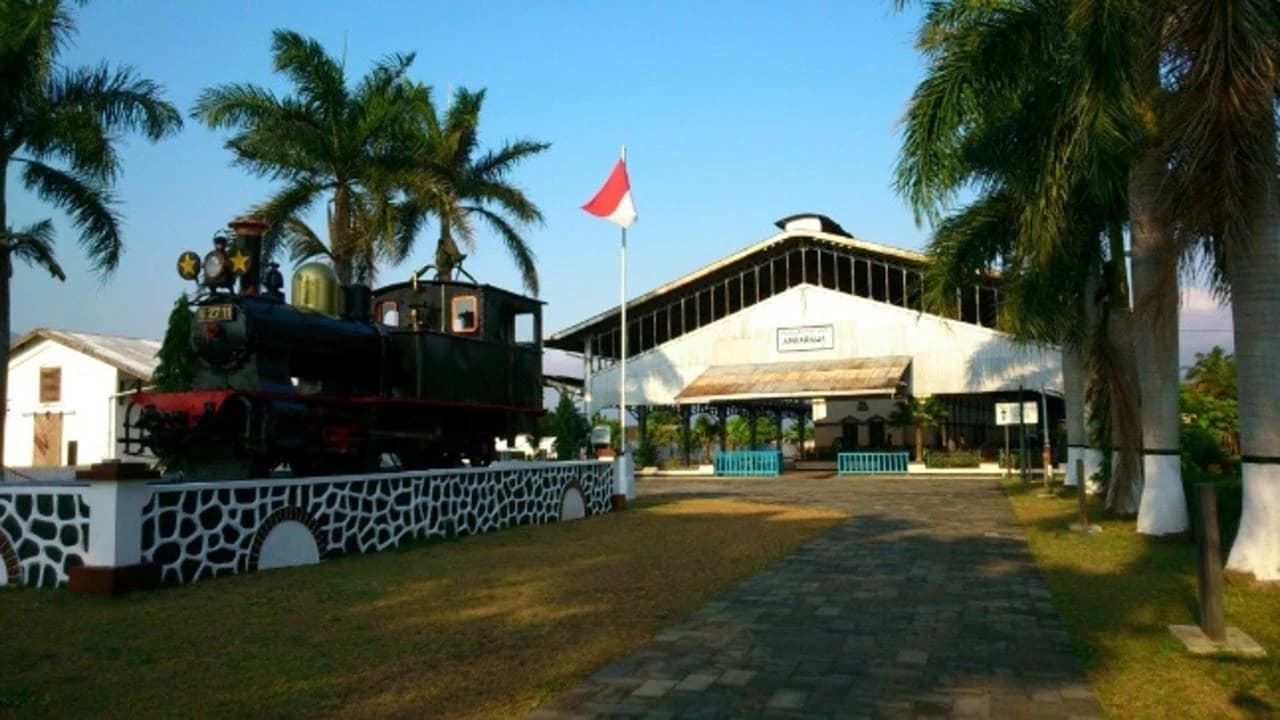
Exploring the History of Railways in the Mountains, Ambarawa Railway Museum Has Endless Stories to Tell
If you are looking for a destination for a trip that is not only enjoyable but also full of stories, the Ambarawa Railway Museum in Semarang Regency can be an option. More than just a place to see old trains, this museum preserves the long journey of Indonesian railways, complete with a historic station building, rolling stock collections, and railway technology from various periods.
The Ambarawa Railway Museum occupies the former Ambarawa Station building, which was once known as Willem I Station. The station was built by the Nederlands-Indische Spoorweg Maatschappij (NIS) and began operating on May 21, 1873, coinciding with the opening of the Kedungjati–Ambarawa railway line.
The name Willem I itself has its own story. The name refers to Fort Willem I, which is located in the Ambarawa area. At the time, Willem I Station played an important role in supporting public mobility, the distribution of goods, as well as activities in the surrounding area.
One of the historical attractions that makes the Ambarawa Railway Museum different is the existence of a cog railway line leading to Bedono. This line used rack railway technology, which enabled trains to travel through steep terrain in mountainous areas. The technology became an important part of the history of Indonesian railways because it was designed to adapt to the geographical conditions of the areas it passed through.
Over time, Ambarawa Station was transformed into a space for preserving the story of Indonesia's railway journey. On April 21, 1978, Ambarawa Station was officially inaugurated as the Ambarawa Railway Museum.
Today, visitors can see various collections that document the development of rail transportation from one period to another. From steam locomotives and railway rolling stock to various operational support equipment, these collections allow visitors to look back at the journey of Indonesian railways in the past.
Public enthusiasm for this historical tourism destination has also been quite high. Throughout 2024, the Ambarawa Railway Museum recorded 161,395 visitors. The figure increased to 180,944 visitors in 2025. Meanwhile, from January to August 2026, the number of visits reached 148,148.
When calculated from 2024 to August 2026, the total number of visits to the Ambarawa Railway Museum reached 490,487 visitors. This figure shows that history and heritage-based tourism continues to have its own appeal among the public.
For those who want to reach Semarang and its surrounding areas by train, mobility to the region is also supported by high customer activity at several stations. From January to August 2026, Semarang Tawang Station served 1,262,315 customers boarding and alighting, consisting of 628,946 customers boarding and 633,369 customers alighting.
Meanwhile, Semarang Poncol Station recorded 1,867,005 customers boarding and alighting during the same period. This figure consisted of 902,984 customers boarding and 964,021 customers alighting, demonstrating the high level of public movement in the Semarang area.
Tourism activities in Semarang Regency have also continued to show positive momentum. Based on data from the Central Statistics Agency (BPS) of Semarang Regency, a total of 4,511,945 tourist visits were recorded throughout 2025. The figure consisted of 4,506,002 domestic tourists and 5,943 international tourists.
With a combination of history, technology, and travel experiences, the Ambarawa Railway Museum can be an option for spending the weekend in a slightly different way. In addition to enjoying the heritage atmosphere, visitors can also see firsthand how railway technology has developed and adapted to Indonesia's geographical conditions for more than a century.