
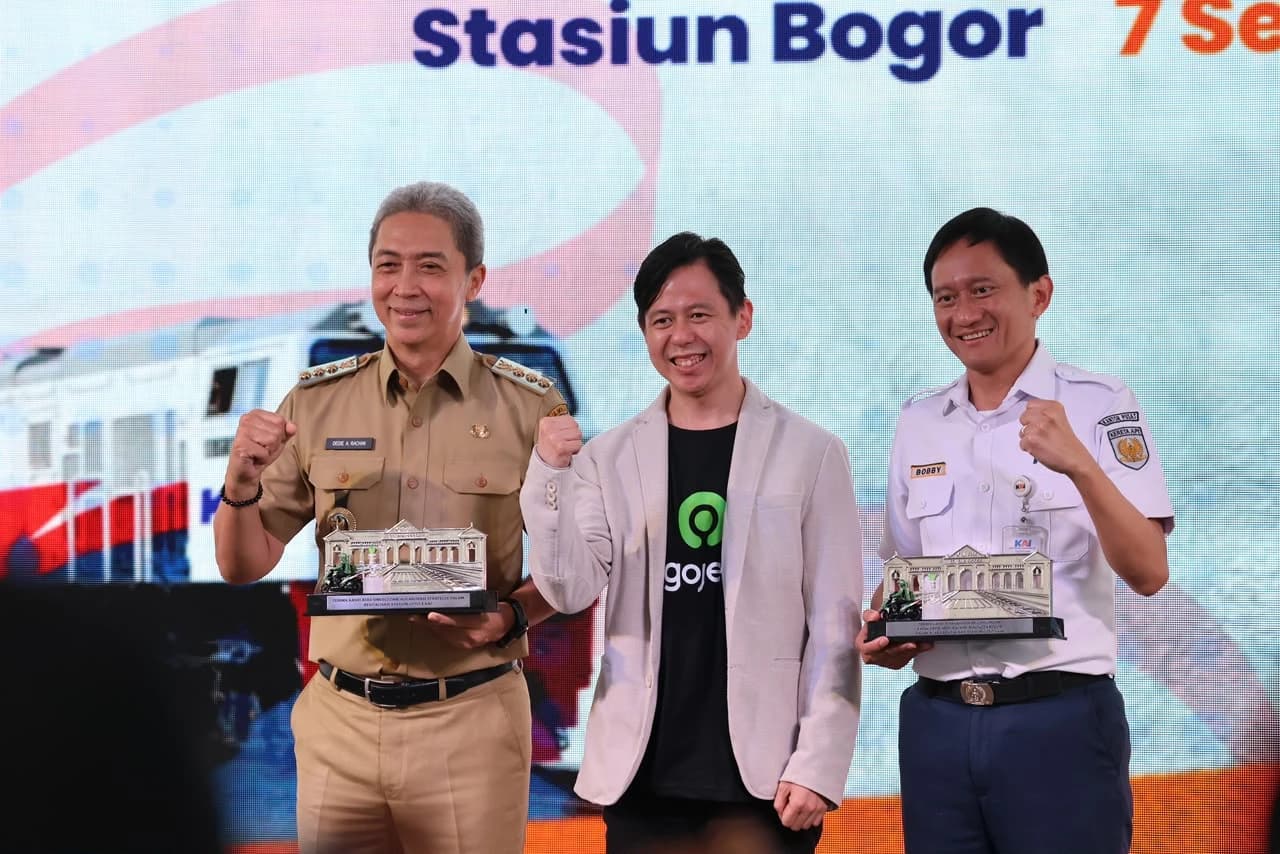
KAI, Gojek, and Bogor City Government Strengthen Transportation Integration in Bogor City
Mobility in Bogor continues to grow. To make travel easier and more connected for the public, PT Kereta Api Indonesia (Persero), Gojek and GoPay, together with the Bogor City Government, are strengthening collaboration to develop station areas and digital transportation services.
The collaboration was marked by the signing of a Joint Agreement between KAI and the Bogor City Government, as well as cooperation between KAI and Gojek and GoPay. The event took place at Bogor Station on Monday (7/9).
The scope of the cooperation is quite broad, ranging from railway development, improving transportation services, organizing stations and surrounding areas, to connecting various modes of transportation to make public travel more practical.
Four station areas are included in the development plan, namely Bogor Station, Sukaresmi Station, Ciomas Station, and Batu Tulis Station. Specifically at Bogor Station, the development also covers traffic management and the arrangement of MSMEs around the station.
Why does this area need to be developed? Travel activity in the Bogor area is indeed quite high. KAI data shows that the Bogor Line served 105,704,913 users from January to August 2026, or an average of around 435,000 users every day. Throughout 2025, the number of Bogor Line user trips even reached around 155 million.
KAI President Director Bobby Rasyidin said the development of the Bogor Station area would adopt three main concepts: connectivity, identity, and spatiality.
“Bogor and Bogor Regency have a population of around 6.9 million people, with high mobility toward Jakarta and surrounding areas. Around 130,000 people per day are served by KRL from the Bogor area,” said Bobby.
According to him, this condition makes connectivity important. Stations are not only places where people get on and off trains, but also need to be connected with onward transportation and activities in the surrounding area.
Interestingly, the development of Bogor Station will also preserve its past. As a heritage area, the station’s historical identity remains an important part of the area’s development.
“In addition to connectivity, Bogor Station has a strong historical identity as a heritage area. Its development will continue to preserve cultural and historical elements while also providing spaces that support the community’s economic activities,” said Bobby.
To make the plan happen, KAI and the Bogor City Government will take various steps, ranging from data collection, study preparation, area development, intermodal integration, to the arrangement of supporting station facilities.
In terms of facilities, Bogor Station has also undergone improvements. The development of platforms 6, 7, and 8 has increased service capacity by around 30 percent compared to before. Improvements to facilities and passenger access have also been carried out to support the safety and comfort of users.
“Stations are mobility hubs for the public. Their development needs to be carried out in an integrated manner to support customer needs and the development of the area,” said Bobby.
Bogor Mayor Dedie A. Rachim said the development of Bogor Station is an important part of the city’s development. According to him, the station area can be made more organized without losing its established historical character.
“Bogor Station has very strong historical value for Bogor City. The development of this area is an opportunity to create a more organized area while maintaining its historical character,” said Dedie.
The development will also cover various aspects closely related to people’s daily activities, such as traffic, street vendors, and public spaces around the station.
It is not only the station area that is being improved. Travel to and from the station is also being made more practical through cooperation between KAI and Gojek and GoPay.
One of the initiatives is the expansion of GoRide Instant and GoCar Instant pickup points at stations. Currently, these pickup points are available at 37 stations, including Bogor Station.
GoTo Chief of Partnership Henky Prihatna said the service is expected to make travel easier for the public, from home to the station, continuing the journey by train, and eventually reaching their final destination.
“Gojek is also part of this effort by providing GoRide and GoCar Instant pickup points at 37 stations, including Bogor Station. We hope this can make people’s journeys easier and more convenient from home to the station, continuing their journey by train, and eventually reaching their destination,” said Henky.
The cooperation also goes beyond transportation services. GoPay will be utilized as a digital payment solution within the KAI Group ecosystem. KAI and Gojek are also exploring the use of Gojek and GoPay technology for the Access by KAI app and various services under the KAI Group, including KAI Logistik and KAI Services.
The collaboration between KAI and Gojek is not new. The two have been working together since 2022 through GoTransit, which integrates GoRide and GoCar services with the KRL Commuter Line.
Through this collaboration, travel for people in Bogor is expected to become more connected. From home, to the station, onto the train, using onward transportation, and finally reaching the destination, everything is aimed at becoming easier and more integrated.
“Public transportation in the future requires comprehensive connectivity. KAI will continue to strengthen collaboration so that people’s journeys become more connected, from residential areas and stations to their final destinations,” Bobby concluded.