
KAI Strengthens Occupational Health and Safety Commitment Through Five Flagship Programs
Occupational Health and Safety (OHS/K3) is a mandatory aspect that must be implemented in company operations, especially in the transportation sector. The principles of caution and emphasis on employee safety and health serve as guidelines in every operational activity.
K3 provides protection for employees by preventing workplace accidents and work-related illnesses. Its implementation also safeguards production resources, which in turn improves company efficiency and productivity. Therefore, KAI consistently applies K3 principles as one of the key factors in its operational success.
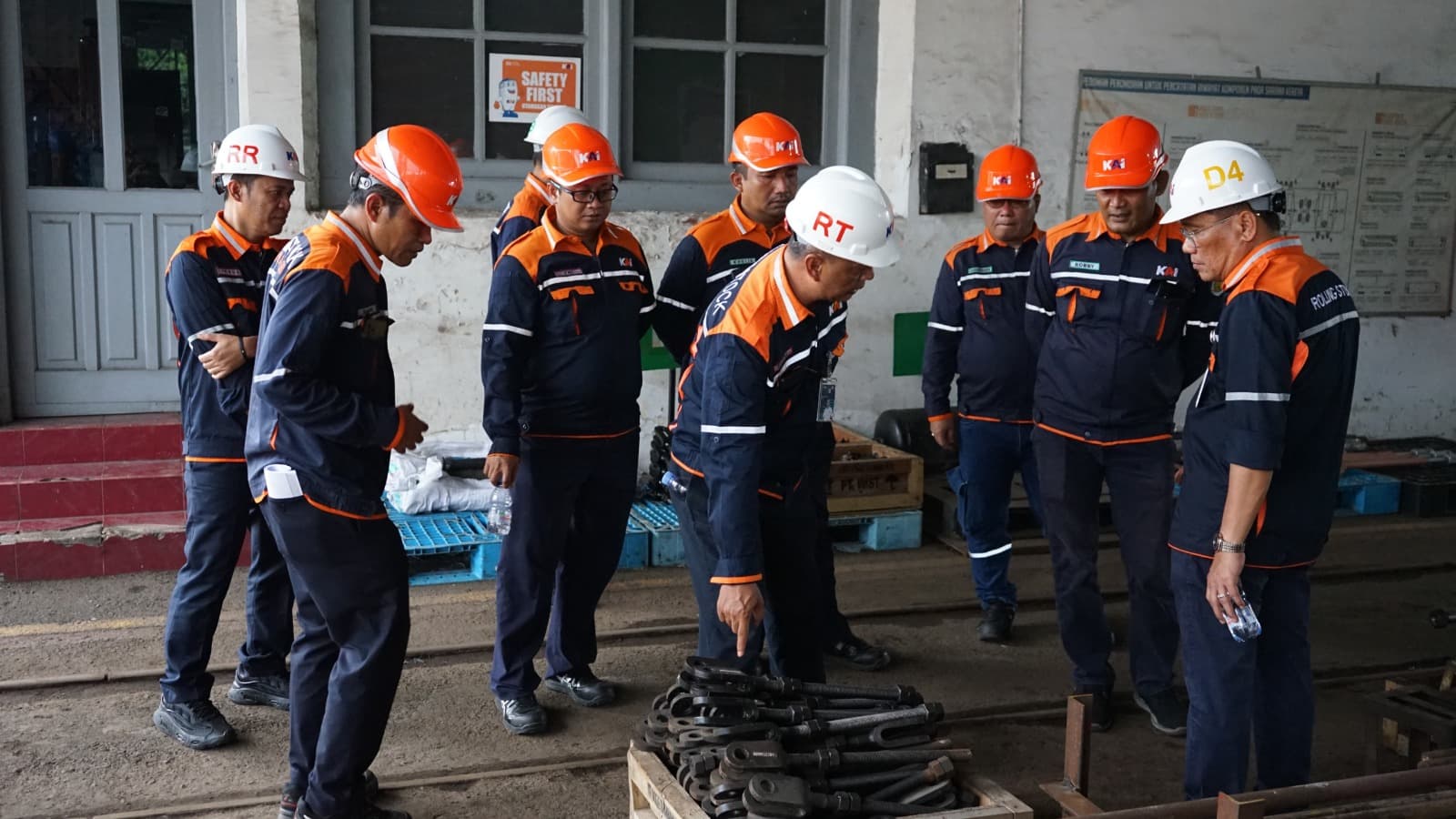
 Inspection of Railway Facilities by the Director of Strategic Planning and Rolling Stock Management Along with Management
In commemoration of the National K3 Month with the theme “Cultivating K3, Healthy and Safe at Work,” KAI emphasizes the importance of human safety as the primary focus. The theme reflects KAI’s commitment to safety in its operations. In welcoming National K3 Month, the rolling stock division conducted various activities, including safety banners and posters, recognition of employees contributing to operational safety, and an annual reward program for implementing the 5R principles (Ringkas, Rapi, Resik, Rawat, Rajin — Sort, Set in Order, Shine, Standardize, Sustain).
Various safety-related programs within KAI’s rolling stock environment include safety audits, management reviews, procurement of personal protective equipment (PPE), joint inspections, development of standard operating procedures (SOPs), and the use of the Safety Railways Information (SRI) reporting application.
KAI Vice President of Public Relations Joni Martinus stated that these programs are continuously implemented with ongoing adjustments and evaluations according to developments. The impact has been positive, particularly in improving operational safety in high-risk units such as depots and maintenance facilities.
"Because employees in the rolling stock units are valuable assets of the company in maintaining operational railway assets, we are committed to continuously managing and controlling work risks as much as possible, in collaboration with relevant directorates, particularly the Safety and Security Directorate," Joni said.
As one of Indonesia’s largest transportation companies, KAI continues to strengthen the quality and reliability of its rolling stock. To achieve this, KAI has established Five Priority Rolling Stock Management Programs that are implemented systematically and sustainably. These programs aim not only to improve reliability but also to enhance efficiency and productivity. Below is an overview of each program:
1. Improving Rolling Stock Reliability
To enhance reliability, KAI implements an integrated system of identification, monitoring, control, and regular evaluation. This is supported by aligning the vision and mission from top management to field operators. A dedicated team is formed to improve reliability through socialization and direct supervision across all units.
For failure analysis, KAI applies Fault Tree Analysis (FTA), a top-down method to identify contributing risks to failures. Through FTA, KAI identifies dominant disruptions, determines root causes, and improves overall reliability.
This approach has helped KAI optimize spare parts needs, improve maintenance planning, and increase operational reliability, especially in high-risk units.
2. Inventory Control and Efficient Material Procurement
KAI identifies procurement needs through analysis, classification, and continuous inspection. Procurement planning uses Analytical ATPS and Lead Time Delivery approaches to ensure materials are delivered according to operational needs.
Inventory control ensures materials are used efficiently and effectively. Monitoring teams oversee spare parts utilization and quality. Standardization and controlled stock levels further support smooth operations.
3. Implementation of Maintenance Digitalization Systems
KAI optimizes digital maintenance systems by integrating existing applications within rolling stock units. A digitalization roadmap is developed to ensure data integration and centralized monitoring.
System integration is carried out using SAP as the primary data source, with coordination from the central IT team to ensure seamless integration across platforms.
4. Improving Human Resource Competency
KAI fosters a culture of knowledge sharing, discussion, and continuous learning. This includes pre-work discussions, proactive knowledge exchange supported by reward and accountability systems, and leadership involvement as role models.
Programs include certification, periodic competency assessments, information-sharing platforms, coaching and counseling, and benchmarking activities. These initiatives improve communication, accelerate problem-solving, and enhance operational efficiency.
5. Occupational Health and Safety (K3)
KAI promotes a healthy, clean, safe, comfortable, and disciplined work environment. Routine health and environmental improvement activities are part of this initiative. The 5R program is also implemented across all rolling stock units, including offices, workshops, and operational areas.
Employee involvement has increased awareness of K3 implementation, reflected in PPE compliance, regular environmental reporting, SMKP audits, and continuous application of 5R principles.
Through the implementation of these Five Priority Rolling Stock Management Programs, KAI reinforces its commitment not only to managing railway assets but also to ensuring reliability, safety, and security in delivering trusted transportation services in Indonesia.
"Rolling stock reliability is the main foundation in providing efficient and safe railway transportation services. Through routine maintenance, modern technology, and compliance with standards, KAI continuously improves service quality. In this way, the public can benefit from a reliable transportation system that contributes positively to mobility and connectivity in Indonesia," Joni concluded.