
Remembering the Historical Footprints of Railways at the Railway Museum
Do you often use trains or are you experiencing train travel for the first time? Traveling by train is always a pleasant experience. Besides its comfort, it is also a good idea to learn about the history of railways in Indonesia.
“In various cities in Indonesia, there are museums that reveal the origins and development of railways. These museums are the right place to learn more about railway historical heritage, various unique collections, and other interesting information,” said Vice President Public Relations KAI, Joni Martinus.
Visiting museums is surely an interesting experience, especially during holidays. Curious about visiting railway museums managed directly by KAI? Here are several railway museums you can visit to end your school holiday season.
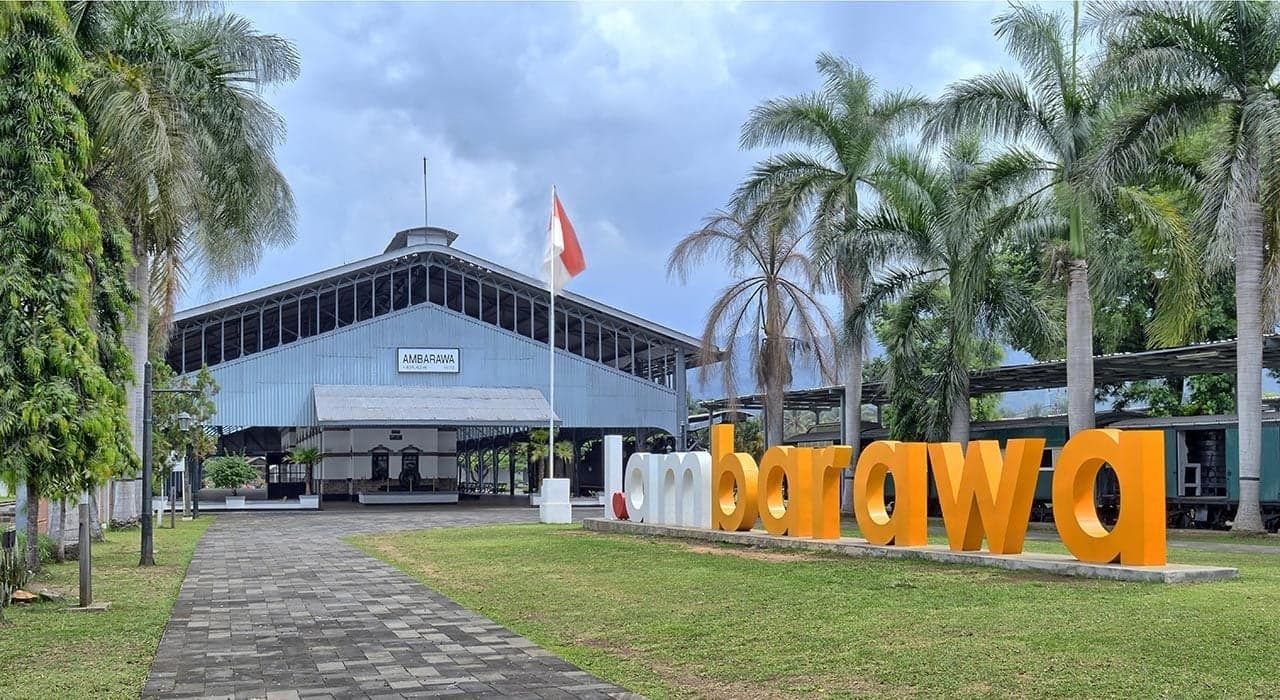
Ambarawa Museum
The Ambarawa Museum was originally a station called Willem I Station. The name Willem I is related to the station’s location, which is not far from Fort Willem I. This station was built by the Nederlandsch Indische Spoorweg Maatschappij (NISM) and inaugurated on 21 May 1873, along with the opening of the Kedungjati–Ambarawa line. In the early 1900s, the station building was renovated into its current form.
At the beginning of its operation, Willem I Station was used for transporting export commodities and military transportation in Central Java. After being deactivated in 1976, Ambarawa Station was designated as a railway museum by the Governor of Central Java at that time, Supardjo Rustam, in collaboration with Ir. Soeharso, Head of Central Exploitation of the Railway Company (now KAI). Ambarawa Station was chosen because it has strong historical background in Indonesia’s independence struggle, preserves old technology that can still operate well, and has a large area.
Today, the Ambarawa Museum displays railway collections from the Dutch East Indies era to pre-independence Indonesia, including rolling stock, infrastructure, and administrative equipment. Some heritage railway collections include 26 steam locomotives, 4 diesel locomotives, 5 passenger coaches, and 6 freight wagons from various regions.
You can also enjoy a heritage train ride on the Ambarawa–Tuntang (round trip) route using steam or vintage diesel locomotives. There is also the Ambarawa–Jambu–Bedono tourist train route (round trip) using a rack steam locomotive to pass through toothed rails. This rack railway is the only one still active in Indonesia.
In addition to being a historical tourist destination, the museum can also be rented for exhibitions, meetings, photography, filming, weddings, festivals, bazaars, performing arts, workshops, and more.
Sawahlunto Railway Museum
The Sawahlunto Railway Museum is located in Sawahlunto City, West Sumatra. This museum showcases the history and railway heritage related to coal mining in the region.
The main reason for the initial construction of railways in West Sumatra was to transport coal from Ombilin, Sawahlunto. Previously, in 1867, research was conducted by geologist W.H. de Greeve, and a year later coal deposits were discovered in Ombilin.
The museum’s history began with the construction of railway lines by the state railway company Staatsspoorwegen (SSS). The construction started from Teluk Bayur–Padang Panjang–Bukit Tinggi and Padang Panjang–Sawahlunto. By 1892, the railway line reached Muara Kalaban.
To reach the Sawahlunto coal mining area, railway construction continued from Muara Kalaban Halt, turning north through a tunnel and a bridge crossing the Lunto River for 30 meters. On 1 January 1894, the line was officially opened along with the inauguration of Sawahlunto Station.
Coal production in Sawahlunto showed strong results after the Teluk Bayur–Sawahlunto line was completed. However, by the end of 2000, coal production declined, which also affected railway operations in West Sumatra.
As an effort to preserve Sawahlunto Station, KAI and the Sawahlunto City Government converted it into a museum. The Sawahlunto Museum was inaugurated on 17 December 2005 by Vice President Jusuf Kalla. One of its famous collections is the E1060 rack steam locomotive, known as “Mak Itam.” You can also experience riding the Mak Itam tourist train.
The museum can also be rented for exhibitions, meetings, photography, filming, weddings, festivals, bazaars, performing arts, workshops, and more. Visiting this museum allows you to understand the railway history of Sawahlunto and appreciate the cultural and technological heritage of the coal mining industry.
Bondowoso Railway Museum
The Bondowoso Railway Museum is the first railway museum in East Java. Originally, this museum was Bondowoso Station. The station was built in 1893 and inaugurated on 1 October 1897 by Staatsspoorwegen (SS) along with the opening of the Jember–Kalisat–Bondowoso–Panarukan railway line. This line was a continuation of the Bangil–Pasuruan–Probolinggo route, which began operation in 1884.
The Panarukan–Bondowoso–Kalisat–Jember railway line was initially used to transport key commodities such as tobacco, coffee, rice, and plantation products like tea from Jember, Banyuwangi, Bondowoso, and Situbondo to the port in Panarukan.
During the independence war, Bondowoso Station witnessed the tragic “Death Train Incident.” A group of 100 Indonesian fighters was transported from Bondowoso to Surabaya by train. Unfortunately, 46 fighters died during the journey. This incident gained international attention and damaged the Dutch image globally.
Bondowoso Station once served local trains between Jember and Panarukan. However, in 2004 the station and Panarukan line were deactivated.
As an effort to preserve and honor the heroic values of the “Death Train Incident” and the struggle for independence, Bondowoso Station was transformed into a museum. It was inaugurated on 17 August 2016, coinciding with Indonesia’s 71st Independence Day, by the Regent of Bondowoso, Drs. H. Amin Said Husni.
Visitors can see restored locomotives and old passenger wagons and learn more about railway history in eastern Java through artifacts and exhibitions.
Lawang Sewu
The name Lawang Sewu is already familiar. This historic building often appears in television programs. Lawang Sewu is a heritage building owned by KAI, originally used as the headquarters of the private railway company Nederlandsch Indische Spoorweg Maatschappij (NISM). Construction began on 27 February 1904 and was completed in July 1907. Additional buildings were constructed between 1916 and 1918.
The building was designed by famous architects from Delft, Netherlands, Prof. Jakob F. Klinkhamer and B.J. Ouendag. They designed Lawang Sewu and supervised construction from the Netherlands, sending drawings and reports.
The NISM headquarters was one of the first modern offices built in Indonesia. Its gallery design suited tropical climates. The building features distinctive architecture, including stained glass by artist J.L. Schouten from ‘t Prinsenhof studio in Delft. One of the stained glass ornaments depicts a flying wheel symbolizing railway glory at that time.
The name Lawang Sewu comes from Javanese, meaning “Thousand Doors,” referring to its many doors, although the actual number is not a thousand.
Today, Lawang Sewu functions as a museum showcasing various collections of Indonesian railway history, including Alkmaar collections, Edmonson machines, counting machines, typewriters, steam locomotive replicas, securities, and more. It also presents restoration documentation in the form of photos, videos, and materials. Near the exit, there is a library containing railway books.
Besides being a historical tourist site, Lawang Sewu can also be rented for exhibitions, meetings, photography, filming, weddings, festivals, bazaars, performing arts, workshops, and more.
Those are at least four museums managed by KAI. Interesting, right? Visiting these museums is an ideal way to better understand the history of Indonesian railways. Vice President Public Relations KAI Joni Martinus said that KAI museums provide visitors with the opportunity to experience nostalgia and understand the importance of railways in Indonesia’s history and development. Through unique collections and presented knowledge, these museums are an ideal place to remember the past, appreciate technology, and learn the impact of railways on our country.
“If people are interested in trains and want to learn more about railway history in Indonesia, visit these museums. Visitors will also experience how railways have played an important role in Indonesia’s historical journey and mobility,” concluded Joni.