
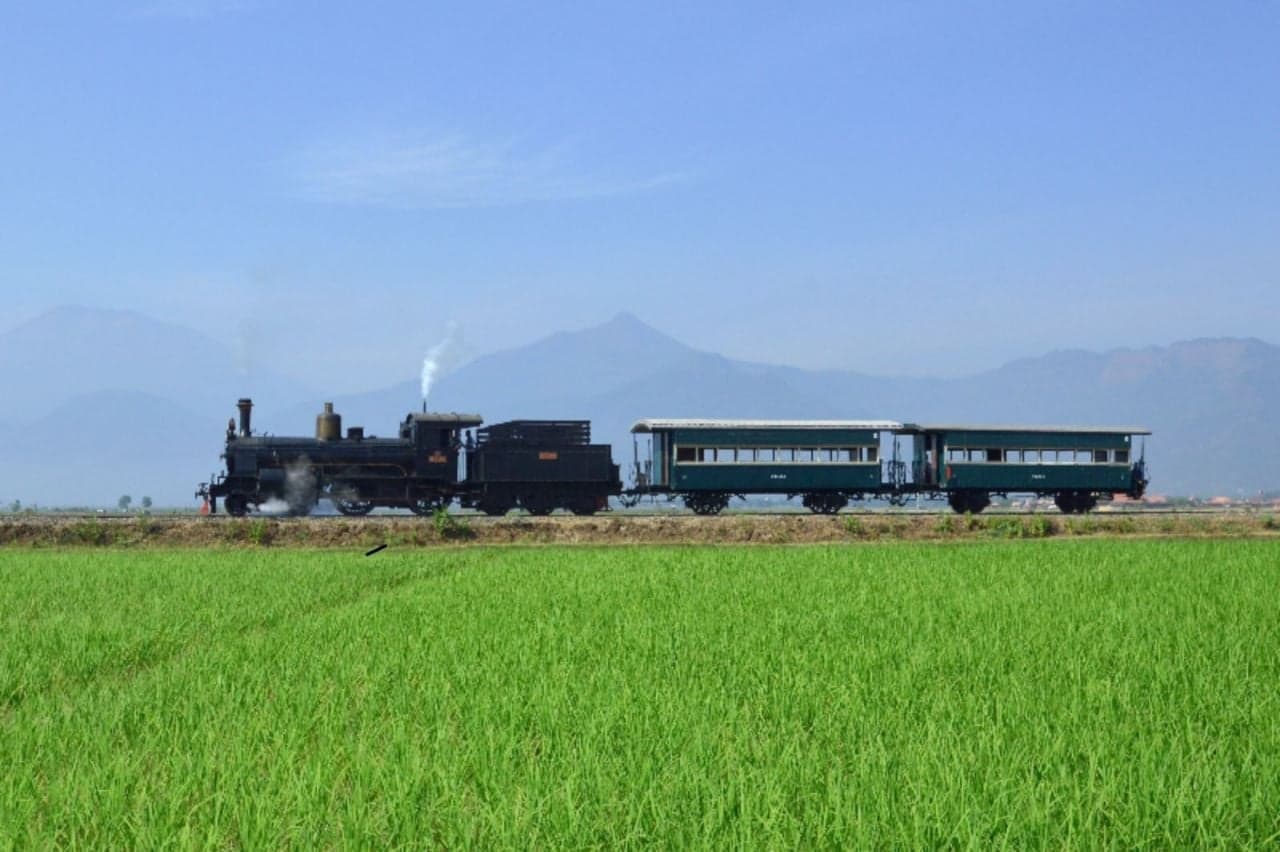
Steam Locomotives, Silent Witnesses in the History of Rail Travel
Behind the progress of technology and railway modernization, there is a valuable heritage that continues to live in the history of KAI. Steam locomotives are silent witnesses of the past and have become an iconic symbol in the railway industry.
Although their age has passed decades and even more than a century, their presence continues to captivate the public. Before the use of diesel and electric locomotives as we know today, steam locomotives were once the main vehicles for pulling train sets.
KAI has a long history in the use and preservation of steam locomotives to this day. Beyond being part of railway history, their iconic appearance also provides a unique attraction. If you are curious, here are some steam locomotives preserved by KAI that are still operational.
B25 Locomotive
The B25 locomotive, manufactured by Esslingen (Germany), began operation in 1902, meaning it is already over 100 years old. Meanwhile, the two wooden passenger coaches that accompany it on tourist train operations were built in 1907.
The railway company Nederlandsch Indische Spoorweg Maatschappij (NISM) purchased this locomotive for military transport and for operating on rack railway lines on the Ambarawa–Secang route. The Ambarawa–Secang railway line (including the Jambu–Bedono–Gemawang rack railway section of nearly 6.5 km) officially began operation on 1 February 1905.
This locomotive is unique because it is equipped with a gear wheel system. The gear engages with the rack rail beneath it. This gear is located between the normal wheels and plays a vital role. It allows steep gradients of up to 65‰ to be climbed at around 10 km/h, while on flat terrain it can reach 40 km/h. During descents, the gear system helps control speed.
The B25 steam locomotive weighs 31 tons with a boiler pressure of 12.25 atm. It has 360 horsepower, a water capacity of 2 m³, and a wood fuel capacity of 1.5 tons.
Currently, only three units of the B25 series remain. Two of them, B25 02 and B25 03, are still operational for tourist trains on the Ambarawa–Bedono route, while B25 01 is displayed as a monument at Palagan Ambarawa Monument.
B51 Locomotive
In addition to B25 locomotives, Ambarawa also has the B51 12 locomotive, which is still operational. The Staatsspoorwegen (SS) railway company purchased 44 units of the B51 locomotive from three manufacturers: Hanomag (Germany), Hartmann (Germany), and Werkspoor (Netherlands), delivered between 1900 and 1910.
The B51 locomotive was once used for local passenger services on routes such as Tanah Abang–Rangkasbitung–Merak, Kertosono–Madiun–Blitar, and Babat–Jombang. To meet transportation needs in South Sumatra, five units were transferred from Java.
During the Japanese occupation, one B51 unit was moved to Sumatra to operate the Muaro (West Sumatra)–Pekanbaru (Riau) line.
The B51 used teak wood as fuel and was designed for flat terrain operations. It had 450 horsepower and a service speed of 80 km/h. It weighed 31.2 tons with a tender weight of 20.6 tons.
Although it had been inactive for more than 30 years, locomotive B51 12 was restored between 2011 and 2014 to operate again as part of tourist trains in Ambarawa.
C12 Locomotive
Produced between 1892–1902 by Hartmann (Germany), this locomotive was used for shunting and short-distance passenger or freight services on flat routes in Java.
The C12 locomotive weighs 31.3 tons, is 8.575 meters long, and has a service speed of 45 km/h with 360 horsepower. It has a boiler pressure of 10 atm and a pulling force of 4,500 kg.
Out of 43 units produced, only three remain: C12 06 (displayed at the Transportation Museum, TMII Jakarta), C12 40 (displayed at the Indonesian Railway Museum Ambarawa), and C12 18.
C12 18 was restored in the early 2000s and returned to operation in 2006. In 2009, it was moved to Solo to operate the Jaladara Tourist Train route.
D14 Locomotive
The D14 steam locomotive series was introduced by Staatsspoorwegen from two manufacturers: Hanomag (Germany) and Werkspoor (Netherlands), built in 1921–1922.
This compact locomotive was suitable for local and mountainous routes such as Bogor–Sukabumi–Cianjur–Bandung, many of which are now closed.
The locomotive weighs 68.66 tons with a boiler pressure of 12 atm and a speed of about 45 km/h. It can carry 9 m³ of water and 3 tons of coal.
From 23 units in Indonesia, only one remains operational: D14 10, which is now used for the Jaladara Tourist Train in Solo, restored and reactivated in 2020.
E10 Locomotive
In 1894, the Dutch colonial railway company completed a 155.5 km line in West Sumatra connecting Emmahaven (Teluk Bayur)–Padang–Padang Panjang–Muaro Kalaban–Sawahlunto. Due to steep terrain, rack railway systems were used in certain sections.
The E10 locomotive was designed with a rack-and-pinion system to handle steep gradients. A total of 22 units were imported between 1921 and 1928 from Esslingen (Germany) and SLM (Switzerland). After Indonesia’s independence, 17 additional units were added in the 1960s.
The E10 60 locomotive, known as “Mak Itam,” weighs 56.4 tons with a boiler pressure of 14 atm and a service speed of 50 km/h.
Today, only two units remain: E10 60 “Mak Itam” in Sawahlunto and E10 16 at the Transportation Museum TMII. Mak Itam resumed tourist operations in 2022 on the Sawahlunto–Muaro Kalaban route.
Steam locomotives are living evidence of Indonesia’s railway history. Through them, we can see how important rail transport has been in national development.
“A steam locomotive is not just a machine, but a reflection of the spirit and progress of the nation,” said Vice President Public Relations KAI Joni Martinus. “We hope this heritage continues to be preserved and enjoyed by future generations.”