
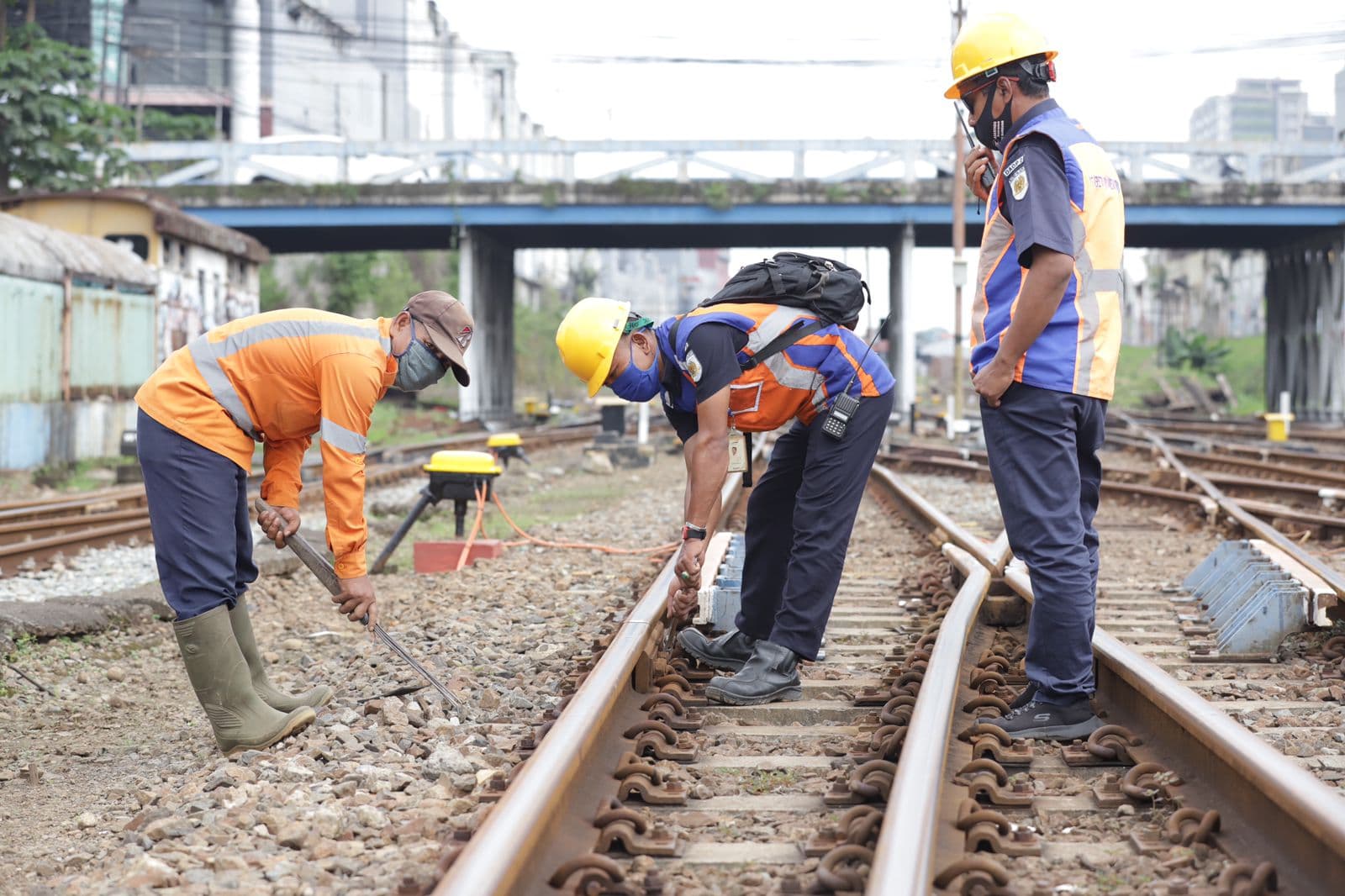
KAI Consistently Implements Occupational Safety and Health (OHS) to Protect Employees
Occupational Safety and Health (OHS) is one of the essential aspects that must be implemented in the operations of every organization or company, particularly those operating in the transportation sector. All operational activities must always adhere to the principles of prudence and emphasize the importance of employee safety and health.
Proper implementation of OHS provides protection for employees by preventing workplace accidents and occupational illnesses. In addition, effective OHS practices also protect production resources, thereby improving organizational efficiency and productivity. As a company engaged in transportation services, PT Kereta Api Indonesia (Persero) consistently applies OHS principles in conducting its business. Railway operations are fundamentally centered on safety. For KAI, safety is non-negotiable in every aspect of its business processes.

OHS Implementation Across Railway Operations
KAI Vice President of Public Relations, Joni Martinus, stated that every KAI employee is required to complete their work properly while maintaining health and safety in accordance with the Company's Standard Operating Procedures (SOPs). During the COVID-19 pandemic, the company also ensured the strict implementation of health protocols for its employees and provided healthcare facilities through its clinics.
"KAI operates 54 healthcare clinics known as Mediska Clinics, located throughout its operational areas. Mediska Clinics provide healthcare services that meet the standards of primary outpatient clinics, including general medical examinations, dental care, specialist consultations, maternal and child healthcare, family planning services, health consultations, pharmaceutical services, and chronic disease management (Prolanis). To monitor employee health, KAI also conducts annual Medical Check-Ups (MCU)," he said.
Mediska Clinics are staffed by qualified and professional healthcare personnel, including general practitioners, dentists, specialists, midwives, nurses, pharmacists, pharmacy assistants, and occupational health experts, all supported by modern facilities and technology.
Beyond healthcare services, since 2020 KAI has also implemented the Railway Safety Management System (SMKP), which refers to Government Regulation No. 50 of 2012 concerning Occupational Safety and Health Management Systems and Minister of Transportation Regulation No. PM 69 of 2018 concerning Railway Safety Management Systems.
The SMKP is mandatory and continuously implemented across every organizational unit at both headquarters and regional offices. Its scope covers railway safety as well as occupational safety and health throughout all KAI business operations. To evaluate SMKP implementation, KAI's Directorate of Safety and Security conducts internal audits, while external audits are carried out by the Directorate General of Railways. KAI has also obtained Occupational Safety and Health Management System certification in accordance with Government Regulation No. 50 of 2012.
Many factors can influence workplace safety and must be monitored to mitigate risks. These include technical factors, organizational factors, and human factors. Workplace accidents often result from a combination of these elements.
Technical factors include the reliability of work equipment and the adequacy of safety devices. Organizational factors include insufficient work procedures or instructions, as well as limited budget allocation for safety. Human factors may arise from fatigue, employees' psychological conditions, physical limitations, or competency levels.
"These factors can be identified through Hazard Identification, Risk Assessment and Risk Control (HIRARC), Job Safety Analysis (JSA), and Health Risk Assessment (HRA), where every work activity is evaluated for potential hazards. Identified hazards are assessed, and appropriate risk controls are established based on the hierarchy of safety risk controls, including elimination, substitution, engineering controls, administrative controls, and personal protective equipment," explained Joni.
To continuously improve OHS performance, KAI regularly provides internal training for its employees. Safety is a mandatory subject in every training session. Additional education and training programs include Accident Review & Safety Awareness, RAMS (Reliability, Availability, Maintainability, and Safety), Safety Champion, Basic Safety Training, and others. Throughout 2022, KAI conducted 53 safety training programs for its employees.
In addition, KAI continuously certifies employees in various OHS competencies in accordance with applicable regulations, including General OHS Experts, Workplace Environmental OHS Experts, Electrical OHS Experts, Electrical OHS Technicians, OHS Officers, and others. Besides training, KAI also regularly conducts occupational safety and health awareness campaigns. In 2022, 59 awareness sessions were held through monthly Safety Series webinars, digital campaigns via email, and the "Safety Talk" program, where technical unit leaders directly deliver OHS-related materials to their teams every month.
KAI also operates the Safety Railway Information (SRI) application. Through this application, employees can report potential hazards related to railway operational safety, occupational safety and health, and environmental safety, including unsafe actions and unsafe conditions that may endanger train operations. The application also provides employees with safety information and weather forecasts across the company's operational areas.
"All reports of potential hazards submitted by employees are forwarded by KAI's Directorate of Safety and Security to the relevant units for monitoring, corrective action, and the prevention of workplace accidents and occupational illnesses," said Joni.
Occupational Safety and Health is a mandatory requirement in every workplace. Every organization and company should recognize that it is a fundamental element for ensuring employee comfort and productivity. Maintaining employee safety and health ultimately benefits not only the workforce but also the company itself.
"By prioritizing safety and health at work, we hope customer service will continue to improve. Customer satisfaction remains a top priority for KAI and serves as a driving force for all KAI employees to deliver the best possible service," concluded Joni.