
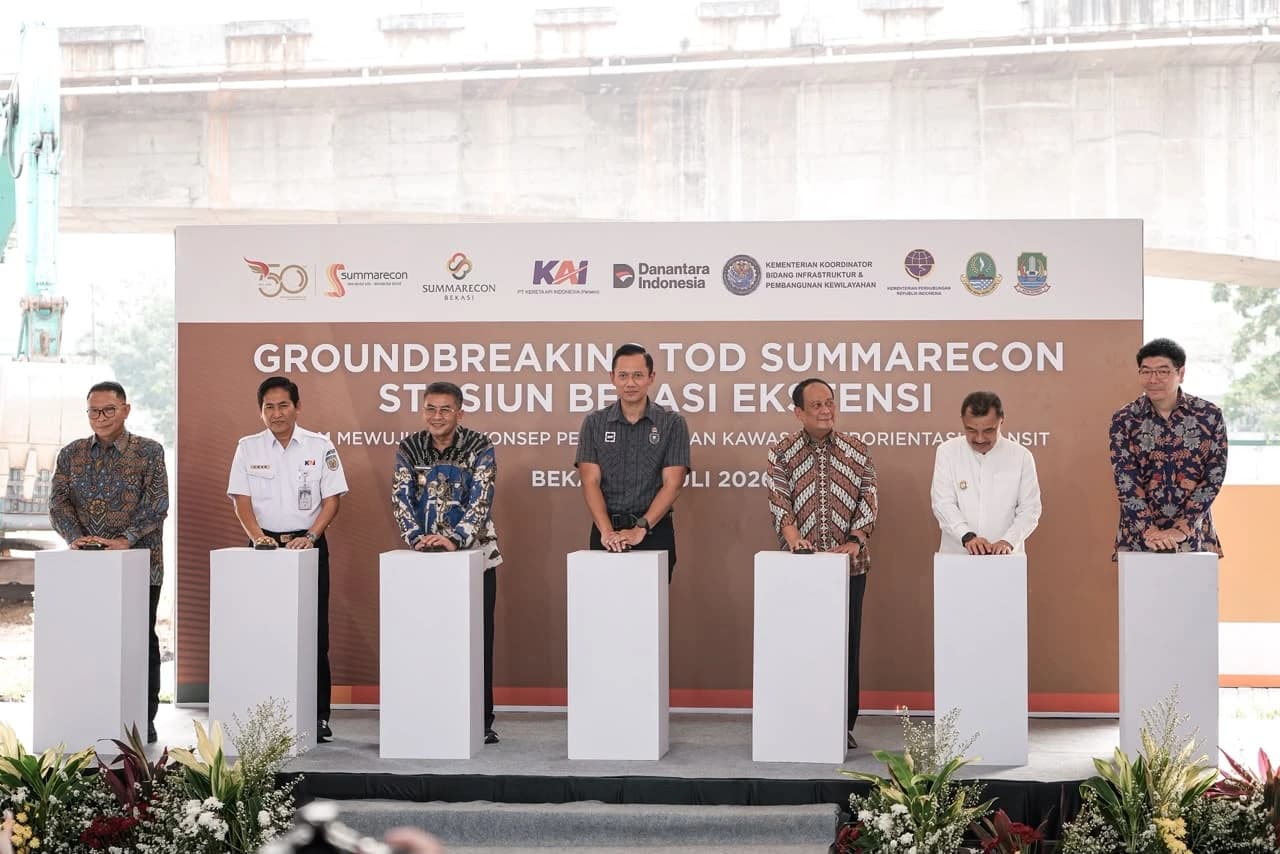
Groundbreaking Begins! Bekasi Station Extension Ready to Serve 12.85 Million Passenger Movements
The construction of Bekasi Station Extension in the Summarecon Bekasi area has officially begun as part of the development of a Transit Oriented Development (TOD)-based area.
The development is expected to expand public access to Bekasi Station, which currently serves long-distance and local train travel managed by KAI, as well as the Jabodetabek Commuter Line managed by KAI Commuter.
Coordinating Minister for Infrastructure and Regional Development Agus Harimurti Yudhoyono carried out the groundbreaking of the Bekasi Station Extension in the Summarecon Bekasi area, West Java, Friday (24/7/2026). AHY stated that urban area development needs to be oriented towards an interconnected transit system, considering that integration between public transportation, residential areas, economic activity centres, and public spaces is needed to respond to the increasing mobility of urban communities. According to him, advanced and modern cities in the world—meaning cities that are productive and healthy—are all oriented towards interconnected transit systems.
Deputy Minister of Transportation Suntana stated that the construction of the Bekasi Station Extension is a strategic step in developing the railway network and TOD-based areas. The development is expected to increase service capacity, strengthen intermodal integration, and provide more travel options for the people of Bekasi.
Vice President of Corporate Communication KAI, Anne Purba, explained that the development of the Bekasi Station Extension is significant because Bekasi Station brings together two mobility characteristics in one area, namely intercity travel using long-distance and local trains and routine community travel using the Jabodetabek Commuter Line. Bekasi Station serves a wide variety of travel needs, ranging from passengers heading to workplaces, schools, economic activity centres, visiting family, to continuing intercity journeys, so improving station access is expected to make these journeys easier and more connected.
The major role of Bekasi Station can be seen from KAI Group’s passenger activity. Throughout the first semester of 2026, the station served 12,852,606 passenger movements from long-distance and local train services as well as the Jabodetabek Commuter Line. This number increased by 8.23% compared to the first semester of 2025, which recorded 11,875,529 passenger movements. Thus, there was an additional 977,077 passenger movements in one year.
In long-distance and local train services managed by KAI, Bekasi Station served 1,426,728 passenger activities during the first semester of 2026, consisting of 724,122 boarding passengers and 702,606 alighting passengers. This figure increased by 11.15% compared to the first semester of 2025 with 1,283,590 passenger activities, consisting of 650,629 boarding passengers and 632,961 alighting passengers. In detail, the number of long-distance and local train passengers boarding from Bekasi Station increased by 73,493 passengers or 11.30%. Meanwhile, the number of passengers alighting increased by 69,645 passengers or 11.00%.
A similar development occurred in Commuter Line services. During the first semester of 2026, Bekasi Station served 11,425,878 Commuter Line passenger activities, consisting of 5,812,326 gate-in and 5,613,552 gate-out. This number increased by 7.87% compared to the first semester of 2025 with 10,591,939 activities, consisting of 5,445,065 gate-in and 5,146,874 gate-out. There was an additional 833,939 Commuter Line passenger activities compared to the same period in the previous year.
Anne stated that the growth in both services shows that Bekasi Station has an important function in the KAI Group transportation ecosystem. This station serves as a departure and arrival point for intercity travel, while also supporting the daily mobility of people in the Jabodetabek area.
The use of the Commuter Line from Bekasi Station has also shown an increase in recent years. The number of passengers performing gate-in was recorded at 7,076,475 in 2022, then increased to 9,426,792 in 2023. In 2024, the number of gate-in passengers rose again to 10,847,952, and then reached 11,413,926 in 2025.
Gate-in growth was recorded at 33.21% in 2023, then 15.08% in 2024, and 5.22% in 2025. Within three years, the number of passengers entering through Bekasi Station increased by around 4.34 million passengers or 61.30% compared to 2022. Meanwhile, long-distance and local train services at Bekasi Station throughout 2025 served 2,615,271 passenger activities, consisting of 1,329,456 boarding passengers and 1,285,815 alighting passengers.
According to Anne, this development shows the community’s need for stations that are more accessible, have adequate service capacity, and are connected to various modes of transportation and surrounding activity centres. The presence of the Bekasi Station Extension is expected to help distribute passenger flow based on arrival directions. People from North Bekasi and the Summarecon Bekasi area can gain closer access to train services through the extension building connected to the existing Bekasi Station.
This access development can also reduce people’s dependence on private vehicles, support walking and feeder transport journeys, and help reduce traffic congestion around the station. For the public, better connectivity will expand access to workplaces, schools, healthcare facilities, commercial centres, and residential areas. For surrounding areas, increased passenger activity can create opportunities for local businesses and MSMEs and encourage economic activity that follows community movement.
Anne concluded by stating that KAI Group will continue to coordinate with the government, regulators, and development partners so that the development of areas around stations aligns with passenger needs, travel safety, and intermodal integration. Stations are expected to become closer to people’s lives and provide benefits to the areas they serve.