
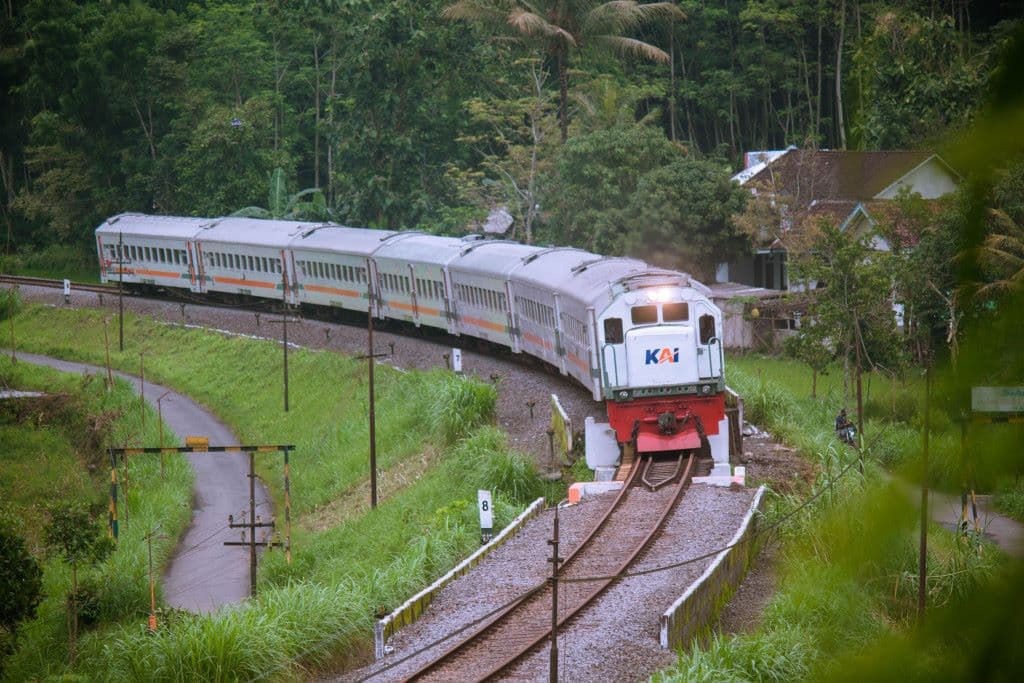
Engaging in Activities on Railway Tracks Can Lead to Criminal Penalties
Many people are still frequently seen carrying out activities around railway tracks, especially in the late afternoon. Some residents even use the railway side as a place to gather, play, or spend their leisure time. However, these activities clearly endanger both railway operations and their own safety. Despite the installation of warning signs along the tracks and repeated warnings from authorized personnel, many people continue to ignore the risks.

KAI Vice President of Public Relations, Joni Martinus, emphasized that individuals who carry out activities on or around railway tracks may face criminal penalties, including imprisonment and fines. Such activities violate Article 181 paragraph (1) of Law No. 23 of 2007 concerning Railways.
Violations of this regulation may result in imprisonment or fines of up to Rp15 million. The law states that no person is permitted to enter the railway operational zone, drag, move, place, or remove objects on railway tracks, or cross railway lines unlawfully. Furthermore, railway tracks may not be used for purposes other than railway transportation.
"In addition to posing serious safety risks, individuals who violate these regulations may be subject to imprisonment for up to three months or a maximum fine of Rp15,000,000," said Joni.
The legal sanctions are stipulated in Article 199 of Law No. 23 of 2007 concerning Railways.
This issue is also aggravated by the large number of illegal structures built near railway lines within the railway operational area (Rumaja), railway property area (Rumija), and railway supervision area (Ruwasja).
Rumaja (Railway Operational Area) is designated exclusively for railway operations and is closed to the public.
Rumija (Railway Property Area) is intended to protect railway infrastructure and may only be used with permission from the railway authority, provided that such use does not interfere with train operations.
Meanwhile, Ruwasja (Railway Supervision Area) is designated to ensure the safety and smooth operation of railway services and may only be used for other activities if they do not endanger railway operations.
"We urge the public to comply with existing regulations and refrain from constructing illegal buildings within these areas. This is regulated under Article 178 of Law No. 23 of 2007 concerning Railways, which prohibits anyone from constructing buildings, walls, fences, embankments, other structures, planting tall trees, or placing objects along railway lines that may obstruct visibility and endanger train operations," explained Joni.
As a consequence of public non-compliance with these regulations, KAI recorded 195 train collision incidents involving individuals as of December 3, 2022. Of these cases, 173 resulted in fatalities, 14 caused serious injuries, and 8 resulted in minor injuries.
KAI routinely conducts public awareness campaigns and coordinates with local authorities regarding the dangers of carrying out activities on railway tracks. In addition, the company consistently assigns personnel to guard high-risk locations and conducts regular patrols to improve railway safety and security.
"We encourage the public to care about and actively participate in creating a safer environment and ensuring smooth railway operations. We also urge everyone to remind or warn anyone seen playing or engaging in activities on railway tracks," concluded Joni.