
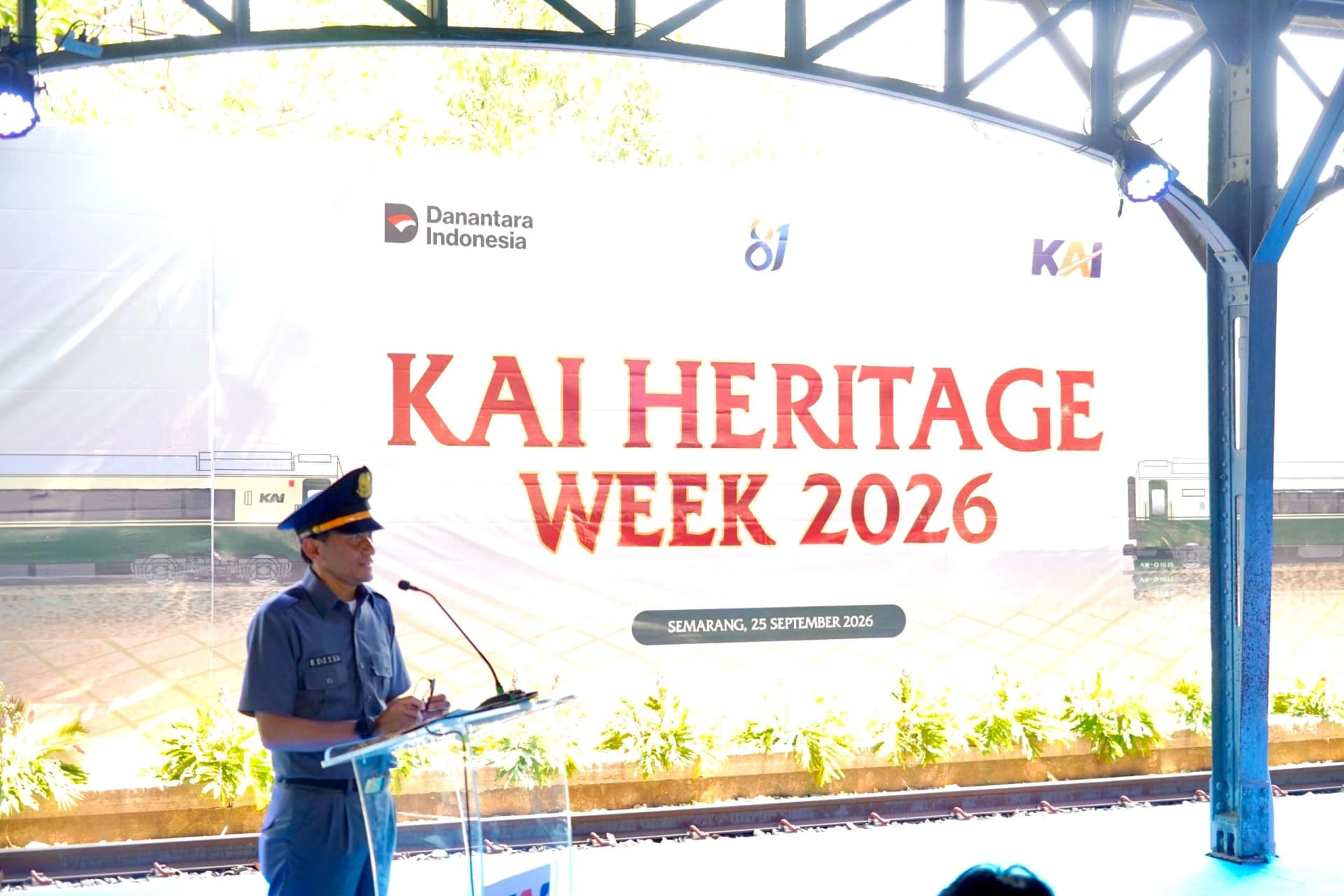
Ride the Rails Through History: KAI Heritage Week Revisits the Birthplace of Indonesia’s Railways
Exploring Indonesian history can now be part of the journey itself. Through KAI Heritage Week 2026, a Kereta Luar Biasa (KLB) special train journey from Semarang Tawang–Tanggung–Kedungjati on Friday (September 25) invited participants to retrace the early story of Indonesia’s railway development in Central Java.
The journey began at Semarang Tawang Station, one of the historic stations that played a role in the development of Central Java’s railway network. From there, participants followed a route filled with stories of Indonesia’s early railway journey toward Tanggung Station and Kedungjati Station.
Semarang holds an important place in this history. At Kemijen, Semarang, the groundbreaking ceremony for the construction of the Semarang–Tanggung railway line took place on June 17, 1864. The approximately 25-kilometer line was built by Nederlandsch-Indische Spoorweg Maatschappij (NIS) and marked the beginning of Indonesia’s railway journey.
Three years later, on August 10, 1867, the Semarang–Tanggung line officially began operations. The opening marked a new chapter in rail-based transportation while improving the movement of people and goods between regions.
Tanggung Station became one of the witnesses to this early chapter. Its presence brings visitors closer to the period when railway networks were beginning to expand and gradually changing how people traveled and conducted economic activities.
The journey then continued to Kedungjati Station. The station played an important role in the development of Central Java’s railway network as one of the strategic points connecting several routes to other regions.
Kedungjati also developed as part of the NIS network, with connections toward Surakarta and Ambarawa. One of its significant milestones came on May 21, 1873, when the Kedungjati–Ambarawa line opened, expanding the railway network and strengthening connectivity across Central Java.
KAI Heritage Week 2026 was designed to offer more than a look at historic buildings and railway lines. At Tanggung Station and Kedungjati Station, the heritage journey featured a series of activities, including Corporate Social Responsibility (CSR) handover ceremonies, plaque unveilings, a fashion show, and theatrical performances bringing railway history to life.
The concept transformed heritage sites from places that simply preserve the past into spaces where history can be experienced in a more engaging way. Participants could see how railway stations and routes became part of the development of mobility and everyday life across generations.
The historical trail across Semarang, Tanggung, and Kedungjati also shows how railway networks grew from a single line into broader connectivity. From the first railway journey to an expanding network connecting different regions, every station carries a story of Indonesia’s transformation.
The journey also highlights the potential of railway heritage assets as destinations for historical tourism. Historic stations, railway lines, stories, and the surrounding culture can come together to create experiences that combine education and exploration.
KAI Heritage Week 2026 serves as a reminder that Indonesia’s railway development did not happen overnight. It began with a single route and gradually grew into a network that continues to support the needs of society today.
From Semarang to Tanggung and onward to Kedungjati, participants were invited to revisit key locations that shaped the early history of Indonesian railways. It was a journey into the past that also showed how heritage continues to have a place in today’s railway landscape.
Through KAI Heritage Week 2026, history is not simply preserved in archives—it is brought back to life, explored, and shared with new generations. From the first railway line opened in 1867, Indonesia’s railway journey continues forward, carrying its heritage from the past into the future.