
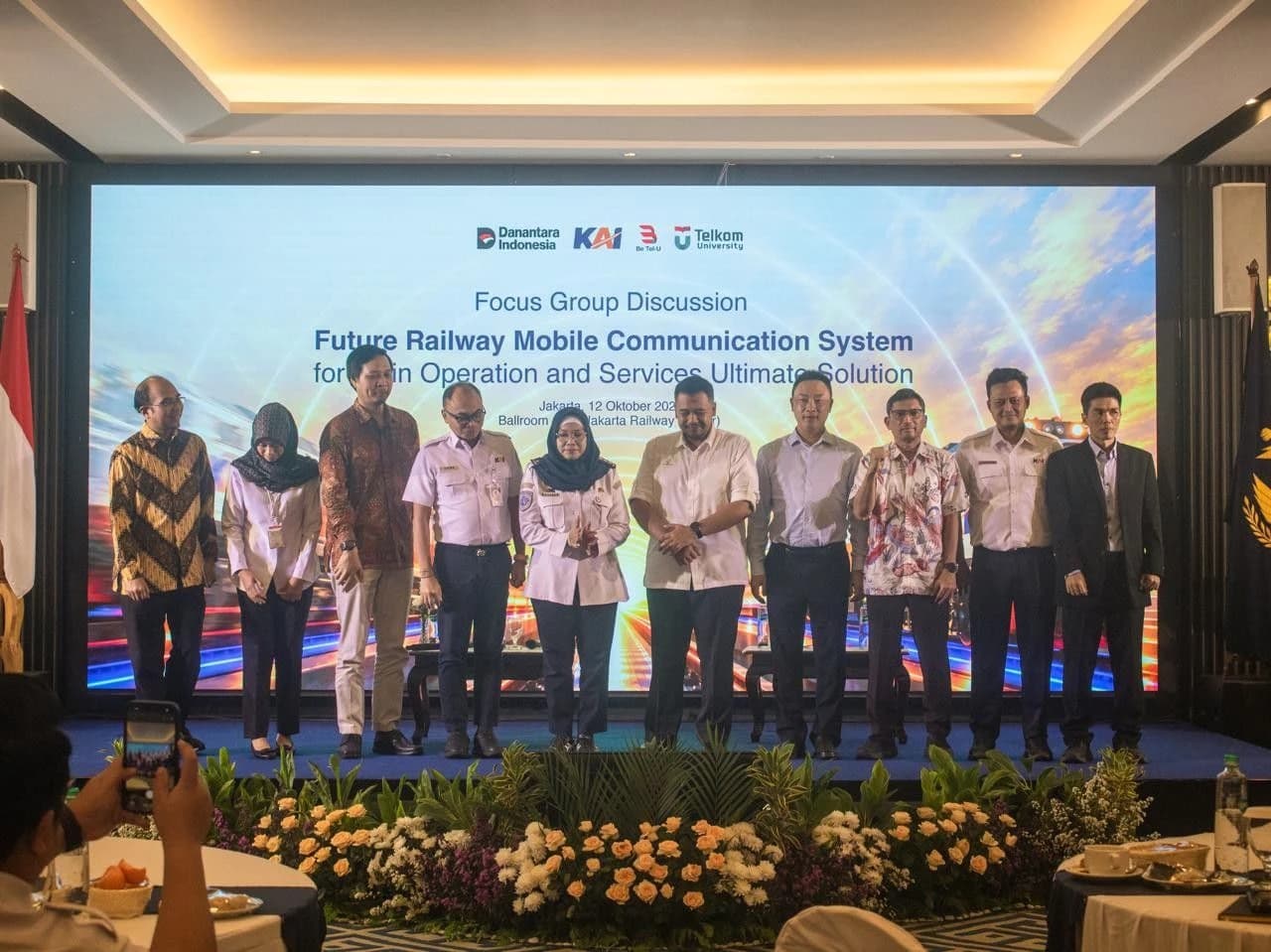
KAI Explores 5G Technology for the Future of Railway Communications
PT Kereta Api Indonesia (Persero), or KAI, is exploring the Future Railway Mobile Communication System (FRMCS), a next-generation 5G-based communication technology designed to support future railway operations. The system aims to integrate voice, data, and video communications, enabling faster, safer, and more reliable information exchange across railway operations.
The discussion took place during a Focus Group Discussion (FGD) titled FRMCS for Train Operation and Services Ultimate Solution at Jakarta Railway Center on Monday, October 12. The forum brought together KAI, the Directorate General of Railways under the Ministry of Transportation, the Ministry of Communication and Digital Affairs, academics, and telecommunications industry representatives.
The study covers operational requirements, technology readiness, frequency allocation, network deployment options, financing, and implementation stages. These factors will help ensure that the proposed technology meets the needs of Indonesia’s railway system.
KAI Director of Portfolio Management and Information Technology I Gede Darmayusa explained that FRMCS could support a range of operational needs, including communication between railway personnel and control centers, train location monitoring, train traffic management, rolling stock and infrastructure maintenance, disruption handling, and emergency response.
Railway safety communications are among the key priorities. Critical information must be delivered quickly and securely, with reliability levels and communication priorities tailored to operational requirements. By managing different priorities within an integrated network, communications for safety, train operations, and supporting functions could be coordinated more effectively.
From a regulatory perspective, Minister of Communication and Digital Affairs Regulation No. 8 of 2026 on Indonesia’s Radio Frequency Spectrum Allocation Table includes the 1,900–1,910 MHz band for FRMCS and advanced technologies for railway signaling. However, further testing and assessment are still required to ensure stable communications and minimize interference from other networks.
KAI is also taking into account the variety of communication systems currently used across the railway network, ranging from analog to digital technologies. The transition to FRMCS therefore needs to be carefully phased, considering equipment readiness, regulatory requirements, investment needs, and the continued operation of existing systems.
The study also compares different network deployment options, including independent development and management by KAI or partnerships with telecommunications operators. Each option will be assessed based on operational requirements, security, investment, management costs, and long-term sustainability.
The proposed FRMCS development roadmap begins with mapping existing conditions and operational needs, followed by system design, field testing, limited pilot implementation, and the potential for gradual deployment. These stages remain preliminary recommendations that will be discussed further with regulators and relevant stakeholders.
Through this study, KAI aims to establish a foundation for a more modern and integrated railway communication system. If developed in line with operational requirements, FRMCS could help improve railway safety, efficiency, and service reliability in the years ahead.