
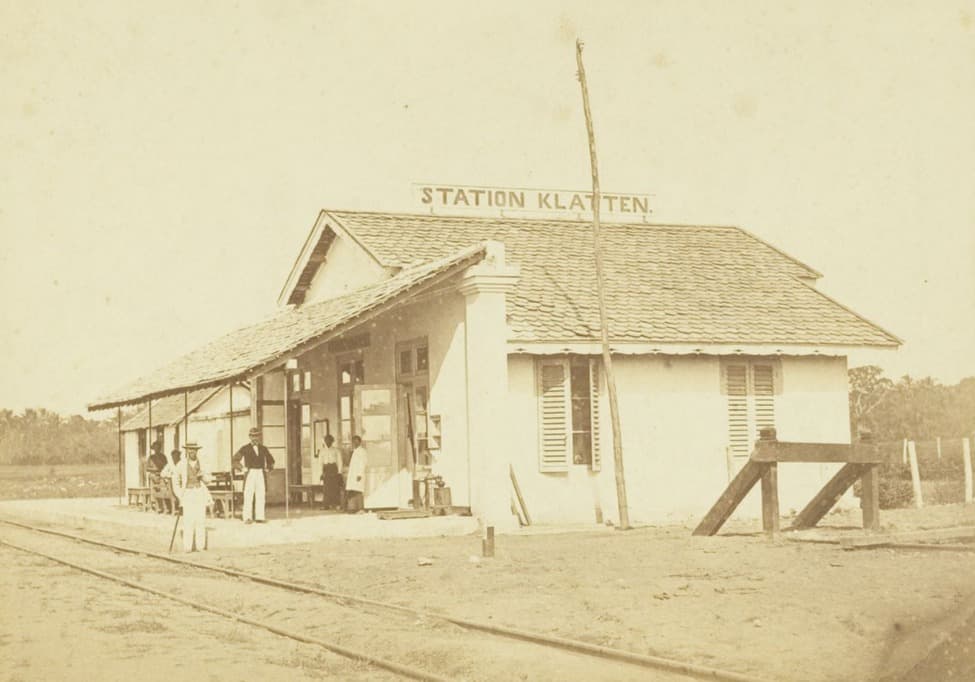
Looking at the History of Klaten Station: A 153-Year-Old Dutch Colonial Building
Who doesn’t know Klaten Station? This station is part of the first railway line between Semarang–Vorstenlanden (Solo–Yogyakarta), as part of the Solo–Yogyakarta development phase. This first-class railway station is located in Tonggalan, Klaten Tengah, Central Java. Klaten Station sits at an elevation of +151 meters above sea level and is managed by KAI Regional Operations (Daop) 6 Yogyakarta.
 Klaten Station in the Past
This station was opened on July 9, 1871, by the private railway company Nederlandsch Indische Spoorweg Maatschappij (NISM) under the name Station Klatten, along with the opening of the Ceper–Klaten line. Today, the building is 153 years old. At the time of its opening, the station building was still simple, with a gable roof design, large door openings, and krapyak-style windows. On the platform side, there was a long roof overhang. The toilet building was also constructed separately on the eastern side of the station.
Klaten Station was built due to the growing economy of the region driven by the development of plantation industries, especially sugar. At that time, sugar was a very important export commodity for the Dutch East Indies, especially for the European market. In fact, the Dutch East Indies was one of the largest sugar-exporting regions in the world.
At the beginning of its operation, Klaten Station served six train stops, namely two round trips between Solo–Yogyakarta and one round trip between Semarang–Yogyakarta. At that time, the journey from Klaten to Solo took around 45 minutes, while the journey from Klaten to Yogyakarta took about half an hour.
In the early 20th century, NISM improved stations along the Semarang–Solo–Yogyakarta line, including Klaten Station, which was renovated around 1903. The station building was made longer with a higher central facade. Platform roofing was added, and a warehouse was built on the eastern side of the station.
In 1990, Klaten Station was renovated again. The central roof, which was originally gable-shaped, was changed into a prism-shaped roof, and several rooms were rearranged for new functions.
Klaten Station, which has a history dating back to the Dutch East Indies era, originally had six railway tracks. Initially, track 1 was the straight line. After the double track section of Srowot–Ketandan began operating in 2001 and the Brambanan–Delanggu section on December 15, 2003, track 1 became the straight line toward Yogyakarta, while track 2 became the straight line toward Solo. Track 3 is used for intercity trains, agglomeration services, the Yogyakarta Commuter Line, and the Bias Train. Tracks 4, 5, and 6 are used as parking tracks for KRL (electric trains).
Today, Klaten Station remains standing strong and has improved significantly with maintenance and the addition of various facilities to provide services for customers in accordance with minimum service standards. Klaten Station now serves not only long-distance and agglomeration passengers but also commuter train users.

Klaten Station today
From year to year, the number of passengers at Klaten Station has increased significantly. In 2022, the number of passengers boarding and alighting at this station reached 1,015,835 people. Then in 2023, the number increased to 1,420,117 people. By June 2024, the number of passengers at Klaten Station had already reached 875,073 people, both for long-distance trains and commuter services. This number is predicted to continue increasing until the end of the year.
Klaten Station remains well maintained, and its original architectural authenticity is still preserved to this day. This Dutch colonial-era station, which is still active and well-maintained, is a living piece of history, connecting the past with the present through its continued function. It is also clear evidence that KAI is consistent in preserving and maintaining historical buildings properly. (KAI Public Relations)