
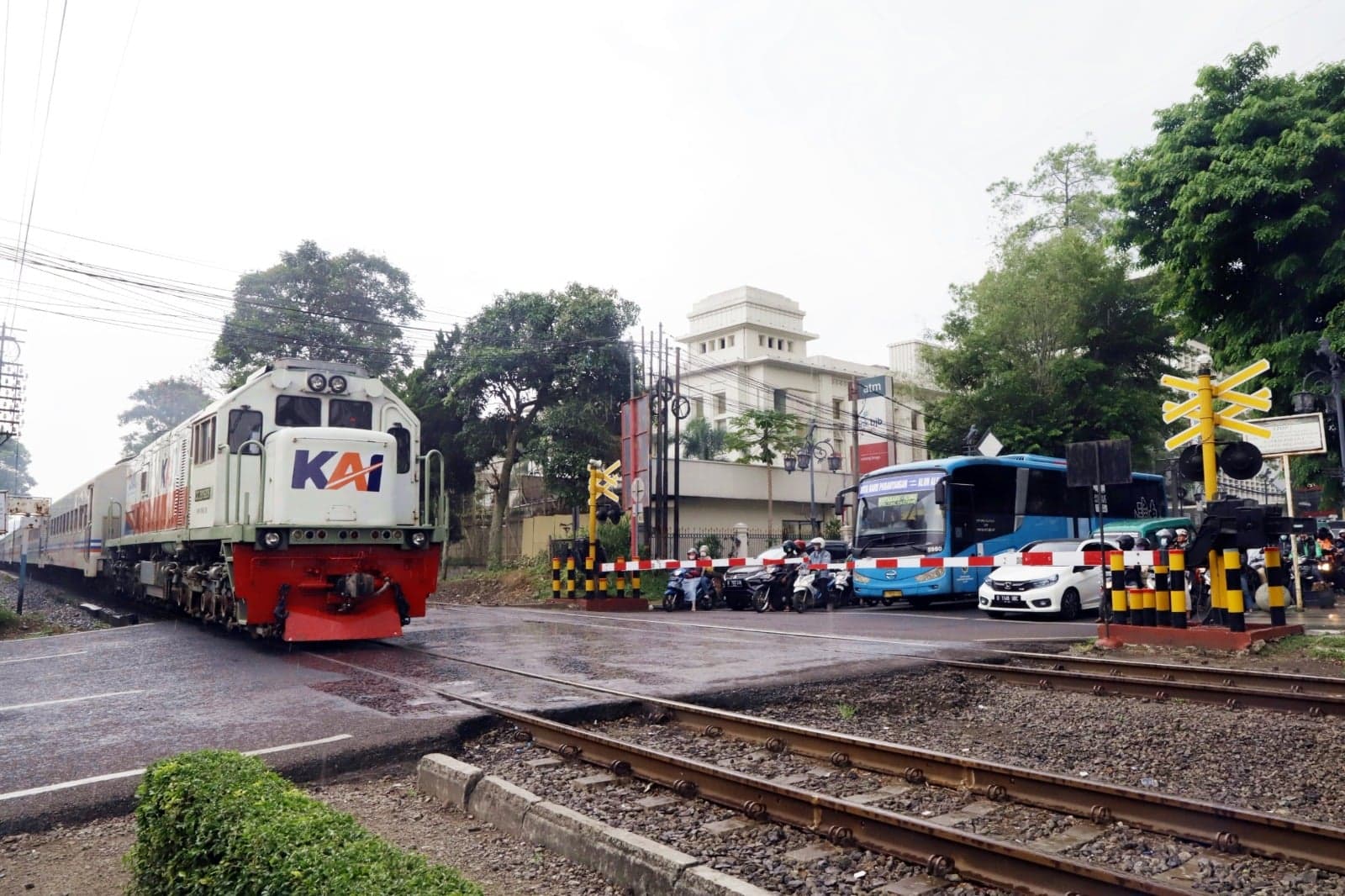
Who Is Responsible for Railway Level Crossings? Here's What the Regulations Say!
Frequent accidents at railway level crossings, both guarded and unguarded, have become a major public concern, raising questions about the safety of both road users and railway operations.
One of the many incidents occurred at an officially guarded level crossing on Tuesday, March 19, 2024, involving the Putri Deli Train and a truck at the Pasar Bengkel crossing in Serdang Bedagai, North Sumatra. The accident resulted in injuries to the train driver and assistant driver, as well as damage to the locomotive. More recently, on Saturday, March 23, 2024, the Airlangga Train collided with two minivans at an unauthorized railway crossing on Jalan Pahlawan, Bekasi City.
Accidents involving trains and other vehicles at railway level crossings are highly detrimental because they can damage railway equipment and often result in injuries or even fatalities.
Between 2023 and March 2024, there were 414 accidents at railway level crossings, resulting in 124 fatalities, 87 serious injuries, and 110 minor injuries.
KAI Vice President of Public Relations Joni Martinus emphasized that trains operate on dedicated tracks and cannot stop suddenly. Therefore, road users are required to give priority to trains at railway crossings.
"All road users are required to give priority to trains when crossing railway level crossings. This is stipulated in Article 124 of Law No. 23 of 2007 on Railways and Article 114 of Law No. 22 of 2009 on Road Traffic and Transportation," said Joni.
Article 124 of Law No. 23 of 2007 on Railways states that at intersections where railway tracks and roads cross at the same level, road users must give priority to trains.
Meanwhile, Article 114 of Law No. 22 of 2009 on Road Traffic and Transportation states that at railway level crossings, vehicle drivers are required to stop when warning signals are activated, when the crossing gates begin to close, or when other warning signals are present; give priority to trains; and give the right of way to vehicles that have already begun crossing the tracks.
Many people assume that KAI is responsible for installing crossing gates and warning signs at every railway level crossing. However, this is not KAI's responsibility. KAI serves solely as the railway operator and does not have the legal authority to install crossing gates or convert level crossings into grade-separated crossings such as flyovers or underpasses.
Joni explained that, in accordance with Article 2 of the Minister of Transportation Regulation No. 94 of 2018, the management of railway level crossings is the responsibility of the authority in charge of the respective road classification. National roads fall under the Minister, provincial roads under the Governor, regency and city roads as well as village roads under the Regent or Mayor, and special roads under the relevant legal entity or institution.
"The role of both the central and regional governments is essential in reducing accidents at railway level crossings. KAI also encourages the government to develop safer crossings in accordance with existing regulations or to close unauthorized crossings that endanger railway operations and public safety," Joni said.
From 2023 through March 2024, KAI recorded 1,514 guarded railway level crossings and 2,556 unguarded crossings. During the same period, KAI permanently closed 157 level crossings as part of efforts to normalize railway operations and improve train travel safety.
KAI continues to collaborate with local stakeholders and railway enthusiasts (railfans) to consistently conduct public awareness campaigns on railway crossing safety. These campaigns encourage road users to obey regulations and always give priority to trains. Safety outreach activities are conducted regularly in person. Between 2023 and March 2024, KAI carried out 1,413 safety awareness activities in various areas identified as having a high risk of traffic violations.
"KAI urges the public to exercise caution when approaching railway level crossings. Always ensure that the tracks are clear, look both left and right, and obey all traffic signs and signals," Joni said.
KAI also calls on all members of the public, government agencies, institutions, and organizations to show greater concern and attention toward safety at railway level crossings.
"Safety can only be achieved when everyone shares responsibility. We hope all parties will play an active role in improving safety at railway level crossings for the benefit of us all," he concluded.