
Traffic Discipline, the Key to Safety at Level Crossings
PT Kereta Api Indonesia (KAI) is committed to providing maximum service to its customers. Therefore, KAI prioritizes safety and security aspects in its train travel operations. Of the many professions in the railway industry, there is one profession that plays an important role in maintaining train travel safety.

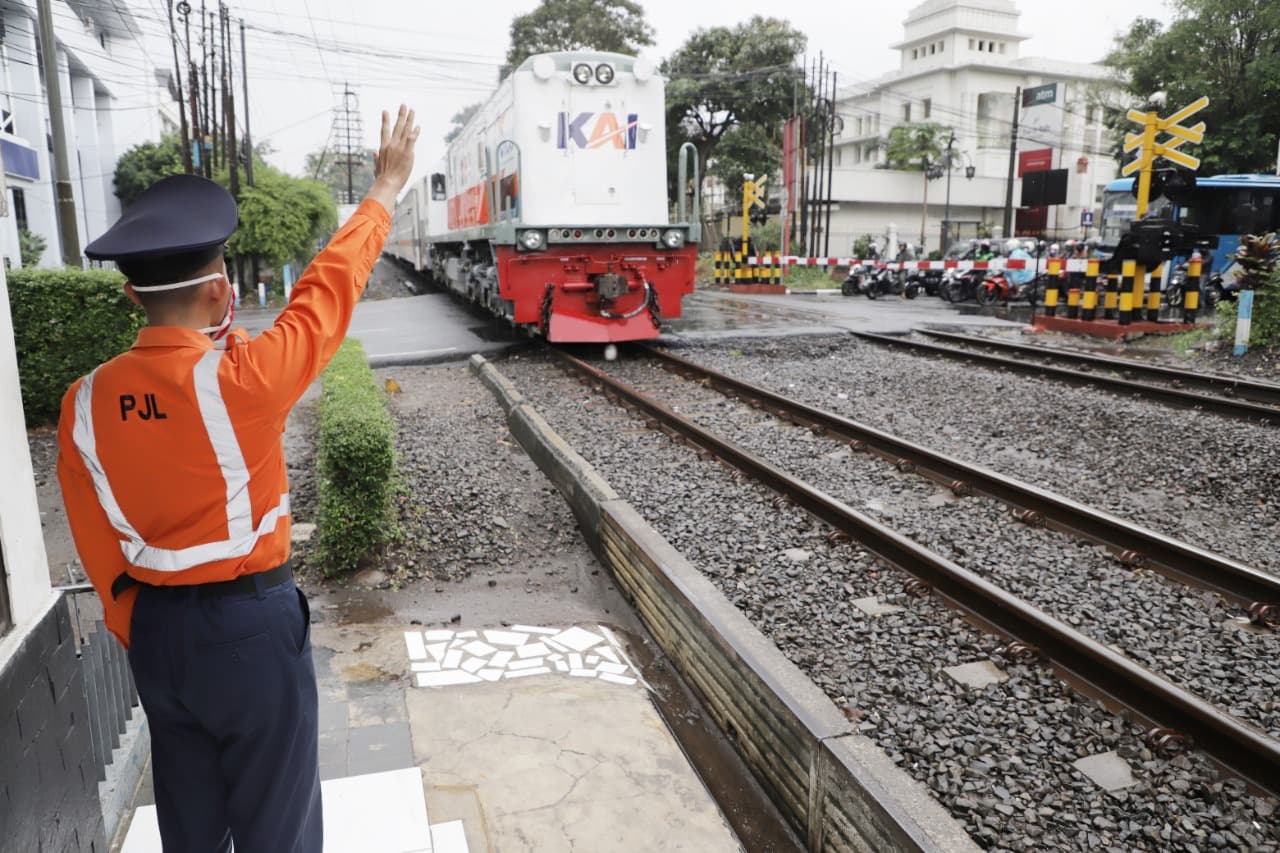
A PJL has the task of securing train travel at level crossings.
That profession is the Gatekeeper (PJL). A PJL has the task of securing train travel at level crossings. Perhaps for some people, their job looks very easy and appears ordinary like common professions. However, their duty actually involves the safety of many people because they must ensure that train journeys can be safe, smooth, and without obstacles. A PJL must have high discipline and be alert in all situations and conditions.
The high number of traffic violations occurring at level crossings that result in accidents makes a PJL's task crucial. The low awareness of road users to obey signs at level crossings or even violating them by breaking through crossings when the gate is already closed keeps traffic accident rates at level crossings high. Not infrequently, these accidents also hamper and endanger train travel. In the period from January to August 2022, there were 188 accident cases at level crossings with details of 29 cases at guarded crossings and 159 cases at unguarded crossings.
Vice President of Public Relations of KAI Joni Martinus said that train gates are actually used to secure train journeys so they are not disrupted by other road users such as motorized vehicles or humans. This is stated in Government Regulation No. 72 of 2009 concerning Railway Traffic and Transport article 110 paragraph 4.
"Train travel is prioritized because if an accident occurs, the impact and losses caused can be greater, so road users must give way to the train. Therefore, the crossing gate is primarily functioned to secure train travel," he explained.
In January-August 2022, KAI noted there were 1,426 guarded level crossings and 1,500 unguarded crossings. During the same period, KAI had closed 194 level crossings with the aim of track normalization and improving train travel safety.
Safety at level crossings is a shared responsibility. The government, operators, and road users each have equally important roles. On the infrastructure side, the evaluation of level crossings must be carried out by the government by involving KAI and other related parties periodically. Based on the results of the evaluation, level crossings can be made grade-separated, closed, or enhanced in safety. This is in accordance with the Minister of Transportation Regulation Number 94 of 2018 concerning Safety Enhancement of Level Crossings between Railway Lines and Roads articles 5 and 6.
The enhancement and management of these level crossings are carried out by the party responsible for the road according to its classification, such as the Minister for national roads, the Governor for provincial roads, and the Regent/Mayor for regency/city roads and village roads. This is in accordance with Ministry of Transportation Regulation Number 94 of 2018 articles 2 and 37.
“KAI together with the government continues to synergize to increase safety at level crossings through various efforts,” said Joni.
Meanwhile, on the law enforcement side, action is needed against every violator to create a deterrent effect and increase the discipline of road users. KAI routinely maintains communication with the local police so that law enforcement is implemented consistently.
As for the cultural side, there needs to be awareness from every road user to comply with all signs and signals present when passing through a level crossing. This is because safety at level crossings is the responsibility of each individual.
Safety socialization at crossings is routinely conducted directly every year. During January-August 2022, this activity was carried out 126 times in various areas considered prone to violations. KAI together with related agencies and railway enthusiast communities carry out education to the public to build a culture of discipline at level crossings and comply with existing signs.
KAI urges road users who are about to cross to #BERTEMAN (Berhenti, Tengok Kanan Kiri, Aman Jalan - Stop, Look Left and Right, Safe to Go) so that accident incidents at level crossings do not keep recurring.
“Whether there is a gate or not at a level crossing, road users are obliged to stop for a moment and look left and right to ensure no train is about to pass. If a train is about to pass, then drivers are obliged to prioritize the train journey,” Joni emphasized.
This rule is also in accordance with Law Number 23 of 2007 concerning Railways Article 124 which states that at a grade intersection between railway lines and roads, road users are obliged to prioritize train travel.
“Safety at level crossings can be created if all elements of society and the government can care together. It is hoped that the concern of all stakeholders, including road users, is capable of creating safety at level crossings,” concluded Joni.