
Manggarai Station
TABLE OF CONTENTS
The name Manggarai in Batavia (Jakarta) is often mentioned as having a connection with the Manggarai region in Flores, East Nusa Tenggara. The name Manggarai in Jakarta originated from the Manggarai people of Flores, who were brought as enslaved workers during the Dutch East Indies era. Over time, this area, which was part of Gemeente (Municipality of) Meester Cornelis, developed into a settlement.
A Brief Overview of Railways in Jakarta
It was a private railway company, Nederlandsch Indische Spoorweg Maatschappij (NIS), that first built a railway network in Jakarta. The line constructed ran from Jakarta toward Buitenzorg (Bogor).
The inauguration of this railway line was carried out in three stages. Initially, the section from Jakarta (now the Jakarta Kota Station area) to Weltevreden (the Gambir area) was opened on September 15, 1871. Following that, the Weltevreden–Meester Cornelis section was opened on June 16, 1872. Finally, the Meester Cornelis–Bogor section was inaugurated on January 31, 1873.
As a boarding and alighting point for passengers as well as freight, the closest station to the Manggarai area was Meester Cornelis Station. The station was located at the end of the line near the railway workshop (now the Bukit Duri Depot). This station was also known as Bukit Duri Pasar Station.

The initial location of the NIS Meester Cornelis Station is marked with a yellow circle on this 1898 map. The bustling activity at Meester Cornelis Station is also visible. (Source: KITLV KK 042-03-07/08 and KITLV 1400451) http://hdl.handle.net/1887.1/item:846665
Besides NIS, another private company, Bataviaasche Ooster Spoorweg Maatschappij (BOS), and the state-owned railway company Staatsspoorwegen (SS) also shaped the railway business in Jakarta. SS opened a railway line towards western Jakarta. The Jakarta–Duri–Tangerang line was inaugurated in 1899. Subsequently, construction continued to Rangkasbitung and all the way to Serang (1900).
Meanwhile, the railway network in eastern Jakarta was developed by BOS: Jakarta–Bekasi (1887), which was then extended to Cikarang and Karawang (1898). However, due to financial difficulties, this line was sold to SS alongside the inauguration of the line to Karawang for five million guilders.
In 1907, the NIS Meester Cornelis Station was no longer used for the public. This was because in the same year, NIS completed the construction of a new Meester Cornelis or Bukit Duri Station. The new station was located north of the original station. The presence of this new station made train operations smoother, as trains no longer had to run onto a branch line.

Bukit Duri Station is marked with a yellow circle on this 1908 map. The black line represents the railway owned by NIS, while the red line indicates the line owned by Staatsspoorwegen (SS). At that time, the line from Tanah Abang to Kramat intersected at the Cikini stop, parallel to Salemba. (Source: KITLV KK 012-02-01)
The Construction of Manggarai Station
In the early 20th century, the government drew up plans to improve railway conditions in Jakarta. However, railways in Jakarta were not only managed by the government through SS; the Jakarta–Bogor line was operated by the private company NIS. Therefore, SS wished to take over NIS's Jakarta–Bogor line. In fact, this proposal had surfaced back in 1877 when SS intended to build the Jakarta–Bandung line. However, tough negotiations delayed the purchase until 1913, when SS finally bought the line for 8.5 million guilders.
After taking full control of all railways in Jakarta, SS proceeded to reorganize the city's railway system. The Manggarai–Meester Cornelis route became the priority line to be restructured by SS. One of the projects along this line was building a new station complex, which was estimated to have started in 1914. Although the location of this new station seemed somewhat remote and isolated at first glance, it actually served as the junction for four major routes: from Jakarta, Banten–Tanah Abang, Karawang, and Bogor.
This major project by SS drew the attention of Governor-General Idenburg. Accompanied by Secretary-General Mr. Hulshoff Pol and his aide-de-camp Mr. d’Engelbronner, he visited the railway project in Manggarai. The visit on May 6, 1917, was warmly received by SS Inspector, Mr. Damme, accompanied by Mr. Koch (the chief engineer responsible for the Manggarai project) and Mr. Boer (the supervising engineer). Starting in the morning, Mr. Damme led a tour of the train workshop project, the workers' housing area, and finally inspected the construction progress of the new station.

An aerial photograph of the project complex in Manggarai, showing the station, railway workshop, and employee housing. (Source: Tropenmuseum 7082-nf-1356-25)
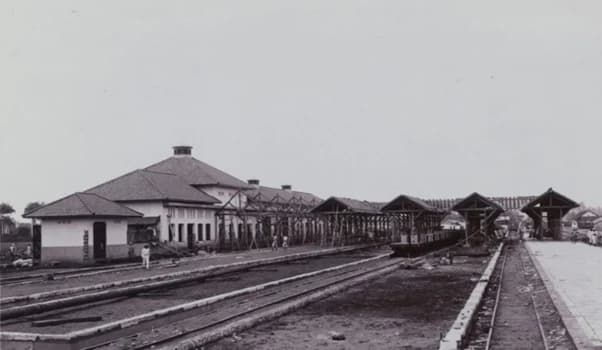
The station building features the characteristic architectural style of Ir. J. Van Gendt. It featured five platforms with granite flooring supplied from Bumiayu. Tracks 4 and 5, spanning 300 meters in length, served as stops for express trains. Meanwhile, the canopy roof was originally designed using iron materials. However, due to World War I, importing iron from Europe faced obstacles. As a result, a 50-meter timber structure was chosen as a replacement material.
Manggarai Station officially began operations on May 1, 1918. That day coincided with the implementation of SS's new schedule and marked the opening of the express train service to Yogyakarta for the first time. The route started from Koningsplein Station (Gambir), passing through a double track to Manggarai Station, continuing to Meester Cornelis Station (Jatinegara), and onward to Karawang.
During the opening, the SS management invited members of the press to try out the express train all the way to Karawang. At exactly seven in the morning, the train departed led by Mr. Damme as SS Inspector. Shortly after, the train passed Manggarai Station. Passengers and journalists were awestruck by the architecture of the new Manggarai Station building. Throughout the journey, SS served refreshments, sandwiches, as well as cigars and cigarettes.

The construction process of Manggarai Station, showing the 50-meter wooden platform canopy roof under construction. (Source: KITLV 34558) http://hdl.handle.net/1887.1/item:726397

The front façade of the Manggarai Station building. (Source: KITLV 34559) http://hdl.handle.net/1887.1/item:724185
A Silent Witness to the Relocation of the Capital
In March 1942, the Dutch government surrendered unconditionally to Japan. Automatically, all of Indonesia fell under Japanese occupation, including its railways. In Java, the railway system was unified under Rikuyu Sokyoku (Land Transport Bureau). Under Rikuyu Sokyoku's control, priorities were shifted toward military needs.
The proclamation of independence by Bung Karno and Bung Hatta ignited the spirits of the entire population, including railway workers. Mostly young, the railway employees acted swiftly to take over the railway network from Japanese hands. Consequently, by early September, the station and the railway workshop (Balai Yasa) in Manggarai were successfully secured by the railway staff.
The takeover spread to various regions. In Bandung, just two days after the successful capture of the headquarters, the Djawatan Kereta Api Indonesia (DKARI — Indonesian Railway Bureau) was formed. DKARI immediately set to work, including executing a secret mission assigned by President Soekarno to relocate the capital city to Yogyakarta by train. The relocation was necessary because the arrival of British forces accompanied by Allied troops rendered Jakarta unsafe as a capital city.
Without wasting time, DKARI in Jakarta prepared all the necessary equipment for the Extraordinary Train (Kereta Luar Biasa / KLB) for the capital's relocation at the Manggarai Workshop. All facilities and rolling stock were prepared in this workshop. Working with focus and utmost care, the workshop employees inspected, repaired, and serviced eight train cars to form the KLB composition.
To ensure the success of this secret KLB journey, DKARI leadership devised a tactical diversion maneuver involving shunting operations. The goal was to avoid raising suspicion among Dutch military patrols when the KLB set off. On January 3, 1946, Manggarai Station served as the command center coordinating operations between Jatinegara and Gambir stations. Several empty carriages were run from Jatinegara Station to Gambir via Manggarai.
In addition, a barricade made of carriages and train cars was arranged along Track 1 of Manggarai Station. This tactic was arranged by Soewignyo from the traffic division to block the view of Dutch soldiers on guard. A Manggarai Station employee, Mirta Soewanda, prepared the suitcases for the President and his entourage.
In the late afternoon as the sun tilted toward the western horizon, steam locomotive C2849 entered the Manggarai Workshop without any lights. In short order, the locomotive was coupled to the eight prepared train cars to complete the KLB setup.
At six o'clock sharp, the train slowly glided out from the workshop toward Manggarai Station. In total darkness and silence, the train moved slowly toward Pegangsaan, behind Bung Karno’s residence.
Exercising great caution while trying to remain calm, Sapi-ie, a train attendant, stepped down to help the entourage board the train. Among them, Sapi-ie assisted First Lady Fatmawati, who was carrying her young son, Guntur. The dark, quiet night heightened the tense atmosphere. Hearts pounded with anxiety and fear of being spotted by Dutch forces. Despite the chaotic situation, all passengers managed to board safely.

Caricature showing the KLB entourage preparing to board the train behind Bung Karno’s house on Jl. Pegangsaan Timur No. 56. (Source: Mosaik Perjuangan Kereta Api 1945: Pemerintah RI Hijrah)
Afterward, the train set off again, heading toward Manggarai Station via Track 6. Track 5 had been blocked by the barricade of empty train cars to deceive the troops standing on the station platform. As it passed through Manggarai Station, the train traveled at a speed of only 5 km/h.
Amid mixed emotions and a sense that time had stood still, the presidential train successfully passed Manggarai Station. Similarly, upon entering Jatinegara Station, the train moved slowly. Only after passing Bekasi Station was the train accelerated rapidly toward Yogyakarta.

The bustling activity at Manggarai Station in 1951. (Source: NVBS)
Today, Manggarai Station has become the busiest railway hub in Indonesia. It handles long-distance trains arriving at or departing from Gambir Station. As a transit point, Manggarai Station serves passengers of the Commuter Line (KRL) heading to Jakarta Kota, Bogor, Tanah Abang, and Bekasi. The Airport Rail Link (KA Bandara) is also accessible from this station.
Manggarai Station, which was officially opened in 1918, has been designated a Cultural Heritage Building registered with the Ministry of Culture and Tourism under registration number RNCB.19990112.04.000470, based on the Regulation of the Minister of Culture and Tourism No. PM.13/PW.007/MKP/05, the Decree of the Minister of Education and Culture No. 011/M/1999, and the Governor of DKI Jakarta Decree No. 475 of 1993.
List of References:
Newspapers and Magazines
“De Staatsspoorwerken”. De Locomotief. May 26, 1917.
“De Reorganisatie der Westerlijnen”. Het Nieuws van den dag voor Nederlandsch Indie. May 1, 1918.
“Langs nieuwe banen”. Het Nieuws van den dag voor Nederlandsch Indie. May 1, 1918.
“Spoorwegtoestanden in en om Batavia”. De Sumatra Post. May 6, 1918.
Sleeswijk, F. O. Wegener. 1929. “Uitbreiding van de spoorwegen in en om Batavia en Tandjong Priok”. De ingenieur. Vol. 5. No. 02.
Books
Boekoe Peringatan Dari Staatsspoor en Tramwegen di Hindia Belanda 1875-1925. 1925. Weltevreden: Topografische Inrichting.
Purbohadisaputro. Mosaik Perjuangan Kereta Api 1945: Pemerintah RI Hijrah.
S. A. Reitsma. 1928. Korte Geschiedenis der Nederlandsch Indische Spoor en Tramwegen. Weltevreden: G. Kolff & Co.