
History of Pasar Senen Station
TABLE OF CONTENTS
The Early Station
Originally, Pasar Senen Station was inaugurated by the private railway company Bataviasche Ooster Spoorweg Maatschappij (BOSM) alongside the opening of the Batavia (Jakarta)–Bekasi line on March 31, 1887. The building of Pasar Senen Station was designed in the Indies Empire style, featuring a semi-circular iron canopy that sheltered the railway tracks underneath.
The Jakarta–Bekasi line was the first phase of the Jakarta–Karawang railway construction. Furthermore, BOS completed the second phase connecting Bekasi–Cikarang (1890) and Cikarang–Kedunggede (1891).

The initial building of Pasar Senen Station constructed by BOS. (Source: Spoorwegstation op Java)
During the fourth phase between Kedunggede and Karawang, BOS faced financial difficulties. The government stepped in under the condition that once the entire line was completed, its management would be handed over to the state-owned railway company, Staatsspoorwegen (SS). As a result, when the line was inaugurated on March 20, 1898, its operation officially belonged to SS.
Since the early 19th century, the Dutch East Indies government had plans to improve railway conditions in and around Jakarta. However, there were obstacles, as the railways in Jakarta were managed by both the state-owned railway company and several private companies. Fortunately, in 1913, SS purchased the Jakarta–Buitenzorg (Bogor) railway network from the private railway company Nederlandsch Indische Spoorweg Maatschappij (NISM). Previously, the Jakarta–Bogor line had been the first railway line in Jakarta, inaugurated in 1873.
Construction of the New Station
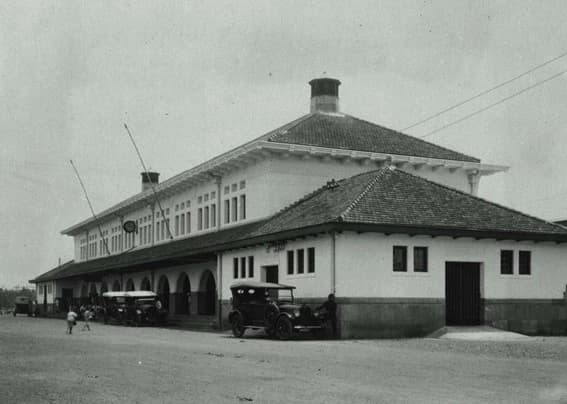
After taking management of the railways in Jakarta, SS began renovating major stations, including Pasar Senen Station. The station was redesigned by architect Van Gendt and built 100 meters east of the original station. The newspaper Het Nieuws van den Dag voor Nederlandsch Indie published on February 2, 1925, reported that Senen Station was confirmed to be open for public use on the 23rd. However, the station was officially inaugurated on March 19, 1925, through a series of events.
The night before, a selamatan (traditional thanksgiving ceremony) was held by Pasar Senen Station staff in accordance with the tradition at that time—specifically, burying a buffalo head. This tradition was believed to prevent accidents from occurring at the station or affecting people nearby, as quoted in the March 18, 1925 edition of Bataviaasch Nieuwsblad.

The construction process of Pasar Senen Station around May 1924. As an island station, the front building of the station appears fully constructed. (Source: Spoorwegstation op Java)
This new station became an island station, with its front building situated on the west side. It is a building designed with a symmetrical axis. The central part of the building served as a service area. The platform area was equipped with two underground tunnels for passengers to cross to other platforms for arrivals and departures. This underground tunnel utilized reinforced concrete construction, built by the Dienst van Constructie SS (SS Construction Service). This tunnel was the first station pedestrian underpass built in Indonesia.
During the proclamation of independence, the stationmaster of Pasar Senen Station was still a Dutch man named Mr. Smidts. In executing his duties, he was assisted by several Indonesians, including Soebargo, Koesto, Kharis Soehoed, and others. When the takeover of the railways in Jakarta from Japan occurred on September 3, 1945, Pasar Senen Station automatically fell under Indonesian control. Soebargo and the young railway workers of Pasar Senen Station then raised the Red and White flag. The takeover took place without incident.
Under Japanese occupation, besides carrying out their duties at Pasar Senen Station, several workers were also involved in activities with the Kaigun Bukanfu, an intelligence-like agency within the Japanese Navy. Following the proclamation, some of the railway youth collected two full drums of dynamite from the Kaigun Bukanfu Headquarters in Gunung Sahari. This dynamite was prepared for the independence struggle.
The railway youth of Pasar Senen were also enthusiastic about attending the Grand Mass Rally (Rapat Raksasa) at Ikada Field on September 19, 1945. They flocked to the field to hear Bung Karno’s speech.
The Ministry of Transportation issued the Master Plan for the Jabotabek Railway Infrastructure Development Project in 1981. Its objective was to build a modern railway system. Pasar Senen Station was included in the eastern line development corridor spanning 11 km along the Jakarta–Pasar Senen–Jatinegara route. In 1983, signal rehabilitation was carried out at Pasar Senen Station.
Currently, Pasar Senen Station has been designated as a cultural heritage building registered with the Ministry of Culture and Tourism under registration number RNCB.19930329.02.000810, based on Regulation of the Minister of Culture and Tourism No. PM.13/PW.007/MKP/05 and Governor of DKI Jakarta Decree No. 475 of 1993.

The platform of Pasar Senen Station in 2019, showing the front building of the station. (Source: PT KAI Collection)

The station waiting room in the middle of the main building, in 2019. (Source: PT KAI Collection)