
A Brief History of Jatinegara Station
TABLE OF CONTENTS
The Origins of Meester Cornelis and the Early Railway Line
The area known as Meester Cornelis was originally a vast piece of land owned by a Christian religious leader named Cornelis van Senen. Following his passing in 1661, his devoted followers honored his memory by naming the entire region after him, using the title "Meester" (Master) Cornelis to preserve the name of their late leader.
Centuries later, a private railway company, the Bataviaasche Ooster Spoorweg Maatschappij (BOSM), officially inaugurated the Meester Cornelis Station on March 31, 1887. The launch of this station coincided with the opening of the railway network connecting Batavia (Jakarta), Meester Cornelis (Jatinegara), and Bekasi. However, BOSM soon faced severe financial difficulties. Consequently, in 1889, the state-owned railway company, Staatsspoorwegen (SS), stepped in and purchased the Batavia–Bekasi line.

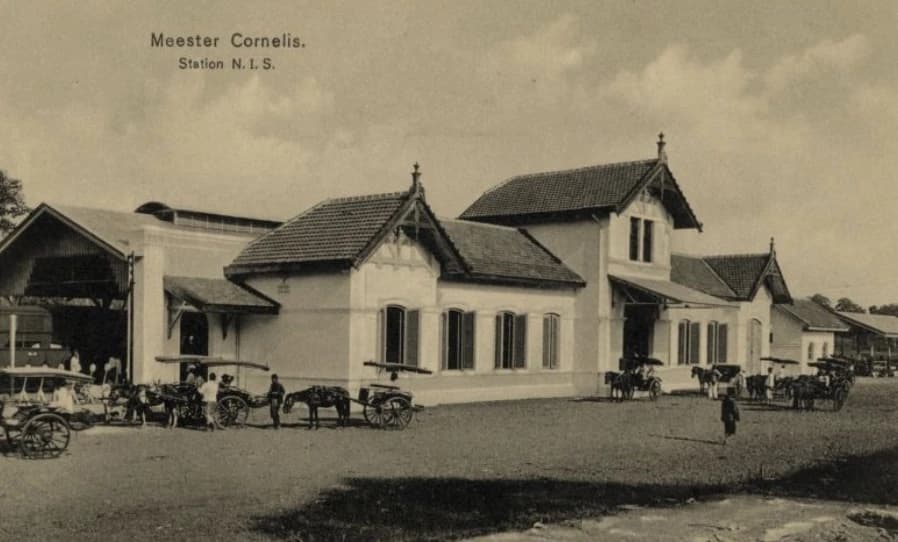
A portrait of the old Meester Cornelis Station (formerly owned by BOSM) in the 1900s. (Source: KITLV 1403487)
In 1909, the Staatsspoorwegen (SS) constructed a brand-new station located approximately 600 meters east of the original BOSM station. The construction of this new hub made headlines in the October 11, 1909 edition of the newspaper Het Nieuws van den Dag voor Nederlandsch-Indië. The Head of the Western Lines (Westerlijnen) Exploitation for SS announced that the new Meester Cornelis Station would temporarily open for passengers, luggage, and freight shipments on October 15, 1909. Meanwhile, the old station building remained in operation exclusively to handle cargo traffic.

The initial location of Jatinegara Station marked with a yellow circle on a 1909 map (left), and its relocated position further east marked with a red circle on a 1925 map (right). (Source: Colonialarchitecture.edu)
The architecture of the new Meester Cornelis Station is widely believed to be the work of Engineer Snuyff, who served as the temporary head of the architectural bureau at Burgerlijke Openbare Werken (the Public Works Department). In its early days, locals often referred to it as the Rawa Bangke Station, named after a nearby swamp.
The station was strategically built to serve as a major stop for express trains heading to Bandung. The colonial government hoped that travelers from Weltevreden would prefer boarding their trains here instead of going to Kemayoran Station. However, this plan was eventually abandoned in 1913 after the state took over the Jakarta–Bogor line from the private company Nederlandsch-Indische Spoorweg Maatschappij (NISM).

An architectural sketch of Jatinegara Station before the addition of the left and right wing buildings. (Source: Spoorwegstation op Java)
Once the Staatsspoorwegen (SS) gained full control of the railway network in Jakarta, they launched a massive infrastructure modernization plan. Upgrading the tracks between Manggarai and Jatinegara became a top priority. The company constructed an elevated double-track system that gradually ascended from Jatinegara Station, positioning the new tracks much higher than before. To seamlessly connect this route with the newly built Manggarai Station, they also constructed a sturdy concrete bridge crossing over the Ciliwung River.

A viaduct over Matraman Road with a passenger stop visible on the right, while a steam tram passes underneath, photographed in 1920. (Source: KITLV 34673)
To eliminate dangerous and congested intersections with busy public roads, SS focused heavily on elevating the tracks. This required building a prominent viaduct over Matramanweg (now Jalan Matraman), which was fully completed in 1918. Following this, the station's railyard was expanded, and the main building underwent a massive renovation to enlarge its capacity.
By the 1920s, the left and right wing structures were added to the station, alongside large platform canopies. The beautifully crafted decorative iron brackets connecting the support pillars to the roof were made of cast iron imported directly from the Netherlands. In 1924, the side structures of the canopies were modified, raising the roofs to accommodate overhead wiring for the electrification of the line. By January 1925, the ambitious 67.7-kilometer railway electrification project linking Meester Cornelis to Tanjung Priok was officially completed.

The front facade of Jatinegara Station in 1925. (Source: KITLV 179195)
Through the Struggles of the Revolution
During the Japanese occupation in World War II, the name of the Meester Cornelis region was officially changed to Jatinegara. Historians note a couple of popular theories behind this change. The first suggests it was because the region was once covered in dense teak (jati) forests. The second theory claims it refers to a "true state" (negara sejati), a term popularized by Prince Jayakarta. Naturally, this change shifted the identity of the railway hub, turning it into Stasiun Jatinegara.
Following the proclamation of Indonesian independence, railway employees and freedom fighters quickly coordinated a plan to seize vital railway networks from Japanese control, recognizing that trains were crucial for the nation's survival. A massive takeover took place on September 3, 1945, sweeping through Jakarta Kota Station, the Manggarai Workshop (Balai Yasa), major stations, and administrative offices—including Jatinegara. At the Jatinegara Signal and Telecommunications Office located just west of the station, a brave fighter named Margono pulled down the Japanese flag and proudly hoisted the Indonesian Red and White flag in its place.
In January 1946, the newly formed Djawatan Kereta Api Republik Indonesia (DKARI) faced a critical and highly historic task: safely transporting President Soekarno and his entourage to move the young nation’s capital to Yogyakarta. To make this high-stakes mission possible, DKARI prepared a Special Extraordinary Train (Kereta Api Luar Biasa or KLB) at the Manggarai Workshop.
To pull the heavy carriages, the finest locomotive from the Jatinegara Depot was chosen: Steam Locomotive C2849. The most skilled train driver and firemen were selected for the journey. The night before departure, crews conducted thorough inspections to ensure everything operated safely and smoothly. The following day, Steam Locomotive C2849 stood ready at Jatinegara Station, operated by an expert team consisting of Mr. Hoesein as the train driver, alongside Mr. Moertado and Soead as the firemen.
Modern Development and Preservation
Decades later, at the beginning of 1980, the Department of Transportation collaborated with the Japan International Cooperation Agency (JICA) to formulate a comprehensive Railway Master Plan for the Jabotabek region. The vision was to establish a modern commuter rail system to bolster public transit.
This development placed Jatinegara Station as a vital junction connecting three major lines. First, The Western Line, spanning 19.1 km along the Jakarta–Kampung Bandan–Tanah Abang–Manggarai–Jatinegara route. Second, The Eastern Line, consisting of the 11 km line between Jakarta–Pasar Senen–Jatinegara. Third, The Bekasi Line, which covers a distance of 14.7 km from Jatinegara–Klender–Bekasi.
Extensive infrastructure updates soon followed. A total overhaul of the station's signaling systems was completed in 1983, track rehabilitation was executed in 1987, and upgrades to telecommunication lines between Jatinegara and Bekasi were finalized in 1988.

The bustling street view in front of Jatinegara Station in 1988. (Source: Spoorwegstation op Java)
Today, Jatinegara Station is recognized as a protected heritage site under the Ministry of Culture and Tourism. It is officially registered with the ID RNCB.19990112.02.000503, backed by the Regulation of the Minister of Culture and Tourism No. PM.13/PW.007/MKP/05 and the Decree of the Minister of Education and Culture No. 011/M/1999. It stands not just as a busy transit hub, but as a living monument to the rich history of Indonesian rail transport.

The historic building of Jatinegara Station in 2019. (Source: PT KAI Collection)

Passengers waiting patiently for their train on the platform. (Source: PT KAI Collection)