
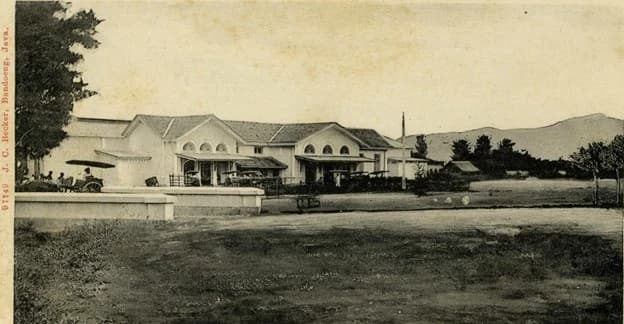
Cimahi Station
TABLE OF CONTENTS
The Story of Cimahi Halt
Cimahi Station was originally a halt opened on May 17, 1884, coinciding with the inauguration of the Cianjur–Bandung railway line by the state railway company, Staatsspoorwegen (SS). This line was part of the construction of the first railway network in the Priangan region, which spanned Buitenzorg (Bogor)–Bandung–Cicalengka. The construction was based on the Law of June 6, 1878, Staatsblad Number 201. The 181-kilometer line was built using a track gauge of 1,067 mm.
Table 1. Construction Stages of the Bogor–Bandung–Cicalengka Railway Line
| No | Section | Length (km) | Opening Year |
|---|---|---|---|
| 1 | Bogor - Cicurug | 24 | October 5, 1881 |
| 2 | Cicurug - Sukabumi | 27 | March 21, 1882 |
| 3 | Sukabumi - Cianjur | 31 | May 10, 1883 |
| 4 | Cianjur - Bandung | 39 | May 17, 1884 |
| 5 | Bandung - Cicalengka | 60 | September 10, 1884 |
Source: Railway Department Magazine, June 1957 Edition
The purpose of constructing the railway network in Priangan was tied to economic interests, connecting the fertile Priangan region with the port in Batavia (Jakarta). The presence of the railway line in Priangan also served military purposes to legitimize Dutch authority in the Dutch East Indies (Indonesia). Furthermore, as a state-owned enterprise, SS had an obligation to improve public welfare by opening up isolated areas.
According to the SS Westerlijnen train timetable printed in 1884, four trains stopped at Cimahi Halt. These were the trains serving the Bogor–Cicalengka (round trip) and Cianjur–Cicalengka (round trip) routes. At that time, the average train speed ranged from 25 to 30 km/h. A journey from Bogor to Cicalengka took approximately 7.5 hours, while the Cianjur–Cicalengka route took about 3.5 hours.
Train fares were differentiated by class. In 1900, for a journey from Bogor to Cimahi, first-class passengers (Europeans) spent 11 guilders. For the same route, second-class passengers (Foreign Orientals: Chinese, Arabs) paid a fare of 7 guilders, while third-class passengers (mixed and indigenous people) only needed to pay 2.96 guilders. Meanwhile, the freight rate per 10 kg was 0.44 guilders.

Image 1: The location of Cimahi Station is marked by a blue circle, based on a 1905 map. (Source: Maps.library.leiden.edu)
Renovation of Cimahi Station
In the early 1900s, Cimahi Halt was renovated, and a new building was erected to accommodate more passengers. It is believed that this was linked to the selection of Cimahi as the Dutch military center in the hinterland. At that time, SS was also constructing a railway line from Karawang to Padalarang, allowing train journeys from Jakarta to Cimahi to take a faster northern route.
Supporting infrastructure for the military city was gradually developed. Cimahi became an important military town after Bandung was proposed as the new capital city to replace Jakarta; Cimahi was designated as a defense zone to protect Bandung.
The new Cimahi Station building was set to become operational in mid or late February 1905. This was reported in the newspaper Het Nieuws van den dag voor Nederlandsch-Indië, published on February 2, 1905.
The Cimahi Station building is a single-story structure with a symmetrical layout facing north. On the front facade of the building, there are two gables or two entrance areas, making it look like twin buildings. The building features thick walls of approximately 30 cm (one brick thick), high ceilings, and tiled floors, creating a cool indoor atmosphere. The roof design uses a gable style with overhanging eaves as an adaptation to protect the building from driving rain and direct sunlight.

Image 2: The atmosphere of Cimahi Station in 1907. (Source: KITLV 1405853)
The entrance section of the building features three tall, doorless openings, each topped with a ventilator decorated with iron tendril ornaments. Additionally, the entrance area has a canopy supported by iron brackets with tendril motifs. Based on the description above, the Cimahi Station building is known to feature a Dutch vernacular architectural style, characterized by the use of gables and numerous wide, tall openings or ventilators. On the eastern side of the station, two warehouses were built to store baggage. One of these warehouses was designated specifically for military use.
Following the construction of the new station, the number of trains passing through Cimahi Station surged fivefold. According to the official travel guide for trains, trams, and automobiles published in 1926, there were 22 trains that stopped at Cimahi Station. These trains covered the Cimahi–Bandung route (one round trip), Bandung–Purwakarta (one round trip), Bandung–Padalarang (three round trips), and Bandung–Cikampek (six round trips).

Image 3: The facade of Cimahi Station around 1910. (Source: KITLV 27606)

Image 4: A group of passengers waiting for a train at Cimahi Station in 1924. (Source: KITLV 79112)

Image 5: Dutch troops resting at Cimahi Station after military exercises in 1947. (Source: Tropenmuseum.nl)
Sources:
Bandung as the Dutch Capital
Kitlv.nl
Maps.library.leiden.nl
Crossing Mountains, Plains, to Swamps: Railway Construction in Priangan 1878-1924
Officieele Reisgids der Spoor en Tramwegen en Aansluitende Automobieldiensten op Java Madoera 1900
Officieele Reisgids der Spoor en Tramwegen en Aansluitende Automobieldiensten op Java Madoera 1926
History of Indonesian Railways Volume I
Sunda: History, Culture, and Politics