
A Brief History of Cirebon Station
The existence of railways in the Cirebon Residency was closely linked to the proliferation of sugar factories along the northern coast of Java, stretching from Semarang to Cirebon. Traditional transportation methods using bullock carts were no longer capable of distributing the rapidly increasing production outputs.
The railway networks traversing the Cirebon Residency were constructed by two different railway companies: the Staatsspoorwegen (SS) and the Samarang-Cheribon Stoomtram Maatschappij (SCS). SS was a state-owned enterprise, whereas SCS was a privately owned company.
On June 3, 1912, SS inaugurated the operations of the 137 km Cikampek–Cirebon railway line. Simultaneously, SS opened Cirebon Station to the general public. This station was designed by the renowned architect Pieter Adriaan Jacobus Moojen.
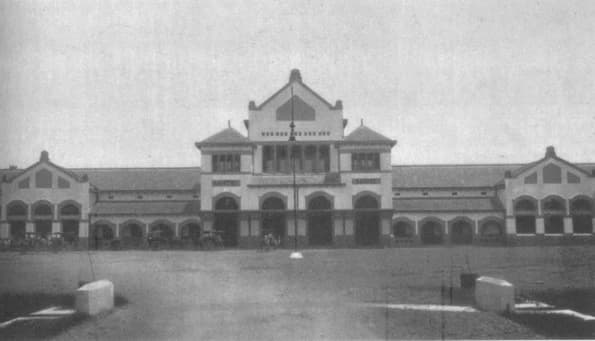
As a transit hub, Cirebon Station features a single-sided station design, where the rail yard and platforms sit on one side of the station building. The architectural style blends Art Deco characteristics with local architectural influences. The Art Deco influence is prominently displayed through the symmetrical facade of the building, featuring a higher central section constructed perpendicular to the main entrance.
At the time of its inauguration, the station entrance consisted of four arched doorways adorned with wall moldings. The leftmost door served as the passenger ticket counter, while the rightmost door was designated for baggage. This layout is visible on the front of the tower, where the sign "KAARTJES" (tickets) was placed above the left entrance and "BAGAGE" (baggage) above the right entrance during its early operations.

Image 1. Front view of Cirebon Station around 1913. (Source: KITLV 119110)
The station hall features a high-ceilinged room that creates a spacious atmosphere. Natural lighting is provided by rows of square windows made of colorful stained glass located above the station facade. During the design phase, the architect originally planned to feature tile artworks depicting the archipelago, but this plan could not be realized. Meanwhile, the rail yard and platforms are sheltered by a wide roof constructed with a steel roof truss framework.
Today, Cirebon Station operates as a busy Class A Large Station, serving passengers traveling to major cities such as Jakarta, Bandung, Yogyakarta, and Surabaya. Situated at an altitude of +4 meters above sea level, this station has been designated as a cultural heritage building registered with the Ministry of Culture and Tourism under registration number RNCB.20100622.02.000798, based on the Ministerial Decree Number PM.58/PW.007/MKP/2010.

Image 2: The SS railway line is indicated by the black-and-white line, while the SCS line is represented by the red-and-white line. The SCS station in Cirebon is Cirebon Prujakan Station, from a 1922 map. (Source: KITLV)

Image 3: The facade of Cirebon Station in 1912. The sign "KAARTJES" is visible above the far-left entrance, and "BAGAGE" is above the far-right entrance. (Source: Spoorwegstation op Java)

Image 4: The platform atmosphere of Cirebon Station in 1913. A locomotive can be seen preparing to change direction using a turntable. (Source: KITLV)
Sources:
Kitlv.nl
DKA Magazine, June 1957 Edition
Marihandono, Djoko. Pembangunan Jalur Kereta Api dan Trem di Cirebon.
Michiel van Ballegoijen de Jong. Spoorwegstation op Java. Amsterdam: De Bataafsche Leeuw. 1993