
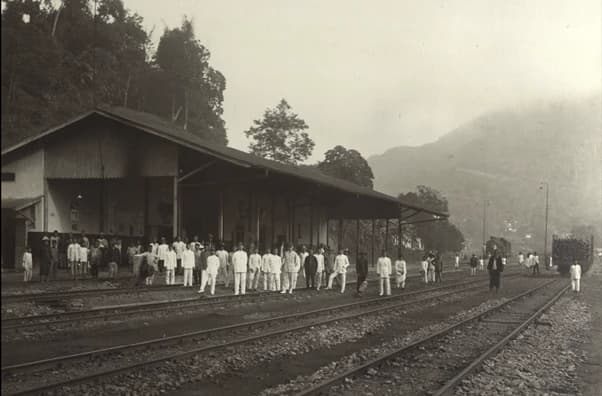
The History of Sawahlunto Station
Sawahlunto Station was officially opened to the public on January 1, 1894, alongside the inauguration of the Muara Kalaban–Sawahlunto railway line. This 4-kilometer track was constructed by the state-owned railway company, Staatssporwegen ter Sumatra Westkust (SSS). Prior to this achievement, SSS had already completed the primary Padang–Padang Panjang–Muara Kalaban route in 1892, which famously featured a specialized rack railway (cog railway) system on the steep section between Kayu Tanam and Batu Tabal.
The presence of the railway network in Sawahlunto was driven entirely by the need to transport coal. Coal deposits were first discovered near the Ombilin River in 1867 by an engineer named W. H. De Grave. Decades later, in 1892, the Dutch East Indies government expanded their search for coal to the Sungai Durian area, which ultimately marked the beginning of the historic Sawahlunto coal mining industry.
During peak operations, coal from the mines was initially loaded onto mining carts (lorries) and moved to Sawahlunto Station. From there, it was transported by large freight trains across the region all the way to Teluk Bayur Harbor. However, toward the end of the year 2000, coal production in Sawahlunto experienced a sharp decline, leading to a complete halt in the station's daily railway activities. Instead of leaving the site abandoned, the building was given a new purpose and repurposed into the Sawahlunto Railway Museum, which was officially inaugurated by Vice President Jusuf Kalla on December 17, 2005.
Today, Sawahlunto Station is protected under multiple historical decrees, having been designated as a cultural heritage building through the Sawahlunto Mayor's Decree No. 105 of 2006, Mayor's Decree No. 188.45/59/WAKO-SWL/2019, and the Minister of Education and Culture's Decree No. 345/M/2014. Furthermore, the station is officially listed in the National Register of Cultural Heritage under the registration number RNCB.20200120.02.001758. It also holds international recognition as an integral part of the "Ombilin Coal Mining Heritage of Sawahlunto," which is proudly inscribed on the UNESCO World Heritage List.

Image 1: A portrait of Sawahlunto Station and its workers around the year 1900. (Source: KITLV 402275)