
History of Kudus Station
TABLE OF CONTENTS
An Overview of the SJS Tramway
The private tram company, Samarang-Joana Stoomtram Maatschappij (SJS), opened a tram network in Semarang City covering the Semarang-Jomblang line. This 4.4 km long track was officially opened to the public on December 1, 1882, with a track gauge of 1,067 mm. Initially, the planned gauge was 914 mm.
When discussing trams, it is important to note that their characteristics differ significantly from regular railways. Trams utilize smaller locomotives and carriages, operate at lower speeds, have smaller transport capacities, and cover shorter travel distances. Furthermore, the opening of a tram line only required a decision from the local government head (Resident), unlike railway lines which required approval from the central government, whether in The Hague or Jakarta.
Subsequently, SJS extended the construction of the tram line to Juana. The construction of the Semarang-Juana line was based on the Governor's Decree No. 5 dated March 18, 1881. The development project for the 87.2 km track was divided into five sections: Semarang-Genuk, Genuk-Demak, Demak-Kudus, Kudus-Pati, and Pati-Joana.
Table 1. Inauguration of the Semarang-Juana Line
| No | Line | Length (km) | Inauguration |
|---|---|---|---|
| 1 | Semarang-Genuk | 6.1 | July 2, 1883 |
| 2 | Genuk-Demak | 19.7 | September 27, 1883 |
| 3 | Demak-Kudus | 26.4 | March 15, 1884 |
| 4 | Kudus-Pati | 21.2 | April 19, 1884 |
| 5 | Pati-Joana | 13.8 | April 19, 1884 |
Source: Gedenkboek der Samarang-Joana Stoomtram Maatschappij 1907
An interesting phenomenon occurred during the construction phase. Rumors circulated about the kidnapping of young children to be used as sacrificial offerings for the opening of the new line. Consequently, as night approached, parents strictly forbade their children from leaving the house. This rumor finally began to fade at the turn of the 20th century.
Section three between Demak and Kudus, spanning 26.4 km, was inaugurated on March 15, 1884. Concurrently, Kudus Station was opened to the public. As a transit point for passengers and goods, SJS always strove to locate stations as close to local markets as possible in major towns. In addition to the station, SJS also built a depot for the maintenance of rolling stock. The Kudus Station Depot building featured a single track equipped with a workshop and a warehouse.
Kudus Station was located right in the heart of Kudus City, not far from the Kudus Town Square (Alun-alun). The station sat adjacent to a specialized European school and was situated near the Rendeng Sugar Factory. This strategic positioning aligned with the primary objective of tram line construction at the time, which was to transport export commodities—chiefly sugar. Therefore, tram lines were deliberately designed to pass through or run close to sugar industries.
The Relocation of Kudus Station
Originally, Kudus Station was a simple wooden structure. The station consisted of an open waiting area and an office building for operational management. In line with the growth and urban planning of Kudus City, municipal re-arrangements were carried out, which directly affected the tram lines and Kudus Station. As a result, SJS rerouted the tram lines and constructed a new station in the Wergu area in 1919.

Image 1: A comparison of the original and new locations of Kudus Station, as seen on maps from 1915 and 1946. The location of Kudus Station is indicated by the yellow circle. The tram line, which originally cut through the city center, can be seen shifting to the right side. (Source: Maps.library.leiden.edu)

Image 2: The original blueprints of the Kudus Station building and the Kudus Depot. (Source: Gedenkboek der Samarang-Joana Stoomtram Maatschappij 1907)
Proposals for building a new station in Kudus had actually surfaced long before. The Bataviaasch Nieuwsblad newspaper published on August 5, 1915, reported on the acquisition of several plots of land in Kudus for the purpose of constructing a new station owned by the SJS company.
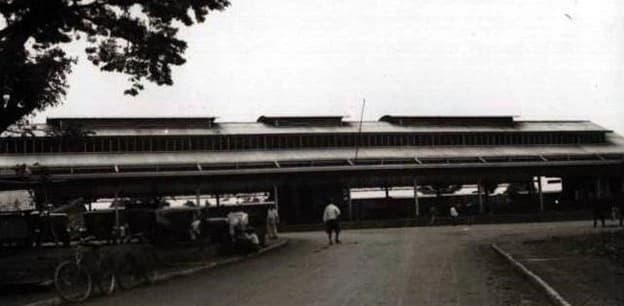
The new station building was designed as an island station with four tracks sheltered by a massive iron canopy. The iron canopy was adorned with yellow-tinted glass panels. Due to its location in Wergu, this station became widely and popularly known as Wergu Station.
According to the train schedule book Officieele Reisgids voor Spoor- en Tramwegen op Java printed in 1900, there were eight tram services that stopped at Kudus Station. These consisted of the Semarang-Juana route (2 round trips), the Semarang-Kudus route (round trip), and trams running from Kudus to Juana (round trip). At that time, the average speed of the trams ranged between 25-30 km/h. A journey from Kudus to Semarang took approximately 3 hours, while the Kudus-Juana route took about 2 hours.
Tram travel fares were categorized by class. In 1900, for a trip from Kudus to Semarang, a 1st class passenger (Europeans) had to pay 2 guilders. For the same route, a 2nd class passenger (Foreign Orientals: Chinese, Arabs) paid 1 guilder, while a 3rd class passenger (mixed and natives) paid just 0.5 guilders. Meanwhile, the freight cost for cargo was 0.15 guilders per 10 kg.
The primary goods transported by the SJS trams were export commodities, particularly sugar. In his 1930 report, the Resident of Semarang, P. J. Bijleveld, noted that during the peak sugar shipping season from factories to the ports, SJS cargo operations became incredibly busy. Aside from sugar, other highly transported goods included salt, tobacco, and coffee.

Image 3: The operational schedule and fare rates for the Semarang-Joana tram in 1900. (Source: Officieele Reisgids voor Spoor- en Tramwegen op Java, printed in 1900)

Image 4: The atmosphere around Kudus Station around 1936.
Following Indonesian independence, Kudus Station became the busiest station along the Tenggang-Juana-Pecangaan-Kayu line. This high volume is evident from passenger and cargo data spanning the years 1950-1952. Despite experiencing a gradual decline in passenger numbers, this station consistently maintained the highest passenger count in the region.
Table 2. Comparison of Passenger and Cargo Volumes (1950-1952)
| Station | Passengers (1950) | Passengers (1951) | Passengers (1952) | Cargo (tons, 1950) | Cargo (tons, 1951) | Cargo (tons, 1952) |
|---|---|---|---|---|---|---|
| Kudus | 729,087 | 451,798 | 377,258 | 11,090 | 13,163 | 10,787 |
| Demak | 319,985 | 216,553 | 210,709 | 2,418 | 1,807 | 194 |
| Juana | 232,775 | 330,255 | 340,725 | 11,235 | 15,424 | 15,165 |
Source: Djawatan Kereta Api di Indonesia Statistik Tahunan 1950-1951-1952
To determine the facilities and transport requirements at each station, the Djawatan Kereta Api (DKA, the predecessor of PT KAI) classified stations into operational tiers. This classification was established via the DKA Decree No. 20493/BB/54 dated March 16, 1954. Stations were categorized into six distinct tiers: Major Station, Class 1 Station, Class 2 Station, Class 3 Station, Class 4 Station, and Class 5 Station. Under this decree, Kudus Station fell into the Class 2 station category.
In the 1980s, Kudus Station ceased operations due to a steady decline in passenger numbers, losing its competitive edge to rising road transport alternatives. Following its closure, the land of Kudus Station was leased by the Local Government (Pemda) of Kudus and transformed into a traditional market in 1993. This market was utilized by the government to relocate traders from the Johar Market and to accommodate the swelling numbers of street vendors (PKL) from the city center.

Image 5: The state of Kudus Station in 1900. (Source: Spoorwegstation op Java)
It wasn't until 1996 that traders fully occupied the converted market space inside Kudus Station. Over time, the Kudus Local Government expanded the market area to three times the original size of the station grounds. This vast marketplace eventually integrated a large number of bicycle and furniture vendors from the Bitingan Market, alongside poultry traders from the Kliwon Market.

Image 6: The Wergu Traditional Market operating inside the former Kudus Station. (Source: Kaskus.co.id)
Sources:
Bataviaasch Nieuwsblad, published August 5, 1915
Djawatan Kereta Api di Indonesia Statistik Tahunan 1950-1951-1952
Gedenkboek der Samarang-Joana Stoomtram Maatschappij 1907
Liem Thian Joe, Riwayat Semarang 1416-1931, Semarang: Boekhandel Ho Kim Yoe, 1933
Maps.library.leiden.edu
Marihandono, Djoko et al., Dari Konsesi ke Nasionalisasi: Sejarah Kereta Api Cirebon-Semarang, Bandung: PT KAI, 2016
Memori Residen Semarang (P. J. Bijleveld), June 2, 1930
Michiel van Ballegoijen de Jong, Spoorwegstation op Java, Amsterdam: De Bataafsche Leeuw, 1993
Officieele Reisgids der Spoor- en Tramwegen en Aansluitende Automobieldiensten op Java en Madoera, January 1, 1900
Romdlani, Nurul, “Pengelolaan dan Pemanfaatan Tanah Perusahaan Kereta Api di Wergu Wetan Kabupaten Kudus Tahun 1965-1998”, Undergraduate Thesis in History, Universitas Gadjah Mada, 2012