
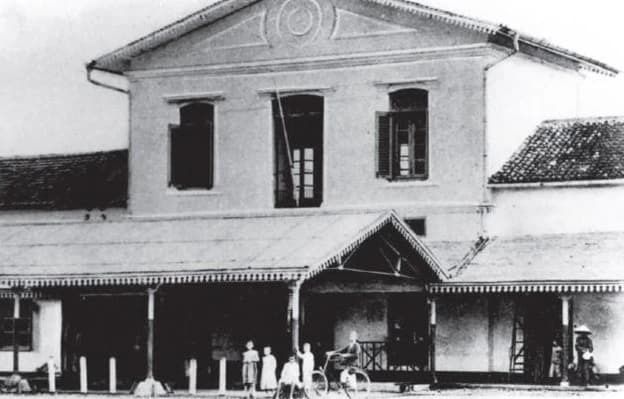
The History of Solo Balapan Station
TABLE OF CONTENTS
Built by NISM
Solo Balapan Station was built by the private railway company, Nederlandsch-Indische Spoorweg Maatschappij (NISM). This company was the first to construct a railway line in Indonesia, covering the Semarang–Vorstenlanden (Solo–Yogyakarta) route. The purpose of developing this railway line was tied to both economic and military interests.
Station Construction
The location of Solo Balapan Station occupied land owned by Prince Mangkunegara IV. This site was formerly adjacent to a race track, one of which was used for horse racing. It is highly suspected that the word "balapan" (racing) became attached to the station's name because of this.
In 1866, the land was leveled and elevated to prevent water from pooling when entering the rainy season. To execute the railway works in Solo, more than 1,200 hired workers were deployed.
By the end of 1866, the station master's house had been completed, but the construction of the station itself was still ongoing. By mid-1867, the interior work of the station building was being prepared. A year later, the relatively simple station building was nearing completion, leaving only the construction of the hall.
De Jonge in Staatsspoorwegen op Java states that the first stations owned by NIS were very simple and small. Often built from bamboo and wood, larger buildings were made of stone and were sometimes accompanied by a station hall. This was because NIS was a private company that prioritized economic interests. Its main focus was the transport of sugar.
Although not yet fully completed, Solo Balapan Station was opened to the public on February 10, 1870. This coincided with the inauguration of the railway line from Kedungjati to Solo. By the end of the year, NIS was still continuing construction on several buildings for operational services.

Image 1: The location map of Solo Balapan Station in 1873. (Source: KITLV)
At the start of its operation, this station served four train trips. Two trains were bound for Semarang (Trains No. 1 and 3), while the remaining two were trains coming from Semarang (Trains No. 2 and 4). At that time, trains did not use names as they do today, but were instead identified only by numbering. A train journey from Semarang to Solo, or vice versa, could be completed in about three and a half to four hours.
The railway served both cargo and passenger transport. Goods from the hinterland were shipped to the port in Semarang. Most of these were plantation and agricultural commodities. It is recorded that in 1870, NISM transported plantation products consisting of 9,039 tons of sugar, 3,248 tons of coffee, 273 tons of tobacco, and 83 tons of indigo. Meanwhile, agricultural products included 12 tons of paddy, 9 tons of kapok, and 5 tons of rice. Various other goods transported included stones, wood, hides, and various miscellaneous items.
On the other hand, goods transported from the port to the hinterland included textiles, beverages, meat, furniture, flour, kerosene, and more. In 1870, the total amount of goods brought in reached 1,824 tons.
Train passengers were divided into three classes: Class 1, Class 2, and Class 3. In 1873, Solo Balapan Station served 97,154 train passengers. The breakdown included 1,366 people in Class 1, 5,276 people in Class 2, and 90,512 people in Class 3.
Class 1 tickets were more expensive compared to Class 2 and Class 3. For the same route, such as between Solo and Semarang in 1898, the price of a Class 1 ticket was 6.5 guilders. Meanwhile, Class 3 passengers only needed to spend 1.6 guilders.

Image 2: The train schedule for the Semarang–Solo round trip in 1870. (Source: De Locomotief, February 25, 1870 edition)
Improving Railway Conditions in Solo
Not long after, two new railway stations were built in Solo City. These were Purwosari Station, owned by NISM, which opened in 1872, and Solo Jebres Station (1884), which was managed by the state-owned railway company, Staatsspoorwegen (SS). In 1911, NISM acquired the Solo–Boyolali tramway line owned by the Solosche Tramweg Maatschappij (STM).
As time went on, the number of passengers and the tonnage of cargo transported by the stations in Solo steadily increased. Railway activities became increasingly complex and busy. Several official residences around the station were also deemed inadequate. Therefore, expansion and renovation of the station were deemed necessary.
Following the takeover of the STM tramway line, NISM planned to erect a new building at Solo Balapan Station. However, SS objected. Both NISM and SS agreed to meet to resolve the railway issues in Solo. The Head of Exploitation of SS, Mr. Weijerman, along with the SS Inspection Chief, traveled to Solo to meet with NISM officials. The meeting, which took place on Wednesday, April 2, 1913, resulted in an agreement that NISM and SS would jointly build a major station in Solo to be used together.
This massive new integrated station was planned to be built between Solo Balapan Station and Purwosari Station. Eventually, Solo Balapan Station would only function as a freight dispatch facility and shunting yard. Meanwhile, the roof structure of Purwosari Station was intended to be repurposed for a new station to be built in the Maguwo area.
However, the plan to build an integrated station gradually faded away. One of the reasons was related to the urban layout of the Mangkunegaran Principality. The former race track area behind Solo Balapan Station was repurposed as a housing estate for Europeans, known as Villa Park, in March 1920. Solo Balapan Station became extremely strategic due to its proximity to this elite residential area. Its presence was even considered to add prestige to Solo Balapan Station.
Ultimately, NISM carried out renovations by expanding and modernizing Solo Balapan Station. The station building was elongated, with a central hall that served ticket and baggage operations. Meanwhile, the west wing of the building was used for the station master's office, telegraph office, Class 1 and 2 waiting rooms, and a restaurant. The east wing housed a warehouse and the Class 3 passenger waiting room.

Image 3: The hall building of Solo Balapan Station. (Source: Harmoni Dalam Perbedaan: Bank Indonesia Dalam Dinamika Ekonomi Solo Raya)
Interestingly, at the end of the east platform lay an SS transit station named Kraton Station (Sko). This stop featured five rooms, each serving as a waiting room, a ticket counter, a station master and telegraph office, and a baggage collection and storage area.
As mentioned earlier, NISM operated train services for the Semarang–Solo–Yogyakarta route. Meanwhile, SS operated journeys from Solo to Surabaya. Although Jakarta and Surabaya had been connected by rail since the early 1890s, passengers had to change trains multiple times. They would depart from Jakarta to Bogor using an NISM train, continue to Bandung–Maos–Yogyakarta aboard an SS train, then take an NISM train between Yogyakarta and Solo, and finally ride an SS train from Solo to Surabaya.
The presence of the SS transit station within the Solo Balapan Station area greatly eased the transfer of train passengers. This arrangement also served as a form of cooperation between SS and NISM.
The Work of Renowned Architect, Ir. Thomas Karsten
During the period of 1917–1920, the palace grounds of Prince Mangkunegara VII were expanded and modified. The person in charge was the celebrated architect, Herman Thomas Karsten. Balapan Station did not escape Karsten’s touch.
Through the architectural firm Karsten en Schouten, Karsten designed a new building in front of Solo Balapan Station. The hall building, measuring 15 x 15 meters along with its wings, adopted the Indo-European architectural style, which combined modern European architecture with local architecture. The local architectural style was reflected in the main building's roof, which utilized the joglo house model.
Construction began in early January 1926. Under the supervision of Mr. Abbing, the new building was completed over the course of a year at a cost of one hundred thousand guilders. The hall building functioned as a shared ticket counter between NISM and SS. In total, there were eight counters: six for daily service and two additional counters used during peak hours. Meanwhile, the west wing building was used for baggage handling and freight shipping.

Image 4: The ticket counter building designed by Thomas Karsten, photographed in 1927. The joglo-shaped roof is clearly visible. (Source: Spoorwegstations op Java)
The floors in both buildings used tiles supplied by the Kitri Factory. Meanwhile, the roof utilized a structure made of iron materials and was covered with corrugated iron sheets. The presence of this new building made it much easier for passengers to purchase tickets for both SS and NISM trains. Previously, the NISM and SS ticket windows were located in separate places with a considerable distance between them, which often caused passengers to run late. Starting in early January 1927, the SS ticket service at Kraton Station was officially closed.
As it developed, Solo Balapan Station grew increasingly busy. During his visit to Solo Balapan Station in 1928, the Governor-General of the Dutch East Indies, de Graeff, declared Solo Balapan Station to be the most strategic station in Solo.
The Era of the War of Independence
One of the mandates of the Proclamation of Independence on August 17, 1945, was that the transfer of power should be executed as quickly as possible. In the railway sector, military forces and railway employees, who were dominated by youth groups, acted swiftly to take over the railway infrastructure and facilities.
In Central Java, the takeover was centered at the Central Exploitation Office located in the Lawang Sewu Building. By September 1945, Lawang Sewu was successfully secured by railway workers and Indonesian soldiers.
The seizure of power over the railway operations at Solo Balapan Station and its surroundings was carried out by several young railway workers. They were Joko Sulaiman, Mr. Sudikman, Haryono, and Harwanto, who met with each other to plan the takeover of the railway assets.
The following morning, they entered the office to clarify the situation to the Japanese soldiers with the intent of taking over. Outside, members of the youth group stood ready, carrying various types of weapons. Without any incidents, the takeover of the station and the depot went smoothly. Furthermore, with the approval of the depot workers, a train was dispatched to Salam, because the Japanese forces there stored a complete supply of wartime necessities.
In Semarang, a battle between freedom fighters and remnants of the Japanese forces broke out on October 14. Five days later, the battle ended, but not long after, Allied forces arrived. To avoid the onslaught of Allied troops, the Central Exploitation Office was evacuated to Kedungjati Station.
Subsequently, the office was relocated again in March 1946. Along with all its employees, the Central Exploitation Office was moved to Solo. Due to area limitations, several departments were scattered across different locations. Several rooms at Solo Balapan Station were repurposed for the use of the Traffic Department and a portion of the Finance Office. The Supplies Department occupied one of the warehouses at Solo Balapan Station. Two years later, a semi-permanent building was erected in the station yard for the requirements of the Way and Works Department as well as the Traction Department.