
Gambir Station History
TABLE OF CONTENTS
The idea of constructing a railway line in Batavia (Jakarta) first emerged in 1846. At that time, the Governor-General of the Dutch East Indies, J. J. Rochussen, proposed that the government build a railway line connecting Jakarta to Buitenzorg (Bogor). The objective of this development was to serve both economic interests, as well as governmental politics and communication. From an economic perspective, the railway service would serve as a means to transport commodities—primarily plantation products—from the inland areas of Priangan to the port in Jakarta. Politically, Bogor was home to the Algemeene Secretarie Building (now the Bogor Palace), which served as the seat of the Governor-General of the Dutch East Indies and the administrative hub of the government.
Following up on Rochussen's proposal, the Dutch Royal Government dispatched David Maarschalk to conduct a survey and draft plans for laying the Jakarta-Bogor railway tracks. Maarschalk was a military officer, a First Lieutenant in the Engineers Corps. The survey was carried out by the military because the route was considered highly vulnerable to security disturbances and faced resistance from local landowners. In his 1853 report, Maarschalk suggested that while construction should be handled by the government, its operation should be handed over to private entities.
After nearly two decades, the vision of building a railway network in Jakarta was finally realized. Precisely in 1864, a private railway company, Nederlandsch Indisch Spoorweg Maatschappij (NISM), was granted a construction concession based on the Dutch East Indies Governor-General Decrees (Gouvernement Besluit or GB) No. 1 dated March 27, 1864, and No. 1 dated June 19, 1865, as well as the Dutch King's Decree (Koningklijk Besluit) dated July 22, 1868.
On Friday, October 15, 1869, construction on the Jakarta-Bogor railway line officially commenced. The groundbreaking was marked by a ceremony attended by Governor-General P. Myer. The 56-kilometer project was led by Engineer J. P. Bordes and divided into three sections: Jakarta-Weltevreden, Weltevreden-Meester Cornelis, and Meester Cornelis-Bogor. Additionally, branch lines were built towards Meester Cornelis (Jatinegara) and Kleine Boom (Pasar Ikan).
Unlike NISM's Semarang-Vorstenlanden (Solo-Yogyakarta) line which used a track gauge of 1,435 mm, the Jakarta-Bogor line utilized a 1,067 mm gauge. This rail line was classified as a second-class track, utilizing rail bars weighing 25 kg each. It could accommodate train compositions traveling at speeds between 20 to 59 km/h.
The 6-kilometer section between Batavia and Weltevreden (now part of Central Jakarta) was inaugurated by NISM on September 15, 1871. Simultaneously, the branch line to Pasar Ikan was opened. To serve as a stopping point in Weltevreden, NISM built Koningsplein Halt, a small and simple structure. It was named Koningsplein because, during the Dutch colonial era, this modest halt sat on the eastern edge of Koningsplein or the King's Square (currently the Monas area). The location of the halt was strategic, being close to the Noordwijk shopping district (now the Juanda area) and Pasar Baru.
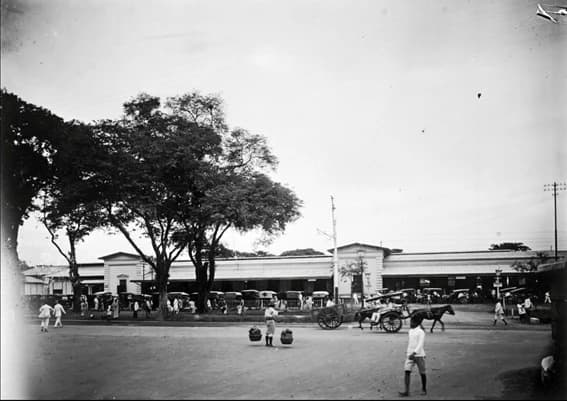
Over time, NISM built a new stopping point in Weltevreden. This was Weltevreden Station, which opened on October 4, 1884, located a few hundred meters north of Koningsplein Halt. The presence of Weltevreden Station automatically replaced the role of Koningsplein Halt. The new station featured an iron roof supported by cast-iron pillars. It served long-distance train journeys to destinations such as Bandung and Surabaya.

Image 1 : Activity at Gambir Station around 1921. Source: Tropenmuseum
Taken Over by Staatsspoorwegen
Since the beginning of the 20th century, the Dutch East Indies government had planned to improve the railway system in Jakarta and its surroundings. However, this plan faced a major obstacle, as the railways in Jakarta were partially owned by the government and partially managed by private companies. Up until 1900, the government, through the state railway company Staatsspoorwegen (SS), operated the Jakarta-Bekasi-Karawang, Jakarta-Duri-Tangerang, and Duri-Rangkasbitung routes.
The opportunity arose in 1913 when the government officially took over the Jakarta-Bogor railway line from NISM. Following this, SS launched a comprehensive overhaul of Jakarta’s railway network. One of SS’s main agendas was to build double tracks and construct an elevated railway line that would ascend from Gondangdia, pass through Weltevreden, and descend back down after crossing Sawah Besar. This elevated track was designed to follow the existing ground route. As part of this elevated system, a new station was to be built in Weltevreden. This new station was strategically planned so that its construction would not disrupt the daily operations of the existing Weltevreden Station. The entire plan was presented by the chief engineer, Koc H, in his address on August 4, 1917.
Unfortunately, the elevated railway proposal put forward by Koc H was never executed. Instead, the existing Weltevreden Station was expanded and redesigned with a much larger front courtyard. Complete alterations were also made to the station's rail yard (emplacement).
Ten years later, in 1928, Weltevreden Station underwent a metamorphosis, transforming into a building designed in the Art Deco style. The station's roof was extended by 55 meters on the north side. Initially, trains were required to stay overnight at Weltevreden Station, which also featured facilities for washing trains and passenger carriages. However, once the construction of the new Jakarta Station (now Jakarta Kota Station) was completed, these maintenance activities were relocated to the Jakarta Station rail yard.
Between 1925 and 1930, railway electrification was implemented across Jakarta, including Weltevreden. Plans for electrification had been initiated around 1915, with work commencing in 1921. In 1937, the name of Weltevreden Station was changed to Batavia Koningsplein Station. By this time, it had become the busiest railway station in the Dutch East Indies. Nearly all major long-distance trains and all trains heading to Bogor made stops at this station.
Batavia Koningsplein Station was also popularly known as Gambir Station. While the exact origin of the name "Gambir" remains uncertain, it is believed to have entered common usage around 1922. At the time, locals referred to Koningsplein as Lapangan Gambir (Gambir Field). According to local lore, this was due to the abundance of Gambir trees growing across the field. The sap from these trees was harvested as a primary raw ingredient for making gambir, a paste traditionally used in betel nut chewing (menyirih).
Becoming an Elevated Station
In 1976, the Governor of Jakarta, Ali Sadikin, and the Governor of West Java, Solihin GP, established a partnership to develop the Jabotabek region (Jakarta-Bogor-Tangerang-Bekasi). The expansion of Bogor, Tangerang, and Bekasi (Botabek) was expected to create new residential areas to accommodate Jakarta's overloaded population. To encourage Jakarta residents to move to Botabek, the government moved to improve transportation infrastructure so that commuters would not hesitate to relocate.
The government, through the Department of Land Transportation, collaborated with Japan to upgrade transport services in Jabotabek. This partnership aimed to create a "Modern Commuter Rail System" to enhance the role of trains within the metropolitan area. One of the core initiatives was the construction of an elevated railway line connecting Jakarta to Manggarai. Japan appointed a team from JICA (Japan International Cooperation Agency) to execute the Jakarta-Manggarai elevated track project.
This development plan was officially recorded in the 1981 Jabotabek Railway Master Plan. The 8.5-kilometer-long elevated track was to be built 5.1 meters above ground level. It would feature double tracks equipped with electrification and automatic signaling, allowing Electric Passenger Trains (KRL), Diesel Passenger Trains (KRD), and long-distance trains to operate on it. New stations were also designed along this elevated track, including a brand-new Gambir Station.
The construction of Gambir Station was carried out alongside the development of elevated track Segment B, which spanned from Gondangdia to Jalan Ir. H. Juanda. The project kicked off with a groundbreaking ceremony for the first pillar of Segment B, located just south of the old Gambir Station, on December 17, 1886. The first pillar was driven into the ground by the Minister of Transportation, Roesmin Nurjadin, and witnessed by the Director-General of Land Transportation, the Governor of Jakarta, and the Director-General of Sea Transportation.
The new Gambir Station opened to the public alongside the inauguration of the elevated line on Friday, June 6, 1992. President Soeharto officially inaugurated the line, marked by the operation of the Electric Rail KRL. Before boarding, the President purchased a ticket at the Gambir Station ticket window.
This new modern station was designed with three levels. The first floor housed the ticket counters; the second floor served as the passenger waiting area, complete with restrooms, shops, restaurants, and staff offices; while the third floor functioned as the boarding platforms.
The architecture of the upper structure appeared simple yet elegant, featuring a multi-tiered roof that integrated traditional Indonesian joglo design elements. Interestingly, each new station along the elevated line was designed with a distinct color scheme in collaboration with the Faculty of Fine Arts and Design at the Bandung Institute of Technology (ITB). Gambir Station was given a dominant green color, accented by glossy green porcelain floor tiles. Alongside Monas and the Istiqlal Mosque, the new Gambir Station building quickly became one of the most recognizable landmarks in the heart of Jakarta.

Image 2 : Aerial view of the new Gambir Station in 1993. Source: Tropenmuseum