
The Longest Active Railway Tunnel
TABLE OF CONTENTS
The Sasaksaat Tunnel is located in Sasaksaat Hamlet, Sumurbandung Village, Cikalong Wetan District, West Bandung Regency. Cutting through the Cidepong Hills, this tunnel is situated between Maswati Station and Sasaksaat Station at km 143+144. To this day, the 949-meter-long Sasaksaat Tunnel remains the longest active railway tunnel in Indonesia.
The Sasaksaat Tunnel was constructed between 1902 and 1903 by the state-owned railway company, Staatsspoorwegen (SS). The construction of this tunnel was part of the Purwakarta–Padalarang railway line project, authorized under the Law of December 29, 1900, Staatsblad No. 8.
Traditional Rituals and Demographics
There is an interesting aspect to the construction of the Sasaksaat Tunnel. Before the project commenced, a traditional offering ritual (sesajen) was held. This ceremony aimed to pray for safety so that no unwanted incidents would occur during the construction process. At that time, the local community believed that the mountain to be bored through for the tunnel was a mystical place ruled by supernatural beings.
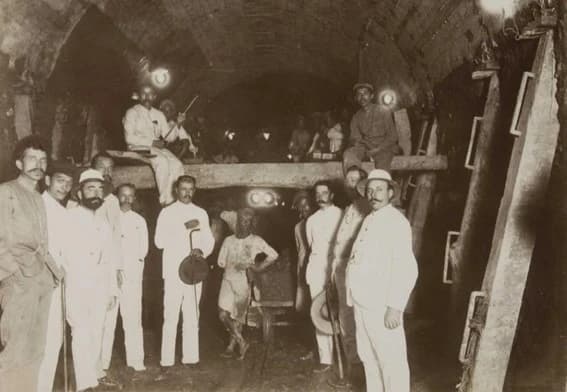
The construction work was entrusted to contractors from Europe, given that the project utilized high-level technology from Belgium. In addition to being contractors, Europeans also worked as branch heads, foremen, and technicians. Meanwhile, Chinese and indigenous people worked as laborers (kuli).
Technical Construction Challenges
Technically, the construction of the Sasaksaat Tunnel was carried out by excavating the ground simultaneously from both the northern and southern sides of the tunnel entrance. During the excavation process, large rocks were frequently encountered. To break them apart, manual hand-drilling was performed.
Dynamite explosives and mechanical drills were not used because their vibrations were too high. This careful approach was chosen to avoid the high risk of vibrating the upper layers of the tunnel, which could trigger catastrophic landslides.
To expedite the work, construction was carried out day and night. The workers used dynamo-powered lamps for illumination. On May 2, 1906, the Sasaksaat Tunnel was opened to the public, coinciding with the official inauguration of the Purwakarta–Padalarang railway line.
Operational History and Present Day
In its early days of operation, the Sasaksaat Tunnel served passenger transport and the carriage of export commodities such as sugar, coffee, and indigo from the Priangan region, as well as daily agricultural products. These commodities were transported to the port in Batavia (Jakarta) to be subsequently shipped to Europe.
Today, the tunnel, which operates under the management of Operational Region (Daop) II Bandung, is traversed by long-distance trains serving the Jakarta–Bandung route as well as trains heading toward Purwokerto.

Image 1 : A portrait of the workers during the Sasaksaat Tunnel construction process, showing Europeans and indigenous people. (Source: Tropenmuseum TM-ALB-1955-17)

Image 2 : Workers posing for a photo at one of the tunnel entrances in 1903. (Source: Tropenmuseum TM-ALB-1955-18)

Image 3 : The atmosphere during the inauguration of the Sasaksaat Tunnel. (Source: Tropenmuseum TM-ALB-1955-15)
Sources:
Data Aset Prasarana PT KAI, Edisi Januari 2018
Melintasi Pegunungan, Pedataran, Hingga Rawa-Rawa: Pembangunan Jalan Kereta Api di Priangan 1878-1924
Sekilas 125 Tahun Kereta Api Kita 1867-1992