
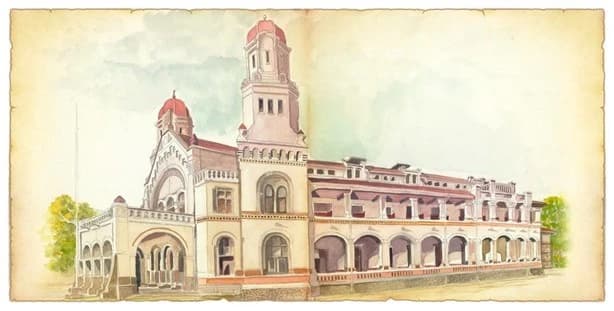
Lawang Sewu Building History
Headquarters of a Private Railway Company
Lawang Sewu is a historic building owned by PT Kereta Api Indonesia (Persero) that was originally used as the Hoofdkantoor (headquarters) of the private railway company Nederlandsch-Indische Spoorweg Maatschappij (NISM). This company opened the first railway network in Indonesia, serving the Semarang–Surakarta–Yogyakarta route, which began operating in 1867 on the Semarang–Tanggung line.
Initially, NISM's administration was conducted at the Samarang NISM Station. Due to rapid network growth and an increasing need for office space, a decision was made to construct an administration building at a new location. The chosen site was a plot of land on the outskirts of the city near the Dutch East Indies Resident's residence, at the southern end of Bodjongweg Semarang, near Wilhelmina Plein (now Tugu Muda Semarang).
The Lawang Sewu building was designed by prominent Dutch architects, Prof. Klinkhamer in Delft and B. J. Ouëndag in Amsterdam. Both architects designed the Lawang Sewu building and managed the construction from the Netherlands by creating all the blueprints and sending all progress reports.

Construction stages of the Lawang Sewu Building.
Construction began on February 27, 1904, and was completed in July 1907. The first structures built were the guard house and the printing building, followed by the main building. After several years of use, an office expansion was carried out by constructing an additional building on the northeast side between 1916 and 1918.
NISM's headquarters was one of the first modern office buildings erected in Indonesia. Designed with outer galleries, the building was well-suited for the tropical climate. The architecture possesses highly detailed and distinct characteristics. The main building features stained glass crafted by the artist J. L. Schouten from the 't Prinsenhof studio in Delft. One of the ornaments on the stained glass depicts a winged wheel, symbolizing the glory of rail transport at that time.
The name Lawang Sewu is a Javanese nickname meaning "Thousand Doors," describing the building's vast number of doors, even though the actual count does not reach one thousand.

Activity in the courtyard of the Lawang Sewu Building around 1930.
A Brief History of the Lawang Sewu Building:
From July 1907, it served as the Administrative Headquarters of NIS.
Between 1942 and 1945, Lawang Sewu was taken over by the Japanese and used as the Riyuku Sokyoku office (the Japanese Transportation Bureau).
Following Indonesian independence in 1945, it became the Central Exploitation Office of DKARI (Djawatan Kereta Api Republik Indonesia).
In 1946, it was used as a Dutch military headquarters, forcing DKARI's office activities to move to the former de Zustermaatschappijen office (currently the PT KAI Daop 4 Semarang Office).
After the recognition of Indonesian sovereignty in 1949, the building was used by Kodam IV Diponegoro.
In 1994, the building was handed back to the national railway company Perumka, now PT Kereta Api Indonesia (Persero).
In 2009, PT Kereta Api Indonesia (Persero) undertook restoration work on the building.
On July 5, 2011, the completion of the cultural heritage restoration for Building A of Lawang Sewu was officially inaugurated.

The atmosphere of Lawang Sewu around 1940, showing tram tracks owned by the private company Semarang–Juana Stoomtram Maatschappij (SJS).

Employees of Riyuku Sokyoku in front of the entrance to Lawang Sewu around 1942.

The Tugu Muda Semarang Monument, inaugurated in 1953 to commemorate the Five-Day Battle of Semarang, pictured in 1955. In that year, Lawang Sewu was used as the Kodam IV Diponegoro Office.
Currently, the Lawang Sewu Building is utilized as a museum, the Lawang Sewu Historic Building, which showcases a wide array of collections from various eras of Indonesia's railway history. Exhibited collections include Alkmaar equipment, Edmondson ticket machines, calculating machines, typewriters, steam locomotive replicas, historical financial securities, and more. Lawang Sewu also presents the restoration process of the Lawang Sewu building through photos, videos, and restoration materials. Near the exit, there is a library stocked with railway-related books.
In addition to being a historical tourist destination, the Lawang Sewu Building can also be rented for exhibitions, meeting spaces, photoshoots, filming, wedding receptions, festivals, bazaars, art performances, workshops, and other events.