
KAI Head Office History
TABLE OF CONTENTS
A Brief Overview of the State Railway Company, Staatsspoorwegen
The initial idea of railways in Indonesia emerged in 1840. It came from a military officer, Colonel Jhr. van der Wijck, who submitted a note to the Dutch East Indies government. It stated, "The construction of railway tracks along Java Island will be very useful for defense. Starting from Surabaya, passing through Solo and Jogja, and ending in Batavia (Jakarta) with several branch lines." Along with the increase in forced cultivation production (Cultivation System), there was an increasing need for more effective and efficient transportation.
After several surveys and investigations were conducted, the need for a railway network became stronger. Subsequently, a debate arose: should it be built by the government (conservatives) or the private sector (liberals)? Finally, in 1862, it was decided that the private sector, the Nederlandsch-Indische Spoorweg Maatschappij, received the concession for the Semarang–Vorstenlanden (Solo–Jogja) route. Between Semarang and Tanggung, spanning 25 km, the first railway journey in Indonesia—and the second in Asia after India—was inaugurated.
The government also took part in the railway business. Through the Law of April 6, 1875, Staatsblad No. 141, the state railway company, Staatsspoorwegen (SS), built the Surabaya–Pasuruan–Malang railway line. This line in the eastern region was also known as Oosterlijnen. Meanwhile, in the western region (Westerlijnen), SS built a railway line from Buitenzorg (Bogor) to Bandung and Cicalengka in 1878. Gradually, these eastern and western lines were connected, along with the construction of several branch lines.
In its development, in 1905, SS built a tram line. The initial route opened was from Madiun to Ponorogo. As a result, the SS company changed its name to Staatsspoor en Tramwagen. Meanwhile, outside Java, SS constructed a railway line in Aceh in 1876, which was initially focused on military purposes. In West Sumatra, railways were built for coal transport in 1891, in South Sumatra in 1914, and in Sulawesi in 1922.
Table of Railway Line Openings Owned by SS
Route | Length (km) | Inauguration Date |
|---|---|---|
| Oosterlijnen | ||
| Sidoarjo–Madiun | 169 | July 1, 1882 |
| Kertosono–Blitar–Malang | 131 | January 10, 1896 |
| Madiun–Solo | 97 | May 24, 1884 |
| Pasuruan–Probolinggo–Panarukan | 225 | October 1, 1897 |
| Kalisat–Banyuwangi | 88 | February 2, 1903 |
| Westerlijnen | ||
| Yogyakarta–Cilacap | 176 | July 20, 1887 |
| Cicalengka–Cilacap | 225 | November 1, 1894 |
| Jakarta–Anyer–Labuan | 217 | December 20, 1900 |
| Jakarta–Karawang | 50 | March 20, 1898 |
| Padalarang–Karawang | 97 | May 2, 1906 |
Source: Korte Geschiedenis der Nederlandsch Indische Spoor en Tramwegen
Staatsspoorwegen Head Office Relocates to Bandung
Initially, SS had its head office in Buitenzorg (Bogor). In March 1888, SS became part of the Department van Openbare Werken (Department of Public Works). Its head office was relocated to Batavia (Jakarta), specifically in Weltevreden (Central Jakarta) on Molenvliet West (Jl. Gajah Mada). Under the leadership of Chief Inspector Stipriaan Luiscius, the SS office was moved to a large old house on Molenvliet East (Jl. Hayam Wuruk) in 1911.
In the early 1900s, a proposal emerged to move the capital of the Dutch East Indies to Bandung. This was reinforced by the establishment of the Gouvernements Bedrijven Building (Ministry of State Enterprises), now known as Gedung Sate, in Bandung. Consequently, the SS head office was also relocated to Bandung.

Location of the KAI Head Office in 1905, which appears to still be a villa/inn. (Source: maps.library.leiden.edu)
The location of the new SS office was originally Villa Maria, also known as Gedong Karet. Owned by M. Philippeau, the building was later used as an inspector's residence. Ownership of Villa Maria was then transferred to C. H. O. M. von Winning, a retired KNIL soldier. The villa featured stone walls coated with Portland cement tiles, rasamala wood for the ceiling, and teak wood for doors, windows, and interior decorations. It consisted of a main building, a back gallery, a dining room, 10 rooms measuring 48 m², 7 rooms measuring 30 m², and 2 smaller rooms. The front yard of the villa was vast, planted with banyan, rubber, dammar, and other trees. It underwent renovation around 1900, which included repainting the entire building.
Ownership of Gedong Karet changed hands once again. Afterward, it was owned by Rudolf Eduard Kerkhoven, a prominent landowner in the Priangan region. The property was a plantation inherited from his father, Rudolph Albert Kerkhoven. It is not known for certain when R. E. Kerkhoven occupied the building, but it is estimated that he became the legitimate owner by 1912. In early 1918, R. E. Kerkhoven passed away, and a year later, Gedong Karet was purchased by a hotel chain.
In 1919, Gedong Karet was converted into a hotel named the Grand National Hotel. The hotel underwent expansion; initially consisting of one building, three additional buildings were added along with enclosed corridors and three warehouses, spanning a total area of 206.75 m². It was intended to accommodate one hundred rooms. This construction project was carried out by Firma Selle & de Bruijn, with engineer Charles P. Schoemaker serving as the chief architect. The former Villa Maria or Gedong Karet building was repurposed into office rooms and a reading room.
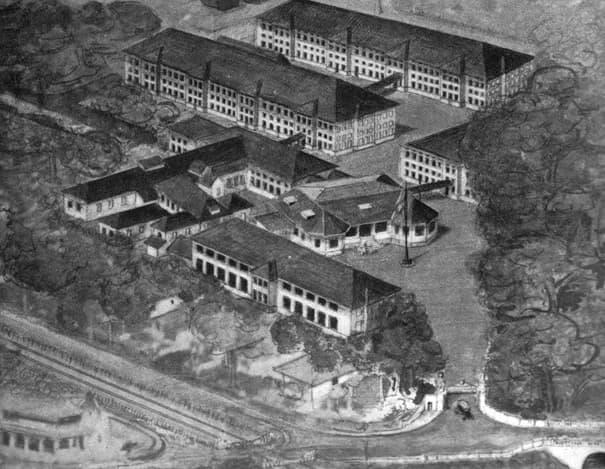
The operation of the Grand National Hotel did not last long. In 1921, the hotel was acquired by Staatsspoorwegen (SS) to be used as its Hoofdkantoor (head office). Furthermore, the expansion of SS required a larger office space. The move from Jakarta took place gradually between 1923 and 1924. The President Director (Hoofdinspecteur) relocated in August 1923, and the entire transfer was completed in 1924. In 1927, SS expanded the building complex. To facilitate the process, the connecting corridors between buildings were demolished. The former Villa Maria became the main office building designated for the president director and other board members. Far in front, separated by an open field, stood the main entrance gate of the Hoofdkantoor Staatsspoorwegen. Several buildings in the head office complex included Pavilion A, Pavilion B, Pavilion C, Pavilion D, an archives building with a basement, garages, and several bicycle parking areas.

Painting of the Staatsspoorwegen Office, showing the Pavilion (Pendopo), Auditorium Room, and Corporate Secretary Building. (Source: Staatsspoor en Tramwegen in Nederlandsch Indië 1875-1925)

Expansion process of the Staatsspoorwegen Office in 1927. (Source: colonial.architecture.edu)

Construction of the Staatsspoorwegen office building in 1927. (Source: colonial.architecture.edu)

Entrance gate of the SS Office, showing the original villa building used by the SS Chief Inspector, 1927. (Source: Het Indische Spoor in Oorlogstijd)
President Director of SS in 1924, Ir. W. F. Staargaard, in his workspace at the Bandung Head Office. (Source: Staatsspoor en Tramwegen in Nederlandsch Indië 1875-1925)
Under the Shadow of Japan
After Japan occupied the Dutch East Indies, it divided the region into three administrative territories: Java and Madura were controlled by the 16th Army; Sumatra was controlled by the 25th Army; while Kalimantan, Sulawesi, Maluku, and Lesser Sunda were controlled by the 2nd Southern Expeditionary Fleet of the Navy.
Regarding railways, control of all railway networks in Java was consolidated under a single entity called Rikuyu Sokyoku (Land Transport Bureau). The railway headquarters was located at the former Staatsspoorwegen (SS) head office in Bandung. Pre-war railway operations under SS, which were divided into two operational regions—the Western Line Exploitation (Exploitatie der Westerlijnen) and the Eastern Line Exploitation (Exploitatie der Oosterlijnen)—were reorganized into three operational regions: Western Exploitation (Seibu Kyoku), Eastern Exploitation (Tobu Kyoku), and Central Exploitation (Chubu Kyoku). Each operational region (Kyoku) was divided into several Inspections (Zimusho), each headed by a Chief Inspector (Zimusho-tyo).
Meanwhile, railways in Sumatra were integrated into the railway system in Singapore, cutting off connection with the railways in Java. Similar to Java, railways in Sumatra were also divided into several operational regions: Nanbu Sumatora Tetsudo (South Sumatra Exploitation), Seibu Sumatora Tetsudo (West Sumatra Exploitation), and Kita Sumatora Tetsudo (North Sumatra Exploitation).
The top leadership of the railway during the Japanese occupation was called Tetsudo Sokyoku Cho. All leadership positions were held by Japanese personnel, though some Dutch employees were still retained because replacements were not yet available. Local railway employees gained significant opportunities to hold strategic positions. In addition, during the Japanese occupation, railway personnel were given opportunities to gain additional technical knowledge in the field of railways. A railway college was established by the Japanese, along with various courses to enhance the knowledge and skills of railway workers.
Takeover of the Bandung Railway Grand Hall (Balai Besar)
On August 17, 1945, Soekarno and Hatta proclaimed Indonesia's independence. The proclamation stated that matters concerning the transfer of power and other details would be carried out carefully and in the shortest possible time. Several vital assets began to be taken over, one of which was the railway system. Following the successful takeover of railways in Jakarta in early September 1945, thousands of railway workers gathered at the Bandung Grand Hall (Balai Besar Bandung) from the morning of September 28, 1945. Together with representatives from Jakarta, several youths designated by the crowd outside went directly into the agency head's office.
Hundreds of railway workers and youth filled the front courtyard of the Bandung head office, waiting for their colleagues negotiating with Japanese military commanders in the director's office on September 28, 1945. After the Japanese departed, the Indonesian flag was raised for the first time while the national anthem, Indonesia Raya, was sung in the head office front yard.

Photograph of the takeover of the Grand Hall (Balai Besar) in Bandung. (Source: DKARI, Setahoen Merdeka, 1946)
On September 30, 1945, a leadership meeting was held at the Bandung head office. During this consultative meeting between representatives of regional railway offices from Jakarta, Semarang, and Surabaya, delegates agreed to establish a new management to replace the old one. In a meeting following the takeover, inside this main building, the Department of Railways of the Republic of Indonesia (Djawatan Kereta Api Republik Indonesia / DKARI) was established by all railway employees on September 30, 1945.
The Grand Hall in Evacuation: From Cisurupan to Yogyakarta
In October 1945, Allied troops accompanied by NICA (Netherlands Indies Civil Administration) forces arrived in Bandung. Inevitably, frequent battles broke out between Indonesian freedom fighters and Allied troops. The city of Bandung descended into chaos. Nevertheless, train operations continued to run, albeit sporadically and often accompanied by the sound of whizzing bullets and mortar explosions.
As conditions in Bandung grew increasingly critical by the day, Allied forces issued an ultimatum to immediately evacuate North Bandung. On March 24, 1946, the residents of Bandung evacuated all buildings and set them on fire, an event known as Bandung Lautan Api (Bandung Sea of Fire). The Bandung Grand Hall was also evacuated, after previously being occupied by Allied forces.
The Bandung Grand Hall evacuated to Cisurupan on March 25, 1946, accompanied by thousands of employees and their families. In Cisurupan, part of the Bandung Grand Hall was relocated to the former Grand Hotel Cisurupan. Meanwhile, the Way and Works Department and the Supply Department occupied the Railway Inspection Office in Purwokerto. The Traction Department was partially relocated to the Leles area. To connect regional railway leadership with the Grand Hall in Cisurupan, train services were operated on several routes: Yogyakarta–Cisurupan, Solo–Garut, Cikampek–Mojokerto, and Yogyakarta–Jember. Despite being in evacuation, the Bandung Grand Hall continued to operate the railway network and perform maintenance and repairs on railway infrastructure and rolling stock. Cisurupan served as the railway command base until May 1947.
Similarly, the situation in Cisurupan eventually became unsafe as well. Gradually, the Grand Hall was moved again to Gombong, Central Java. One of the reasons was that the Indonesian government had moved to Yogyakarta, making coordination with the central government easier. On June 25, 1947, the Railway Grand Hall was temporarily housed at Fort Van der Wijck. The first and second floors served as offices, while the outside area was used as long barracks-style dormitories for railway employees.
As military pressure intensified, Gombong came under threat. Consequently, the Grand Hall was evacuated once again to Yogyakarta. Using an Extraordinary Train (Kereta Luar Biasa / KLB) at night, railway employees and their families were transported. Due to limited train sets and the rush caused by fear of Allied military attacks, some items and official archives could not be carried along. On July 20, 1947, the Grand Hall occupied the former Hotel Mataram at Jalan Malioboro No. 20.
A New Chapter: Head Office of PT Kereta Api Indonesia (Persero)
Following the recognition of Indonesia's sovereignty, the railway dualism between Djawatan Kereta Api Republik Indonesia (DKARI) and Staatsspoorwegen/Verenigd Spoorwegbedrijf (SSVS) was merged into Djawatan Kereta Api (DKA) in 1950. Subsequently, Dutch-owned railway and tram companies were nationalized.
To run railway operations, DKA reoccupied the Railway Grand Hall in Bandung. As a tribute to DKA heroes who fell while serving their homeland and nation in general, and DKA in particular—heroes who fought selflessly and sacrificed their lives—the 50th-anniversary monument of SS was converted into the Monumen Kenangan Hormat (Respectful Remembrance Monument). This monument was the result of a competition held by the Railway Sports and Entertainment Arts Association (Perkumpulan Olahraga dan Seni Hiburan Kereta Api / POSHKA).

Ir. Abu Pariytno, Director General and Head of DKA, inaugurates the Monumen Kenangan Hormat in front of thousands of DKA employees. (Source: Berita DKA, December 1962)

The Monumen Kenangan Hormat inaugurated by the Director General and Head of DKA, Ir. Abu Pariytno. The Governor of West Java is seen as one of the invited guests. (Source: Majalah DKA, December 1962)
The Railway Grand Hall in Bandung is now known as the Head Office of PT Kereta Api Indonesia (Persero). This building witnessed various transformations of the corporate status, including Perusahaan Nasional Kereta Api (PNKA) in 1963, Perusahaan Jawatan Kereta Api (PJKA) in 1971, Perusahaan Umum Kereta Api (Perumka) in 1991, up to its current state as a limited liability state-owned company. The head office has not undergone major structural changes, with only several additional buildings erected around the 1970s–1980s.
The current layout of the buildings remains very similar to its era as the Hoofdkantoor Staatsspoorwegen, consisting of Building A, Building B, Building C, Building D, and Building E, with a total of around 25 buildings. In terms of architectural form, the old buildings remain well preserved while adapted for modern functions. The architectural style of the added buildings appears distinct. Today, the Head Office of PT Kereta Api Indonesia (Persero) has been designated a Cultural Heritage Building under Bandung City Regional Regulation No. 7 of 2018.
Sources:
Ade Maulida Shifa. Bangunan Pendopo Kantor Pusat PT KAI: Kajian Adaptasi Dalam Pelestarian Cagar Budaya
Colonialarchitecture.eu
Diannisa Nur Rahma. Bentuk-bentuk Bangunan Kantor Pusat Staatsspoor en Tramwegen di Bandung: Perspektif Kebudayaan dan Lingkungan
Jan de Bruin. Het Indische Spoor in Oorlogstijd
Javapost.nl
Madjalah DKA
Setahoen Merdeka
Maps.library.leiden.edu
Poerbahadisaputro. Mosaik Perjuangan Kereta Api 1945: Balai Besar KA Bandung Mengungsi
R.P.G.A Voskuil. Bandoeng Beeld van Een Stad
S.A Reitsma. Boekoe Peringatan dari Staatsspoor en Tramwegen di Hindia Belanda 1875-1925
S.A Reitsma. Korte Geschiedenis der Nederlandsch Indische Spoor en Tramwegen