
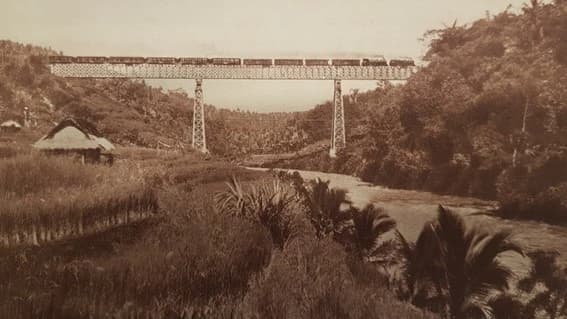
Cirahong Bridge
The state railway company, Staatsspoorwegen (SS), officially inaugurated the Tasikmalaya–Kesugihan railway line on November 1, 1894. Previously, SS had completed the construction of the Warungbandrek–Tasikmalaya railway line in 1893. The construction of these routes aimed to foster development in the southeastern Priangan region.
Table 1. Construction Stages of the Warungbandrek–Kesugihan Railway Line
Section | Base Office | Line Section | Length (km) |
|---|---|---|---|
Section 1 | Cibungur | Cibatu Halt – Trowek Village | 28.23 |
Section 2 | Tasikmalaya | Trowek Village – Tasikmalaya | 29.42 |
Section 3 | Ciamis | Tasikmalaya – Citandui | 32.78 |
Section 4 | Banjar | Citandui – Cilongkrang | 28.81 |
Section 5 | Cilacap | Cilongkrang – Kesugihan and Maos Station | 55.46 + 1.62 |
Source: Agus Mulyana, Crossing Mountains, Plains, and Swamps: The Development of Railways in the Priangan Region, 1878–1924.
The areas traversed by the Warungbandrek–Cilacap railway line were fertile lands. The presence of the railway served to facilitate the transport of commodities into and out of southeastern Priangan, as well as incoming goods. In addition, the railway line was utilized by the Colonial Government for military defense.
Constructing the Warungbandrek–Cilacap railway line required traversing many mountainous regions and river streams. To connect these routes, SS constructed several bridges. Over the Citandui River, SS built three bridges: Citandui Bridge 1 (between Manonjaya and Ciamis), Citandui Bridge 2 (between Ciamis and Banjar), and Citandui Bridge 3 (between Banjar and Sidareja).
The entire construction of these bridges utilized iron imported from Europe, which was shipped to Tanjung Priok Port. Before being dispatched to the construction sites, the materials were stored and processed in Bandung.
The installation of stone pillars for Citandui Bridge 1—also known as Cirahong Bridge—took place on August 19, 1893. The design of Cirahong Bridge was crafted by Chief Building Officer Hesselink. The bridge rests on four pillars: the two middle pillars are made of iron, while the two outer pillars are constructed from cement masonry and stone. The distance between the stone and iron pillars is eight meters. During the construction phase, the foundation and stone pillar work were supervised by 1st Class Inspector E. G. Wijers.
The superstructure of the bridge weighed 795 tons, while its iron pillars weighed 195 tons. On September 29, 1893, the superstructure was completed, and by mid-December 1893, trains were already able to cross the bridge.
By category, Cirahong Bridge is classified as a wall bridge (lattice girder bridge), where the load is not borne directly by the main girders but transferred via longitudinal and transverse beams to the main girders. Its framework features a continuous truss girder system (vakwerkwandbrug met continuligger).
Between 1956 and 1958, Djawatan Kereta Api (DKA, the predecessor to PT KAI) conducted bridge repair and maintenance across Java. Afterwards, DKA upgraded the load capacity scheme for bridges, including the section along the Cibatu–Banjar line. The load capacity was increased from an evenly distributed load of 5.55 t/m (1907/1911 Load Scheme) to 8.75 t/m (1921 Load Scheme).
Today, the 202-meter-long Cirahong Bridge operates under Operational Area (Daop) 2 Bandung. Long-distance passenger trains serving routes such as Bandung–Yogyakarta–Surabaya and Jakarta–Purwokerto via Bandung cross this bridge. Situated between Manonjaya Station and Ciamis Station, this bridge connects two regencies: Tasikmalaya and Ciamis. Uniquely, Cirahong Bridge is not only used by trains; the lower deck beneath the track can be traversed by road vehicles, including cars, motorcycles, and bicycles.

Location of Cirahong Bridge marked with a red circle, while Manonjaya Halt is marked with a yellow circle, 1917 map. (Source: Maps.library.leiden.edu)

A train set pulled by two locomotives crossing Cirahong Bridge. (Source: Staatsspoor en Tramwegen in Nederlandsch Indie 6 April 1875-1925)

The atmosphere around Cirahong Bridge around 1925–1933. (Source: Tropenmuseum.nl)

Diagram model of a continuous truss wall bridge. (Source: DKA Magazine, December 1956)

A group of Dutch soldiers repairing Cirahong Bridge, August 1947. (Source: Gahetna.nl)


Portraits of Cirahong Bridge in the 1930s and in 2014. (Source: Tropenmuseum.nl and PBA Collection)
References
Gahetna.nl
DKA Magazine, December 1956
Maps.library.leiden.edu
Mulyana, Agus. 2005. “Melintasi Pegunungan, Pedataran, Hingga Rawa-Rawa: Pembangunan Jalan Kereta Api di Priangan 1878-1924”. Doctoral Dissertation. History Study Program, Universitas Indonesia.
Tim Telaga Bakti. 1997. Sejarah Perkeretapian Indonesia Jilid II.
Tropenmuseum.nl
Subarkah, Iman. 1992. Sekilas 125 Tahun Kereta Api Kita 1867-1992.
Staatsspoor en Tramwegen in Nederlandsch Indie 6 April 1875-1925.