
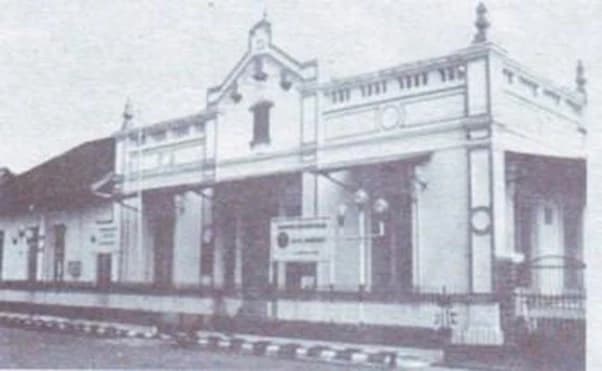
Regional Operation 2 Office
Since the Bogor–Bandung railway line began operations in 1884, numerous railway heritage sites have been scattered across the city of Bandung. One of the Dutch colonial heritage buildings still standing today is the Regional Operation (Daop) 2 Office building, located directly across the south side of Bandung Station. This building is one of three railway office buildings that operated during the Dutch colonial era. At that time, they faced each other along Maarschalk Road (Maarschalklaan). This two-lane road, resembling a boulevard, connected Bandung Station with Kebonjati Road (Kebondjati weg).
Initially, the state railway company of the Dutch East Indies, Staatsspoorwegen (SS), had built only one railway office building in Bandung since 1882, concurrently with the construction of the Bogor–Sukabumi–Cianjur–Bandung–Rancaekek railway line. In 1884, the construction of the office was completed and was used as the SS administration office representing the Surabaya division in Bandung. A few years after the first railway operations in West Java commenced, the structure of the SS, which was previously centered in Surabaya, was split into two exploitation areas: the West Exploitation (SS Westerlijnen) and the East Exploitation (SS Oosterlijnen). In 1888, the administration office of the SS West Exploitation first occupied the building at the southeast corner of Maarschalk Road, which had been in use since 1884. By 1900, an additional SS building at the southwest corner of Maarschalk Road was completed and began operating as the office of the head of the SS West Exploitation in 1901. This very building serves as the Daop 2 Bandung Office today. Meanwhile, the official residence of the head of the SS West Exploitation (located across from the Daop 2 Office) completed the trio of railway buildings on Maarschalk Road since 1906.

Image 1: The area of the Staatsspoorwegen (SS) Westerlijnen Office is indicated by the blue circle, from a 1933 map. (Source: Maps.library.leiden.nl)
When the regional inspection divisions (equivalent to Regional Operations) for the SS Java West and East Exploitations were established starting in 1917, the Daop 2 building at that time was centralized as the SS Inspection 2 Office for Bandung and its surrounding areas. Meanwhile, the administration of the West Exploitation, which oversaw the inspection regions, remained in the old building (the 1884 building). Once the SS headquarters at Kebon Jukut, Bandung, became fully functional in 1924, the West Exploitation office relocated to the headquarters. The Daop 2 Office building itself continued to serve as the railway Inspection 2 Office until 1971, spanning from the era of SS Westerlijnen (until 1942), Rikuyu Sokiyoku (1942–1945), DKARI (1945–1947), SS/VS (1947–1949), DKA (1950–1963), up to PNKA (1963–1971). A few years after being managed under PJKA (Perusahaan Jawatan Kereta Api), the West, Central, and East Exploitation regions along with their subordinate inspection areas in Java were abolished and replaced by nine regional operations. For Regional Operation 2, the Daop 2 Bandung Office building was utilized and remains operational to this day.

Image 2: Buildings around Maarschalk Road connecting Bandung Station with Kebon Jati Road, circa 1910. (Source: KITLV)

Image 3: The front view of the Daop 2 Bandung Office in 1984. (Source: APA Collection)
The physical structure of the current Daop 2 Office building has undergone several renovations. However, the earliest original design elements of the structure can still be seen at the front facade of the building. First constructed between 1898 and 1900, the ancient Greek architectural art style is still visible in the supporting pillars at the front corners that blend into the building walls. Throughout the decades from the 1880s to 1900, this architectural style was frequently applied to masonry buildings in Indonesia. Nonetheless, a new style, serving as a transitional phase from the ancient Greek era toward modern art, appears to predominantly dominate the front facade of the building.

Image 4: The atmosphere of the Daop 2 Bandung Office building in 2016. (Source: APA Collection)
Sources:
KITLV
Mulyana, Agus. “Melintasi Pegunungan, Pedataran, Hingga Rawa-rawa: Pembangunan Jalan Kereta Api di Priangan 1878-1924.” Doctoral Program of Historical Studies, Faculty of Humanities, Universitas Indonesia, 2005.
Reitsma, S.A. Gedenkboek der Staatsspoor en Tramwegen in Nederlandsch-Indie 1875-1925. Weltevreden, Topografische Inrichting, 1925
