
The Story of Cikubang Bridge
On December 27, 1902, the state-owned railway company Staatsspoorwegen (SS) inaugurated the Karawang-Purwakarta railway line. Two years later, SS continued the construction of the Purwakarta-Padalarang line. This 56-kilometer-long railway line passed through many mountain slopes. Consequently, SS built several connecting bridges.
There were approximately eight bridges built by SS, three of which were long-span bridges: Cikubang, Cibisoro, and Cisomang. The construction of these bridges utilized iron imported from Europe, which was shipped to the Port of Tanjung Priok, while some parts were delivered via the Port of Cilacap. During the construction process, the project faced a major obstacle when the iron shipments were delayed for nearly eight months.
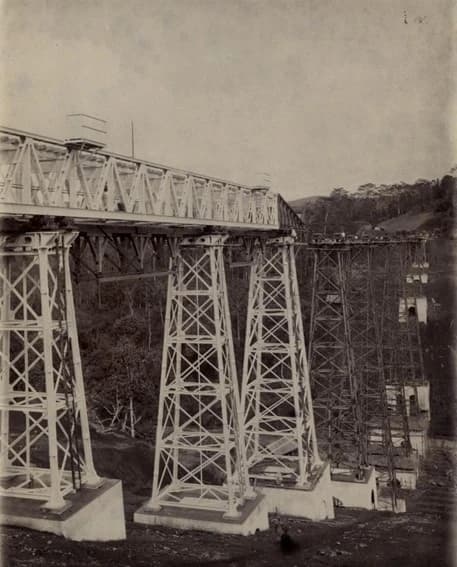
The Cikubang Railway Bridge has a structural configuration length of 3x20+2x(3x30)+3x20 meters. It is highly probable that the bridge was named Cikubang because it spans across the Cikubang River. On May 2, 1906, the Cikubang Bridge was opened to the public, coinciding with the official inauguration of the Purwakarta-Padalarang railway line.

Image 1: The construction process of the Cikubang Bridge. (Source: KITLV)
Based on its structural type, the Cikubang Bridge is classified as a deck truss bridge, where the transit load is not placed directly onto the main girders, but rather transferred through longitudinal and transverse beams. Meanwhile, the framework utilizes an open-deck truss structure with a top-chord deck (vakwerkwandbrug met bovengelegen rijvloer) with a span length ranging from 12 to 50 meters.

Image 2: A diagram of the top-chord deck framework with a span of 12-50 meters. (Source: DKA Magazine, December 1956)
In the 1950s, Djawatan Kereta Api (DKA, the predecessor of PT KAI) carried out structural strengthening projects on various bridges across Java, including the Cikubang Bridge. DKA upgraded the load capacity plan for the Cikubang Bridge. Initially, it was designed to withstand a uniformly distributed load of 5.55 t/m under the 1911 Load Plan. This capacity was successfully upgraded to 8.75 t/m under the 1921 Load Plan.

Image 3: The atmosphere surrounding the Cikubang Bridge around 1910. (Source: Tropenmuseum.nl)
Today, with a total length of 300 meters, the Cikubang Bridge holds the title of the longest active railway bridge in Java. Operating under the management of Regional Operation (Daop) II Bandung, this bridge is crossed daily by long-distance trains serving the Jakarta-Bandung and Jakarta-Purwokerto (via Bandung) routes.

Image 4: Welcoming the morning, a train crosses the Cikubang Bridge in 2017. (Source: Photo by Akhmad Dody)
Sources:
DKA Magazine, December 1956
Melintasi Pegunungan, Pedataran, Hingga Rawa-Rawa: Pembangunan Jalan Kereta Api di Priangan 1878-1924
Sejarah Perkeretapian Indonesia Jilid II
Sekilas 125 Tahun Kereta Api Kita 1867-1992