
SEA's Largest Train Factory
TABLE OF CONTENTS
An Overview of Railways in Madiun
Since the 19th century, Madiun has been a region of significant political and economic potential. The Madiun area was used as a defense base, and most of its territory consisted of fertile land producing export commodities such as coffee and sugar. To improve the transport of these export goods, the Dutch East Indies government constructed a railway network passing through Madiun. This railway line was built by the state-owned railway company, Staatsspoorwegen (SS), and spanned from Surabaya-Sidoarjo-Nganjuk to Madiun, serving as a corridor connecting Surabaya and Solo. The construction of this line was intended to transport sugar from several sugar factories along the Solo-Madiun-Surabaya route to the Port of Surabaya.

Image 1: Map of Madiun Station connecting the Solo-Surabaya railway network. The location of Madiun Station is marked by a red dot. Map dated 1905. (Source: Media-kitlv.nl)
The railway network in Madiun opened on July 1, 1882, concurrent with the inauguration of Madiun Station. At the end of the 19th century, a "Werkplaats" or workshop (currently known as a balai yasa) was built behind the station as a facility for the maintenance and repair of steam locomotives, passenger coaches, and freight wagons, ranging from minor repairs to locomotive boiler overhauls. During its early operations, the Madiun Workshop became the largest and most fully equipped facility in Java among all workshops owned by SS (which included Surabaya Kota and Jember). When the Gubeng Workshop was opened by SS in 1916, some of the machinery and equipment from the Madiun Workshop were transferred to Gubeng.

Image 2: A side view of Madiun Station in 1930. (Source: KITLV 35104)

Image 3: The location of the Madiun Workshop (Werkplaatsen SS) was situated directly behind Madiun Station. Map dated 1917. (Source: Maps.library.leiden.edu)
In addition to serving as a maintenance and repair hub, the Madiun Workshop was used to inspect all rolling stock belonging to the SS Eastern Exploitation (Oosterlijnen) that had newly arrived from the ports. During the construction of the Malang-Blitar line (1896-1897), Probolinggo-Jember-Panarukan line (1895-1897), and Surabaya-Tarik line (1897), the Madiun Workshop played a vital role in providing various railway spare parts and served as an assembly site for imported steel bridges.

Image 4: Workers at the Madiun Workshop performing foundry/casting work around 1919. (Source: Spooren van Smaragd: Per Trein door Nederlands-Indie 1867-1949)
Under the Japanese Occupation to Independence
During the Japanese occupation, the Madiun Workshop fell under the control of the Japanese military as it was considered a vital asset. The Japanese utilized the workshop's extensive and modern equipment to support the maintenance and repair of their war machinery.
Following Indonesia's independence, the Madiun Workshop was successfully taken over without any incidents on September 23, 1945. For the first time, the Madiun Workshop was led by Indonesians, with Kasio as the Head and Soelaiman as the Deputy Head of the workshop. In 1946, when firewood became scarce and difficult to obtain, the Madiun Workshop successfully modified wood-burning steam locomotives to run on diesel fuel.
Amidst the turmoil of the war to defend independence, the responsibilities of the Madiun Workshop expanded. The workshop was utilized to manufacture weapons such as swords, daggers, sickles (clurit), and bayonets, as well as to repair firearms for the freedom fighters. One notable project was the manufacturing of mortar barrels using old railway wheels from ex-NISM stock, completed at the request of the Indonesian National Armed Forces (TNI). In mid-1947, just before the First Dutch Military Aggression, activities at the Madiun Workshop intensified. Heavy machinery and equipment from the Manggarai Workshop were evacuated to the Madiun Workshop, and several employees from Manggarai were also relocated since Jakarta was no longer safe. However, this period of heavy activity at the Madiun Workshop did not last long. The outbreak of the Second Dutch Military Aggression in December 1948 allowed Dutch forces to successfully occupy the Madiun Workshop. Railway workers and freedom fighters evacuated from Madiun without having the opportunity to carry out a scorched-earth policy on the facility.
Transformation of the Workshop into a Railway Industry
Following the 1949 Round Table Conference peace agreement between Indonesia and the Netherlands, vital railway assets had to be handed over to Indonesia, including the Madiun Workshop. Under the new management of DKA (Djawatan Kereta Api / Department of Railways), the Madiun Workshop resumed the maintenance and repair of railway rolling stock. To boost its operational capacity, DKA procured several new machines between 1952 and 1955.

Image 5: The Madiun Workshop complex in 1950. (Source: inka.co.id)
The Madiun Workshop repaired locomotives, including the D 52 steam locomotive manufactured by the Krupp Factory in Germany, which was the first steam locomotive purchased by DKA. In addition to locomotives, the workshop also repaired passenger coaches, freight wagons, weighing scales, and weighbridges.

Image 6: Locomotive B 1221 undergoing repairs at the Madiun Workshop in the early 1970s. (Source: 35 Tahun INKA Berkarya Untuk Negeri)

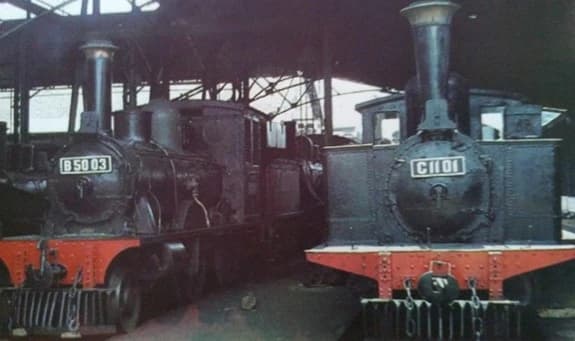
Image 7: Two locomotives awaiting maintenance around the 1970s. (Source: 35 Tahun INKA Berkarya Untuk Negeri)
At the end of the 1970s, following the retirement of steam locomotive operations, workers at the Madiun Workshop busy shifted their focus to manufacturing railway stock and components, such as freight wagon prototypes. Twenty units of freight wagons were successfully built. Not only that, but the workers of the Madiun Workshop also succeeded in building an economy-class passenger coach named "Si Belo Kuda Troya". Under the successive management of DKA-PNKA-PJKA, the Madiun Workshop continued its operations for more than 30 years until 1981.
The government officially inaugurated a new company named PT Industri Nasional Kereta Api (PT INKA) at the site of the former Madiun Workshop on May 18, 1981. Three months later, on August 29, 1981, the operational management of the "train factory" was officially transferred from PJKA (Perusahaan Jawatan Kereta Api) to the management of INKA.
Sources:
Andibya, Budut, 35 Tahun INKA Berkarya Untuk Negeri
Evelien Pieterse, Spooren van Smaragd: Per Trein door Nederlands-Indie 1867-1949
Maps.library.leiden.edu
Media-kitlv.nl
Murti, Ibnu, “Riwayat Bengkel Kereta Api Madiun”, in Maska Magazine 2nd edition, April 2017
Inka.co.id
Purbohadisaputro, Mosaik Perjuangan Kereta Api 1945 V: Perjuangan Kereta Api Jawa Timur
Tim Telaga Bakti, Sejarah Perkeretaapian Indonesia Jilid II
Widoyoko, Yoyok, et al., Menghela Roda-Roda Inovasi: 25 tahun Perjalanan Industri Kereta Api